NASA-SpaceX Crew-13 launch time: four astronauts, backup plan and ISS docking
NASA and SpaceX are targeting an Oct. 1 Crew-13 launch; meet the four-person crew, the Oct. 2 backup and planned ISS docking.
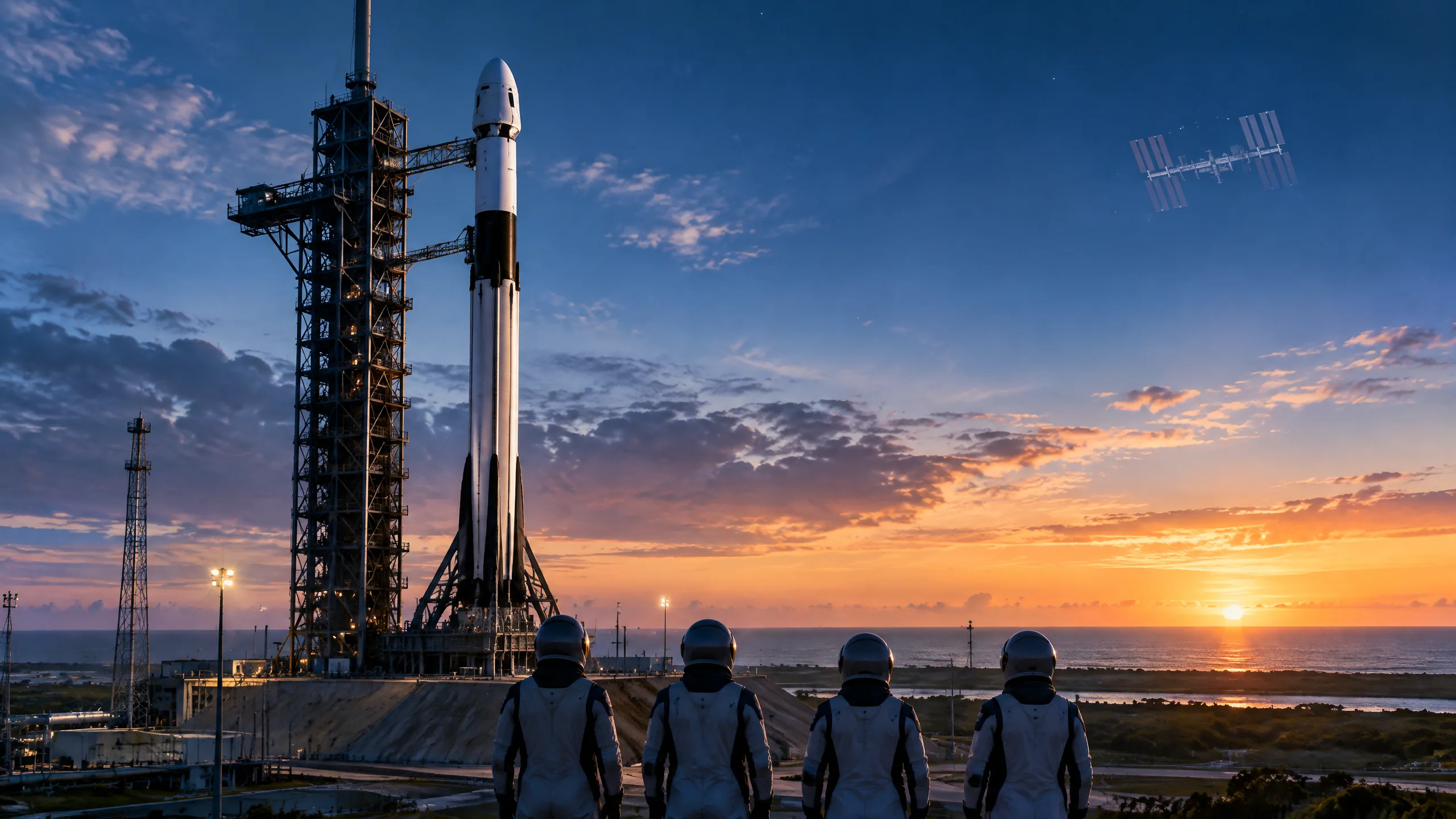
- As checked on 27 September, NASA and SpaceX are targeting no earlier than Thursday, 1 October, at 11:10 a.m. EDT (15:10 UTC; 8:40 p.m. IST) for Crew-13; liftoff has not occurred.
- The four-person crew is NASA commander Jessica Watkins, NASA pilot Luke Delaney, Canadian Space Agency astronaut Joshua Kutryk and Roscosmos cosmonaut Sergey Teteryatnikov.
- SpaceX lists Friday, 2 October, at 10:47 a.m. ET as a backup opportunity; it is an alternative launch attempt, not a confirmed new date.
- If the 1 October target holds, NASA plans Dragon docking at about 8 p.m. EDT at Harmony’s forward-facing port — approximately midnight UTC on 2 October and 5:30 a.m. IST.
- The current plan follows an earlier postponement to address an oxidizer leak in Dragon’s propulsion system; NASA and SpaceX later completed readiness reviews and are continuing final preparations.
Crew-13 is targeted for 1 October — not launched yet
NASA and SpaceX are targeting no earlier than 11:10 a.m. EDT on Thursday, 1 October 2026 for the Crew-13 mission from Space Launch Complex 40 at Cape Canaveral Space Force Station in Florida. That is 15:10 UTC and 8:40 p.m. IST. As of this article’s 27 September source check, the mission has not lifted off: it remains a target, not a completed launch. NASA’s latest Crew-13 update says the four astronauts arrived at Kennedy Space Center on 26 September and are spending the remaining days in quarantine and final preflight operations.
The flight is SpaceX’s 13th crew-rotation mission for NASA and the company’s 14th mission carrying NASA astronauts to the International Space Station when the Demo-2 test flight is included. NASA says managers from the agency, SpaceX and international partners polled “go” at the 25 September Flight Readiness Review to continue preparations. That review is evidence that teams could proceed with prelaunch work; it is not the same as a final guarantee of liftoff. Weather, vehicle status, range requirements and station operations can still affect the countdown.
The most useful short answer for readers checking the NASA SpaceX Crew-13 launch time is therefore: plan around 11:10 a.m. Eastern daylight time on 1 October, but keep the official NASA mission blog and SpaceX mission page open for changes. A named launch time is a mission target until Falcon 9 actually lifts off.
Who are the four astronauts flying to the ISS?
Crew-13 brings together four flyers from three partner agencies. Jessica Watkins of NASA is spacecraft commander, responsible for the overall mission and Dragon operations. Fellow NASA astronaut Luke Delaney is the pilot. Joshua Kutryk represents the Canadian Space Agency (CSA), while Sergey Teteryatnikov represents Roscosmos; NASA assigns both as mission specialists. NASA’s crew announcement and its current mission updates use those roles, rather than describing the four as an interchangeable group of passengers.
After arrival, the four are expected to join Expedition 75 aboard the ISS. The purpose is a long-duration station expedition, not a short sightseeing flight. SpaceX says the crew will carry out research intended to support human exploration beyond low-Earth orbit and to benefit people on Earth. That is broad programme context, not a completed list of experimental results: none can be claimed before the crew reaches the laboratory and begins work.
The international composition also explains why schedule language matters. A crew rotation depends on the readiness of the Falcon 9 and Dragon, the launch team, the incoming crew and the receiving space station. It must also fit the handover with Crew-12 already on orbit. Independent reports from Space.com and FOX 35 Orlando likewise describe Crew-13 as the incoming four-person ISS crew, corroborating NASA’s current roster and the planned crew-swap context.
The backup plan: 2 October is an opportunity, not an automatic launch
SpaceX’s Crew-13 mission page lists a backup opportunity on Friday, 2 October at 10:47 a.m. ET. In October that Eastern clock time is daylight time: 14:47 UTC and 8:17 p.m. IST. The word “opportunity” is important. It means SpaceX has published a possible alternate attempt if the 1 October target does not go ahead; it does not mean the mission has already slipped or will certainly launch then.
NASA uses “no earlier than” for the 1 October timing. That wording allows time for remaining inspections, integrated operations and conditions to be acceptable. Readers should not translate it as “exactly at” or as proof that a delay is imminent. If the first day is scrubbed, the next attempt can depend on the reason for the hold, the status of the spacecraft and rocket, weather, the launch range, and the orbital geometry needed to reach the station. NASA or SpaceX will publish the operative plan rather than a static explainer.
There is a practical reason to treat schedule changes carefully. NASA delayed the previously planned September flight after detecting an oxidizer leak in Dragon’s propulsion system during standard prelaunch processing. Its 29 August statement said the joint teams would test, review data and complete any necessary rework before naming a new target. Subsequent NASA updates set the October target, reported the Flight Readiness Review’s go to continue preparations, and confirmed the crew’s arrival at Kennedy. Those are confirmed milestones; they do not erase the distinction between preparation and a successful launch.
When is Crew-13 expected to dock with the International Space Station?
For an on-time 1 October liftoff, NASA plans Crew Dragon’s docking about 8 p.m. EDT at the forward-facing port of the Harmony module. That converts to about 00:00 UTC on Friday, 2 October, or roughly 5:30 a.m. IST on 2 October. “About” is the correct qualifier: NASA describes this as a plan based on the 1 October launch, not an observed docking or a promise that the time cannot move. The Canadian Space Agency independently gives the same approximate arrival concept — less than nine hours after a 1 October launch.
The trip is not a straight line from launch pad to station. SpaceX describes a sequence in which Dragon separates from Falcon 9, activates and checks its propulsion, life-support and thermal-control systems, then makes phasing burns to gradually match the ISS orbit. It establishes station communications, performs approach and proximity operations, and autonomously lines up along the docking axis. Only then does it make its final approach and dock.
Docking is followed by vestibule pressurisation, hatch opening and crew ingress, according to SpaceX. Those are distinct operations. A Falcon 9 liftoff would confirm the start of the mission, but it would not by itself confirm docking, hatch opening or that the crew has joined the station. Readers looking for the Crew-13 ISS docking time should check the live NASA coverage after launch for the final, observed milestones rather than assuming the projected clock time became reality.
A launch-day time guide for viewers in the US, UK and India
For the primary 1 October target, the key clock is 11:10 a.m. EDT at Cape Canaveral. The matching time is 15:10 UTC, 4:10 p.m. BST in the United Kingdom and 8:40 p.m. IST in India. NASA’s stated docking plan of about 8 p.m. EDT falls just after midnight in UTC and early on 2 October in India, which is an easy date change to miss. These conversions are for the currently published target and planned docking, not a substitute for an updated launch notice.
For the stated backup opportunity, SpaceX gives 10:47 a.m. ET on 2 October — 14:47 UTC, 3:47 p.m. BST and 8:17 p.m. IST. SpaceX says its webcast is scheduled to begin about one hour before liftoff. NASA says additional launch details will appear on the Crew-13 mission blog. Both sources should take precedence if they alter the time, webcast start or coverage plan.
The site’s related report on Google Project Suncatcher’s Transporter-18 test can help readers distinguish a planned uncrewed rideshare flight from this human ISS rotation. For broader context on why different spacecraft fly very different missions, see Small satellites are changing how research reaches orbit and the Reddy News technology coverage index. They are context, not live authority for Crew-13 timing.
What to watch before calling the mission a success
The relevant sequence is simple but should not be collapsed into one claim. Before launch, the confirmed facts are the crew assignment, the target time, the backup opportunity, the launch site and the continuing final preparations. At liftoff, NASA and SpaceX can confirm the mission has begun. After that, viewers should look for Dragon separation, orbit activation, phasing operations, a completed docking, hatch opening and crew ingress. Each is a separate status update.
SpaceX says the Dragon assigned to Crew-13 previously supported the Ax-4 mission, while the Falcon 9 first stage has previously flown Crew-12 and one Starlink mission. It also plans to land that booster at Landing Zone 40 after stage separation. Those are elements of the published mission plan, not completed flight events. The schedule has already changed once for a real technical issue, which is precisely why a sober, source-led approach is more useful than treating a countdown page as a result.
This is explanatory technology reporting based on the latest available primary and independent sources at the stated check time. It will need an immediate update if NASA or SpaceX changes the target, confirms liftoff or revises the docking plan.
Reader guide
Article questions, answered
Short answers to common reader questions based on the reporting above.
What time is NASA-SpaceX Crew-13 scheduled to launch?
NASA and SpaceX are targeting no earlier than 11:10 a.m. EDT on Thursday, 1 October 2026 from Cape Canaveral Space Force Station. That is 15:10 UTC and 8:40 p.m. IST. It remains a target until liftoff is confirmed.
Who are the four Crew-13 astronauts?
NASA astronaut Jessica Watkins is commander and NASA astronaut Luke Delaney is pilot. Canadian Space Agency astronaut Joshua Kutryk and Roscosmos cosmonaut Sergey Teteryatnikov are mission specialists.
What is Crew-13’s backup launch date?
SpaceX lists Friday, 2 October at 10:47 a.m. ET as a backup opportunity. It is an alternate attempt if needed, not a confirmed delay or launch outcome.
When will Crew-13 dock with the ISS?
If the 1 October target holds, NASA plans Dragon docking at about 8 p.m. EDT at Harmony’s forward-facing port. That is about 00:00 UTC and 5:30 a.m. IST on 2 October. Docking timing can change with launch and mission operations.
Sources and further reading
These references support the factual context used in this article. Links open the original publisher.
- NASA’s SpaceX Crew-13 Lands at NASA KennedyNASA · accessed 27 September 2026
- NASA, SpaceX Move to Final Crew-13 Prelaunch Prep for Oct. 1 LiftoffNASA · accessed 27 September 2026
- Crew-13 MissionSpaceX · accessed 27 September 2026
- SpaceX's next astronaut launch for NASA now set for Oct. 1 after delaySpace.com · accessed 27 September 2026
- NASA, SpaceX target October for Crew-13 launch from Florida to ISSFOX 35 Orlando · accessed 27 September 2026