Reddi Kingdom: a sourced guide to 1325–1448 Andhra history
From post-Kakatiya upheaval to the battles for Kondavidu and Rajahmundry, this sourced guide traces Reddi power, patronage and decline in Andhra.
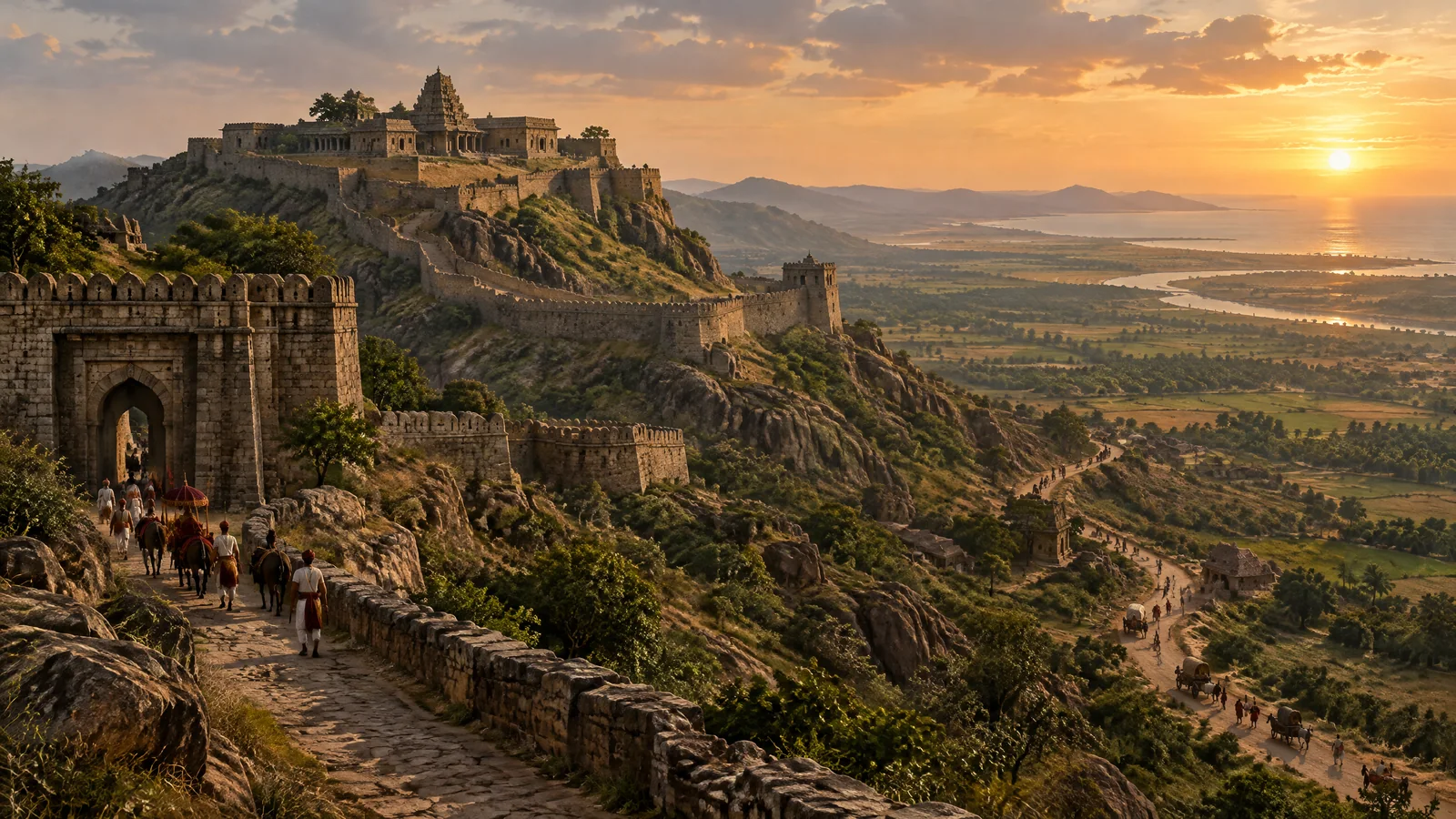
- The Reddi Kingdom is conventionally dated to 1325–1448, emerging amid the political rearrangement that followed the fall of the Kakatiyas.
- Prolaya Vema Reddi is identified in the standard accounts as the founder; Addanki, fortified Kondavidu and Rajahmundry mark successive or parallel centres of power.
- Fortifications, temple grants, coastal commerce and literary patronage belong to the historical picture, but some popular details need stronger source checking.
- The state’s last decades were shaped by divided authority, succession disputes and pressure from Vijayanagara and the Gajapatis.
- This guide separates a supportable chronology from origin and literary claims that the current Wikipedia article itself labels as needing verification or more citations.
A kingdom born in a changing Andhra
The Reddi Kingdom is usually dated from 1325 to 1448. It belongs to the unsettled decades after Warangal fell to the Delhi Sultanate in 1323 and Kakatiya authority broke apart. That setting matters: the Reddis were one of several regional powers that took shape in a landscape of local chiefs, shifting alliances and competing claims to territory. A date range is useful shorthand, but it should not make the period look like one uninterrupted, centrally controlled state.
Historical surveys identify Prolaya Vema Reddi as the founder, with an early base at Addanki. Later accounts place Kondavidu at the heart of the western kingdom and describe Rajahmundry, or Rajamahendravaram, as the seat of an eastern branch. These places are not interchangeable labels. They help readers see how political authority moved, split and was contested across coastal and central Andhra.
Prolaya Vema Reddi, Addanki and Kondavidu
Prolaya Vema Reddi is the best starting point for a grounded narrative. The standard chronology names him as the first ruler, followed by Anavota Reddi. Addanki is described as the initial capital; Kondavidu then became the principal fortified centre. Moving the political focus to a hill stronghold made strategic sense in a period of repeated conflict, although the precise reasons given in later summaries should not be repeated as certainty without checking their evidence.
Kondavidu was more than a pin on a map. Its hill-fort setting made it a defensible seat from which rulers could project authority into the surrounding country. Kondapalli, Bellamkonda, Vinukonda and Nagarjunakonda are also associated in historical summaries with the kingdom’s defensive landscape. The surviving fort sites are valuable material reminders of regional warfare, but a fort’s later appearance should not by itself be treated as proof that every visible structure belongs to the Reddi period.
Rajahmundry and the problem of succession
In the late fourteenth century, an eastern polity centred on Rajamahendravaram emerged within the wider Reddi sphere. The East Godavari district history describes Kumaragiri’s eastern campaign, the formation of a Rajamahendra Rajya, and Kataya Vema’s later role there. Its account also records regencies and short-lived rulers after Kataya Vema, illustrating why a single straight line of succession can be misleading.
The commonly reproduced ruler lists place Kumaragiri Reddi at Kondavidu from 1386 to 1402, Pedda Komati Vema from 1402 to 1420 and Racha Vema from 1420 to 1424, while eastern rulers and regents operated on a partly overlapping timetable. For readers, the key point is not to force both centres into one sequence. Rival claims and divided authority weakened the ability to respond to larger neighbouring powers.
Fortifications, patronage and trade
The Reddi period is remembered not only for war. Historical accounts describe grants to Brahmins and support for Hindu institutions, including sites at Srisailam, Tirumala, Vontimitta and Ahobilam. Such patronage was part of how medieval rulers built relationships with temples, learned communities and local society. It is safer to describe the documented pattern of grants and support than to repeat large, dramatic numerical claims about temple building without tracing them to inscriptions or a scholarly study.
Trade is another part of the picture. P. Raghunadha Rao’s Andhra history, cited by the Reddi Kingdom page, connects the reign of Anavota with changes to commercial dues and identifies Motupalli as an outlet for sea trade. This supports a cautious conclusion: access to the coast and merchant activity mattered to the kingdom. It does not establish a modern-style free-trade policy, nor does it tell us that every merchant community near the port owed its presence to one royal decision.
Telugu and Sanskrit literature: an important story with a source warning
Telugu and Sanskrit learning form an important part of the Reddi-period historical memory. The current Reddi Kingdom article associates Errapragada (Errana), Srinatha and Potana with the period, and it describes royal interest in literary culture. Srinatha’s importance is independently illuminated by Velcheru Narayana Rao and David Shulman’s cultural biography, which provides a stronger route into the world of a major Telugu poet than a bare court list.
However, the current Wikipedia article places a “more citations needed” notice over its entire literature section. That is an explicit editorial warning, not a minor footnote. Accordingly, this guide does not present its uncited statements about particular rulers as authors, poets’ exact court appointments, or the full list of works as settled fact. Those claims deserve checking against inscriptions, critical editions and specialist literary scholarship before they are used in a definitive biography or school resource.
Decline, 1424–1448, and what remains debated
The end of the kingdom came in stages rather than in a single clean collapse. The widely cited outline says Vijayanagara annexed Kondavidu in 1424 and that the eastern Reddi power was later overtaken by the Gajapatis, producing the conventional end date of 1448. The East Godavari district history also records Vijayanagara intervention in the Rajahmundry region around 1423. These accounts agree on mounting external pressure, but they caution against treating every date in a compressed succession table as beyond dispute.
Origin narratives need the same care. The current Wikipedia page marks three assertions in its origin section as needing verification: the specific role attributed to Annaya Mantri and Kolani Rudradeva in initiating revolt; the statement that the Tughlaqs lost the whole region by 1347; and the claim that Reddi ancestors were independent warlords and Kakatiya military officers. One of those passages also carries a “need quotation to verify” tag. We therefore distinguish the well-supported broad context—post-Kakatiya fragmentation and the rise of Reddi rule—from those more detailed, still-unverified narratives.
Reader guide
Article questions, answered
Short answers to common reader questions based on the reporting above.
When did the Reddi Kingdom exist?
The conventional date range is 1325–1448. It emerged after the collapse of Kakatiya authority and ended through a process of fragmentation and conquest, rather than one simple handover on a single day.
Who founded the Reddi Kingdom?
Historical surveys and the standard chronology identify Prolaya Vema Reddi as its founder, with 1325 used as the starting date. Addanki is described as the early capital.
Why are Addanki, Kondavidu and Rajahmundry all linked to the Reddis?
Addanki was the initial capital in the usual account. Kondavidu became the fortified centre of the western kingdom, while Rajamahendravaram, now Rajahmundry, became the base of an eastern branch whose history overlapped with Kondavidu.
Did the Reddi rulers support Telugu and Sanskrit literature?
The period is associated with Telugu and Sanskrit literary culture, and Srinatha is a major figure for study. But Wikipedia’s current Reddi Kingdom literature section is marked “more citations needed,” so its precise claims about authorship and court connections should be verified in specialist sources before being repeated as fact.
Which Reddi Kingdom claims require extra caution?
The current Wikipedia page itself marks several origin claims as needing verification, including detailed statements about the early revolt, the Tughlaqs’ loss of the region by 1347 and the founders’ Kakatiya military ancestry. This article treats those as debated, not established.
Sources and further reading
These references support the factual context used in this article. Links open the original publisher.
- Reddi KingdomWikipedia · accessed 11 September 2026
- History Of The Reddi KingdomsAndhra University, via Internet Archive · accessed 11 September 2026
- Pre-colonial India in Practice: Society, Region, and Identity in Medieval AndhraOxford University Press · accessed 11 September 2026
- A Comprehensive History of Medieval India: From Twelfth to the Mid-Eighteenth CenturyPearson Education India · accessed 11 September 2026
- History of the Andhras up to 1565 A.D.P. G. Publishers, archived copy · accessed 11 September 2026
- History and Culture of Andhra Pradesh: From the Earliest Times to the Present DaySterling Publishers · accessed 11 September 2026
- Multiple Literary Cultures in Telugu: Court, Temple and PublicUniversity of California Press · accessed 11 September 2026
- Srinatha: The Poet who Made Gods and KingsOxford University Press · accessed 11 September 2026
- HistoryEast Godavari District, Government of Andhra Pradesh · accessed 11 September 2026