Korea Exchange after-market 2026: KRX evening trading hours, rules and Nextrade routing
Korea Exchange after-market 2026 trading is live from 4 p.m. to 8 p.m., replacing the former 10-minute call auction with continuous matching for most KOSPI and KOSDAQ shares.
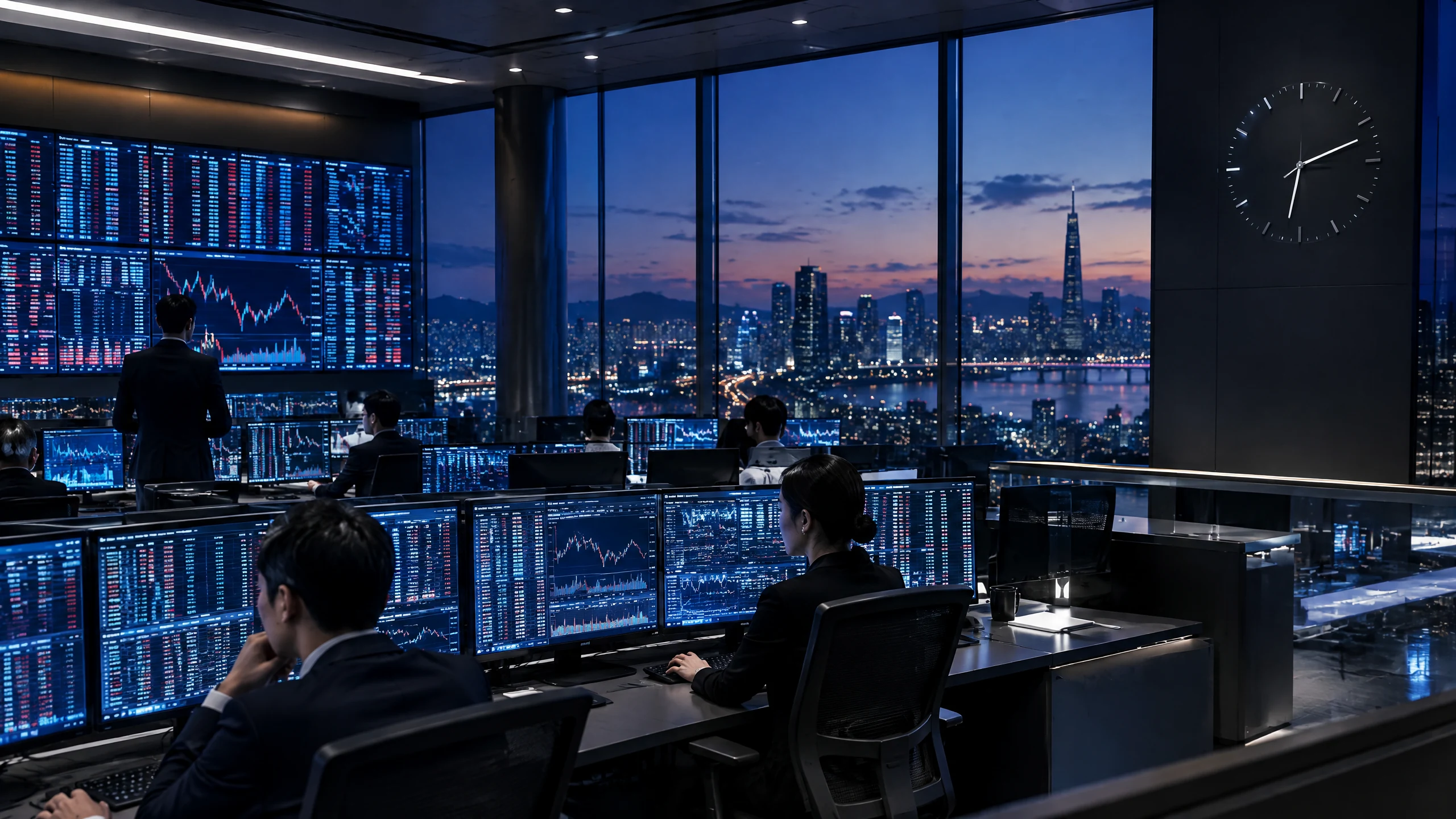
- Korea Exchange began its real-time after-market on 14 September 2026, operating from 4 p.m. to 8 p.m. Korea time for most KOSPI and KOSDAQ shares.
- The session replaces the former 4–6 p.m. after-hours single-price market, where orders were gathered in 10-minute intervals, with continuous order matching.
- Limit, best-priority limit and best-limit orders are permitted; market orders are barred. ETFs, ETNs and certain market-management securities are excluded.
- The first session recorded 72.24 million shares and KRW 1.8177 trillion in turnover, according to KRX information-system figures reported by Yonhap and ChosunBiz.
- Nextrade remains a separate venue with its own after-market; smart order routing can distribute undesignated orders between NXT and KRX, but it does not guarantee liquidity or execution quality.
KRX evening trading is live from 4 p.m. to 8 p.m.
Korea Exchange, or KRX, opened a real-time after-market for most KOSPI and KOSDAQ shares on 14 September 2026. The live session runs from 4 p.m. to 8 p.m. Korea time, after the regular cash-market session ends at 3:30 p.m. The central change is practical rather than cosmetic: eligible shares can now be matched continuously through the evening session instead of only at periodic after-hours auction prices.
KRX announced the 14 September opening through its official channel, while the government broadcaster KTV and Yonhap reported the launch and operating terms. The 4–8 p.m. KRX evening trading window is therefore a confirmed current rule. It should not be confused with a future proposal to extend the market still further.
For people following Korean listed companies after the main session, the new window creates another period in which reported prices may form. It does not change the fact that the regular KRX session has its own hours, closing process and much longer-established depth of participation.
What replaced the former KOSPI after-hours call auction
Before the change, KRX operated an after-hours single-price market from 4 p.m. to 6 p.m. Orders were collected for 10 minutes and then matched at one price. That design produced a sequence of discrete auction results rather than trades matching as compatible orders entered the book.
The new Korea Exchange after-market is a four-hour continuous matching session. KTV described it as using the same order-matching approach as the regular market, and Yonhap reported that participants no longer have to wait for the next 10-minute matching point in the former system. Continuous matching describes the mechanism; it does not by itself establish how many buyers and sellers will be present for any particular share.
This distinction matters when reading an evening price. A price from a continuous session is a record of an executed match at that time. It is not a replacement for the regular closing price, nor is it a forecast of the following day’s opening price.
Eligible securities and KRX evening order rules
KRX says most shares listed on KOSPI and KOSDAQ can be traded in the after-market. Yonhap’s account of the rules specifies that shares needing market management, including investment-warning and liquidation-trading issues, are outside the session. The exchange also excludes exchange-traded funds and exchange-traded notes. The exclusions are part of the live rule set, rather than a judgment about the merits of any individual security.
Only three quoted order forms are permitted: a limit order, a best-priority limit order and a best-limit order. A limit order states a maximum purchase price or minimum sale price. The two other permitted forms are also limit-based order types. KRX does not permit a market order in the evening session, according to KTV and Yonhap.
That restriction is an exchange safeguard for a period in which available orders can differ from the main session. It is important to separate the rule from an outcome: banning market orders reduces one route to an uncontrolled-price execution, but it does not promise a particular spread, price or volume for an eligible share.
Price limits and market safeguards still apply
KRX said daily stock price limits and market-stabilisation measures, including circuit breakers, apply to the after-market. Those safeguards mean the evening session is not a rule-free extension of the day. The exchange’s stated rationale for excluding ETFs and ETNs was concern about market volatility in the four-hour window.
A follow-up report by Segye Ilbo illustrates why the distinction between safeguards and liquidity matters. It reported 1,637 static and dynamic volatility interruptions across KOSPI and KOSDAQ in the opening after-market on 14 September, compared with 400 during that day’s regular session. The report described thinner displayed orders in some smaller shares; its figures are a report of the first session, not a measure of the quality of every future evening session.
The narrow factual conclusion is that safeguards were available and used during the debut. Whether participation, order books and price formation settle into a different pattern requires more than one day of data.
First-day KRX after-market turnover and share volume
The first KRX evening session produced 72.24 million shares of volume and KRW 1.8177 trillion of turnover, according to KRX information-data-system figures reported by Yonhap at 9:04 p.m. Korea time on 14 September. ChosunBiz independently reported the same totals later that evening. These are completed first-session figures, not a live intraday estimate.
Yonhap reported that KOSPI-listed shares accounted for 22.18 million shares and KRW 1.3252 trillion, while KOSDAQ accounted for 50.06 million shares and KRW 492.5 billion. Against the KRX regular market on that date, the after-market totals were 7.04% of share volume and 8.03% of turnover. The percentages use the reported KRX regular-session denominators of 900.5 million shares and KRW 25.8082 trillion.
Those comparisons describe the scale of one launch day. They do not show that the same turnover, depth or execution conditions will persist, and they do not support a claim about future prices or returns.
Where Nextrade and smart order routing fit in
Nextrade, known as NXT, is Korea’s alternative trading system and remains a separate trading venue from KRX. Its own market page listed an after-market from 3:40 p.m. to 8 p.m. on 17 September. That overlap means the KRX 4–8 p.m. session did not replace NXT; it added a KRX venue during much of the same evening period.
On the first KRX session, Yonhap reported that orders not directed to a named venue were divided between KRX and NXT by smart order routing, or SOR. The report described the system as comparing price, fees, costs, order size and the likelihood of execution before routing to the relatively more advantageous venue. ChosunBiz reported the same allocation mechanism and first-day split of evening flow.
The Financial Services Commission’s framework explains the regulatory context. It requires securities companies in the multiple-venue market to establish best-execution standards and SOR systems, and to make those standards available before taking and automatically executing orders. This is a process designed to compare venues under a broker’s standards. It is not a uniform guarantee that every order will execute, receive a particular price or find the same liquidity at KRX and NXT.
Confirmed rules versus longer-hours plans
What is confirmed now is limited and clear: the KRX after-market is operating from 4 p.m. to 8 p.m.; it uses continuous matching; most KOSPI and KOSDAQ shares are eligible; ETFs, ETNs and certain supervised securities are excluded; and market orders are not permitted. The first-day volume and turnover are also historical figures tied to 14 September.
KRX has described the launch as part of a longer-term effort to improve the competitiveness of Korean market infrastructure and said it would monitor global moves toward longer hours. KTV reported that the exchange plans to pursue trading-hour expansion in stages. Those remarks are exchange plans and stated ambitions, not a currently implemented 24-hour KRX market or a timetable that should be treated as fixed.
The useful way to read the Korea Exchange after-market 2026 change is as a market-structure development with defined live rules and early, limited operating evidence. Future rule changes, venue participation and evening liquidity remain matters to be verified when the exchange or regulators publish them.
Reader guide
Article questions, answered
Short answers to common reader questions based on the reporting above.
What are the KRX evening trading hours?
The Korea Exchange after-market runs from 4 p.m. to 8 p.m. Korea time on trading days. It follows the regular KRX cash session, which runs from 9 a.m. to 3:30 p.m. The 4–8 p.m. session is a live rule in force from 14 September 2026, not a proposal.
Which shares can trade in the KOSPI and KOSDAQ after-market?
KRX says most KOSPI and KOSDAQ-listed shares are eligible. Reporting on the rules says securities requiring market management, including investment-warning and liquidation-trading issues, are excluded. ETFs and ETNs are also excluded from the KRX after-market.
Are market orders permitted in the Korea Exchange after-market?
No. The permitted order types are limit, best-priority limit and best-limit orders. Market orders are not allowed in the evening session, a restriction the exchange links to the risk of rapid price moves in a lower-liquidity period.
How does KRX Nextrade smart order routing work?
When a customer does not designate a venue, a participating securities company’s smart order routing system can compare KRX and Nextrade on factors such as price, fees, costs, order size and likelihood of execution, then send the order under that company’s best-execution standards. It is a routing mechanism, not an assurance that an order will be filled or that liquidity will be the same as in the main session.
Sources and further reading
These references support the factual context used in this article. Links open the original publisher.
- Korea Exchange opens stock-market after-market on 14 September 2026Korea Exchange · accessed 17 September 2026
- KRX after-market opens on the 14th, expanding the choice of trading after workYonhap News Agency · accessed 17 September 2026
- Korea Exchange to embark on after-market stock trading starting next Mon.Yonhap News Agency · accessed 17 September 2026
- KRX opens after-market, enabling real-time trading until 8 p.m.KTV National Broadcasting · accessed 17 September 2026
- KRX after-market debuts: 72.24 million shares and KRW 1.8 trillion traded on opening dayYonhap News Agency · accessed 17 September 2026
- KRX aftermarket debuts as SOR splits flows with Nextrade in KoreaChosunBiz · accessed 17 September 2026
- FSC grants final approval to Nextrade for operation of ATSFinancial Services Commission, Republic of Korea · accessed 17 September 2026
- Nextrade market informationNextrade · accessed 17 September 2026
- Many volatility interruptions trigger on the first day of the KRX after-marketSegye Ilbo · accessed 17 September 2026