Telangana’s proposed education policy: Revanth Reddy outlines a future-generation framework and funding target
Telangana Chief Minister A. Revanth Reddy says a proposed education policy should serve Gen Z, Gen Alpha and Gen Beta while gradually raising education’s state-budget share to 15%.
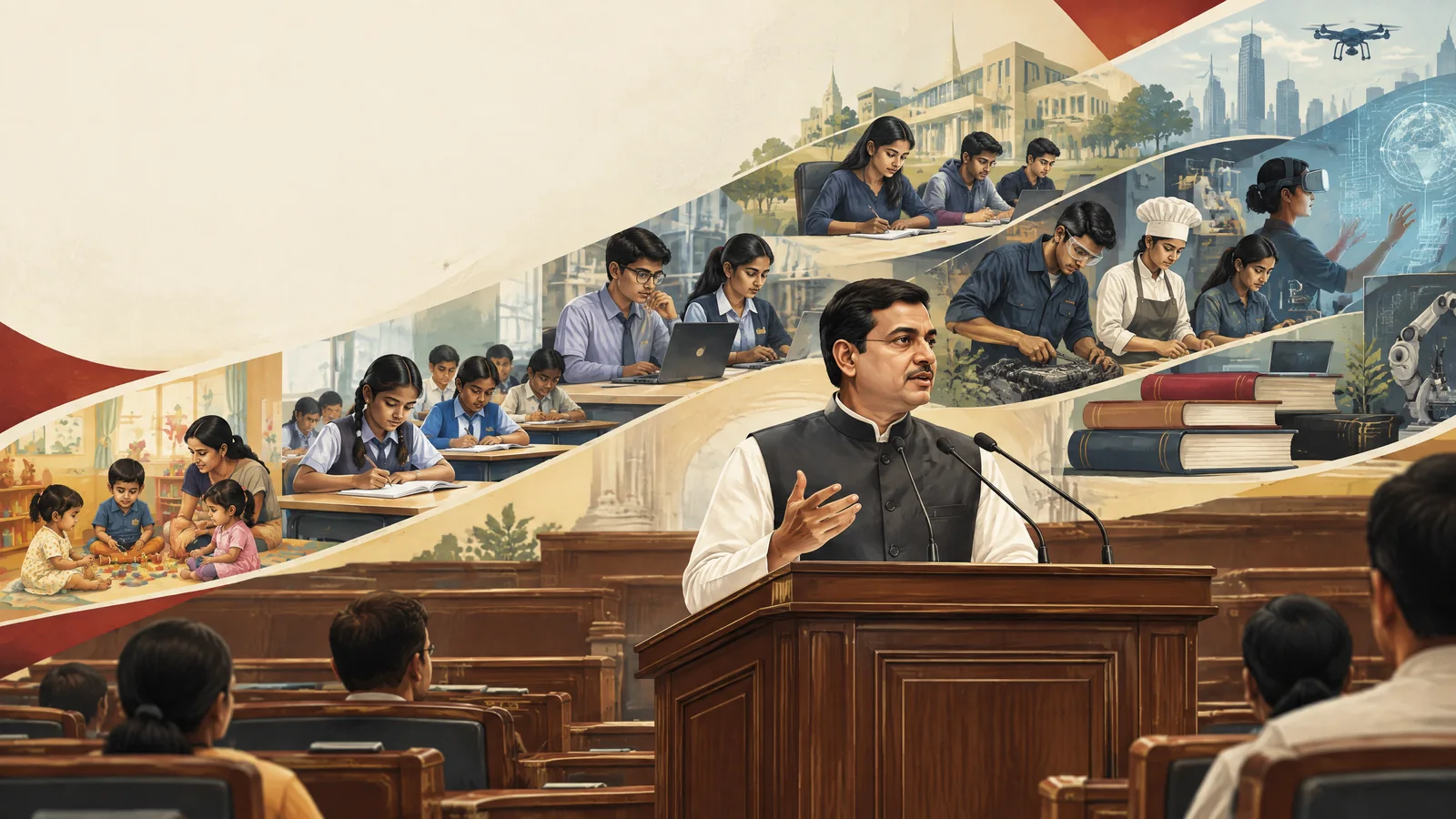
- Telangana is working on a new education policy framed around the needs of Gen Z, Gen Alpha and Gen Beta.
- An Education Commission has prepared a report, and a committee headed by K. Keshava Rao is examining it; the government says public and legislative suggestions will be considered.
- Reddy cited education allocations rising from ₹19,093 crore in 2023–24 to ₹26,647 crore in 2026–27 and set a goal of progressively raising education to 15% of the state budget.
- The Assembly remarks describe a policy in development, not a final instrument already adopted or implemented.
What the latest reporting shows
Hyderabad — Telangana Chief Minister A. Revanth Reddy has used an Assembly debate to set out the broad direction of a proposed state education policy: skills for young adults, stronger foundations for children entering school, and a system designed with generations yet to pass through classrooms in mind. The important qualification is that the policy remains under development. The speech outlined an ambition, an institutional review and a funding goal; it did not mark the adoption of a final policy.
Reddy linked the exercise to Telangana’s ‘Rising 2047’ agenda and its aspiration to become a $1 trillion economy by 2034. He argued that education would be central to those goals and said the system should serve Gen Z, Gen Alpha and Gen Beta. ANI reported the remarks after the September 11 Assembly proceedings, while The Hindu and Deccan Chronicle separately reported the debate, the policy process and the government’s budget claims.
The announcement is a policy direction, not a finished instrument
The clearest immediate takeaway is procedural. Reddy said the government was working on a new education policy. Deccan Chronicle reported that an Education Commission had been constituted to formulate it and that a committee headed by K. Keshava Rao was examining the commission’s report.
That sequence matters because it places the Assembly remarks at the policy-development stage. The government has described the intended beneficiaries, broad themes and fiscal ambition, but the reports do not establish that a final instrument has been adopted or implemented. Readers should therefore treat the speech as an outline of direction rather than a completed rulebook.
The government also said it was open to suggestions from legislators and the public if they were submitted to Keshava Rao. This creates a stated route for consultation before the policy is finalised. The supplied reports do not specify a publication date for the final document, a formal consultation timetable or the detailed standards against which proposals will be assessed.
Gen Z, Gen Alpha and Gen Beta form the organising frame
Reddy organised his argument around three age cohorts. In his Assembly description, Gen Z covers people born from 1997 to 2012, Gen Alpha those born from 2013 to 2024, and Gen Beta children born from 2025 to 2039. These are the Chief Minister’s stated categories and time ranges in the debate.
The framework gives the proposal a long horizon. For Gen Z, the discussion emphasised skills and preparation for employment, innovation and entrepreneurship. For younger cohorts, the reported focus runs from nursery through Class 12 and includes education, language and communication skills. Reddy’s core proposition was that one policy should address people already approaching or in the workforce, children now in school and those only beginning to enter the education system.
That is also how he connected education to the state’s larger economic aspirations. ANI quoted him as saying the system should be useful for all three generations if Telangana is to meet its ‘Rising 2047’ goals and pursue a $1 trillion economy by 2034. The economic figure is a stated government aspiration, not a projection verified by the reports.
The commission and review committee are the institutional route
The proposed policy is being developed through two reported bodies with distinct roles. The Education Commission has been constituted to formulate a new policy for Telangana. The K. Keshava Rao-led committee is examining the commission’s report. Reddy said public and legislative suggestions would be considered through that review process.
This institutional path is more concrete than the generational language, but important details remain unavailable in the supplied reporting. The reports do not provide the commission’s full recommendations, the committee’s conclusions or the text of a draft policy. They also do not set out how feedback will be published or incorporated.
For now, the Assembly statement establishes who is reviewing the work and the broad direction being considered. It does not settle questions about implementation schedules, programme design or departmental allocations within the eventual policy.
Allocation growth is being used to support a 15% budget goal
Reddy said one government goal was progressively to raise education’s share to 15% of Telangana’s annual budget outlay. In making the case for that direction, he cited a rise in education allocations from ₹19,093 crore in 2023–24 to ₹26,647 crore in 2026–27. The intervening figures he cited were ₹21,292 crore in 2024–25 and ₹23,108 crore in 2025–26.
The figures were reported as part of the Chief Minister’s Assembly argument. He said the allocation had increased by ₹7,554 crore over the period. The 15% figure, however, is a goal, and the reports do not say that the share has already been reached. They also do not provide the total state budget figures needed to calculate the education share for each year from the reported material alone.
The distinction between a larger rupee allocation and a larger share of total spending is important. The Assembly remarks supplied the first set of numbers and stated the second as a target. The final policy and future budgets will determine how those two elements are connected in practice.
Reddy ties his education portfolio to accountability for delivery
The Chief Minister also responded to criticism that Telangana did not have a separate full-time education minister. He said retaining the portfolio himself reflected the importance attached to the sector and allowed him to review the entire system. ANI reported him saying that he kept the department while thinking about the needs of Gen Z, Gen Alpha and Gen Beta and seeking changes through the policy.
Reddy supported that case with claims about the government’s record. He said 10,006 teacher posts had been filled within 55 days during the administration’s first year, and that government-school enrolment had risen by 86,000 after he took charge of the department. He also said 64,000 children were receiving newly introduced pre-primary education in government schools and that meals were being provided to students and teachers from nursery to Class 12.
Those figures are the Chief Minister’s claims as reported from the Assembly; the supplied sources do not include separate underlying datasets. They indicate the measures the government wants associated with the policy debate, but they should not be confused with the final policy’s still-unpublished provisions.
What is established — and what remains open
The September 11 debate establishes four points. Telangana is developing a new education policy; the government is presenting three generations as its planning frame; an Education Commission report is under review by a K. Keshava Rao-led committee; and the government has set a goal of moving education towards 15% of the state budget.
What remains open is equally significant. No final policy text is contained in the supplied reports. There is no reported adoption date, implementation schedule or programme-by-programme funding breakdown. The Assembly outline is therefore best read as a statement of intent accompanied by a review mechanism and fiscal direction.
For readers, the next decisive document will be the policy itself. Until that is released, claims about what Telangana’s new education framework definitively requires, funds or changes would be premature. Reddy’s intervention has defined the government’s proposed destination; the commission review, public input and final policy will have to define the route.
Reader guide
Article questions, answered
Short answers to common reader questions based on the reporting above.
Has Telangana adopted the new education policy?
No final policy adoption is established by the supplied reports. They say the government is working on the policy and that a K. Keshava Rao-led committee is examining the Education Commission’s report.
What do Gen Z, Gen Alpha and Gen Beta mean in Reddy’s framework?
Reddy described Gen Z as those born from 1997 to 2012, Gen Alpha as those born from 2013 to 2024, and Gen Beta as children born from 2025 to 2039. These ranges are his stated framing in the Assembly.
Has education already reached 15% of the Telangana budget?
The reports describe 15% as a government goal to be reached progressively. They do not say the target has already been achieved.
How can suggestions enter the policy process?
Reddy said the government was willing to consider suggestions from legislators and the public if they were submitted to K. Keshava Rao, whose committee is examining the Education Commission’s report.
Sources and further reading
These references support the factual context used in this article. Links open the original publisher.
- ANI — Education policy must cater to Gen Z, Gen Alpha, Gen Beta to achieve its goals for Rising 2047: CM Revanth ReddyANI · accessed 12 September 2026
- The Hindu — Govt education policy is for Gen Alpha, Gen Beta and skills for Gen Z, Revanth tells AssemblyThe Hindu · accessed 12 September 2026
- Deccan Chronicle — State to Target Gen Alpha, Gen Beta in New Edu Policy: RevanthDeccan Chronicle · accessed 12 September 2026