WHO says DRC Bundibugyo Ebola outbreak has expanded to 63 health zones in seven provinces
WHO says the DRC’s Bundibugyo Ebola outbreak now affects 63 health zones in seven provinces, while global risk remains assessed as low.
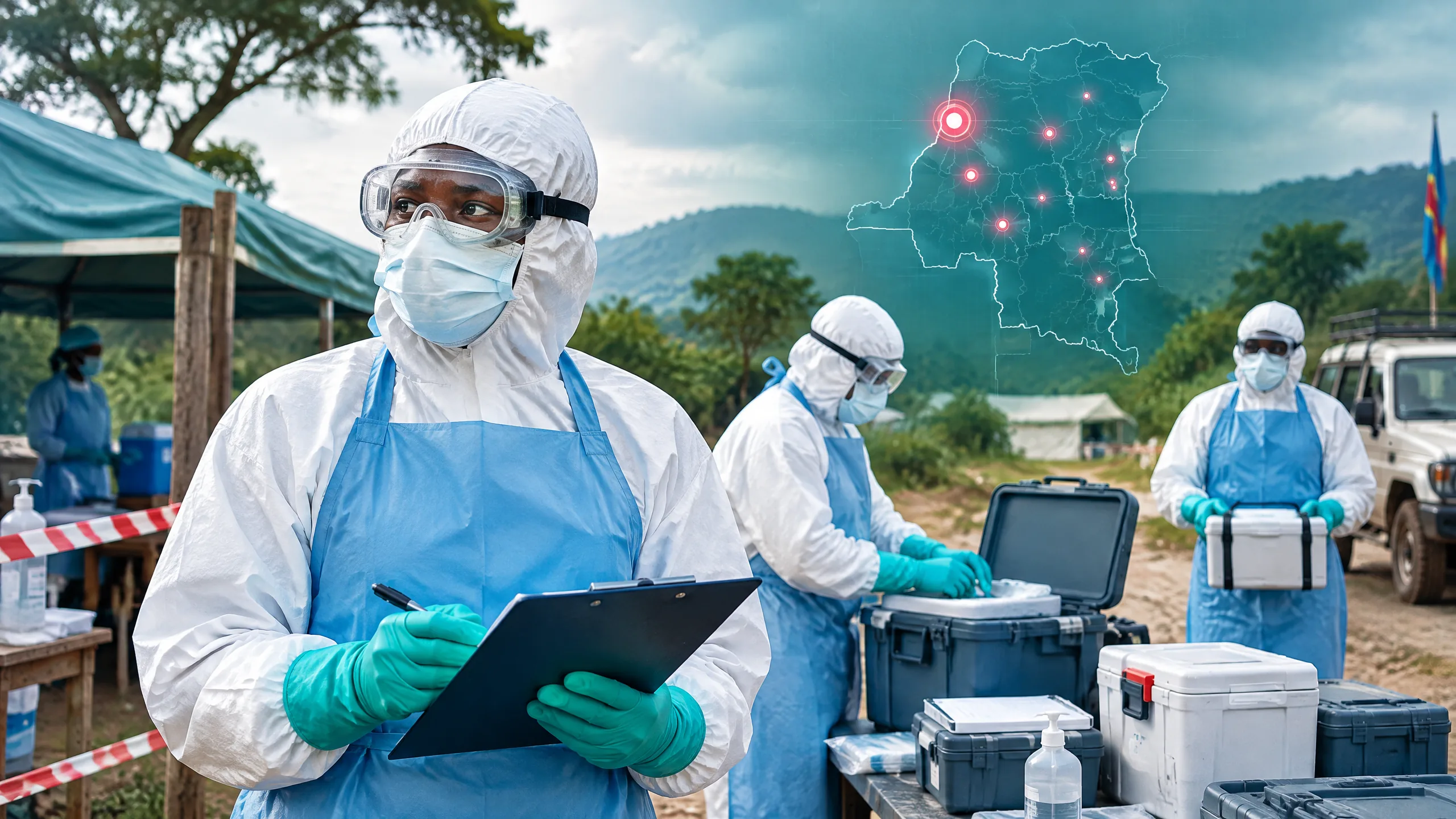
- WHO’s 25 September update says the Bundibugyo virus outbreak has reached 63 health zones in seven of the DRC’s 26 provinces.
- Bulu in Sud Ubangi and Dungu in Haut-Uélé are the two newly affected health zones since WHO’s previous notice of 11 September.
- As of 23 September, the DRC had reported 7,890 confirmed cases and 3,799 confirmed deaths; the figures are subject to change as the outbreak evolves.
- WHO assesses the risk as very high within the DRC, high for countries sharing its land borders, and low for the rest of Africa and globally.
- WHO advises against travel or trade restrictions on affected countries while calling for coordinated control, surveillance and cross-border preparedness.
WHO says DRC Bundibugyo Ebola outbreak has expanded to 63 health zones
The DRC Bundibugyo Ebola outbreak has expanded to 63 health zones across seven provinces, the World Health Organization said in a Disease Outbreak News update published on 25 September. The update records two newly affected zones since WHO’s previous notice on 11 September: Bulu in Sud Ubangi, in the north-west of the Democratic Republic of the Congo, and Dungu in Haut-Uélé, which borders South Sudan.
The change is significant because it is geographical as well as numerical. WHO says the wider footprint raises the risk of cross-border transmission, even as the intensity of transmission differs markedly between provinces and health zones. The outbreak is caused by the Bundibugyo virus, one of the viruses that can cause Ebola disease.
The latest count is tied to 23 September
WHO reported 7,890 confirmed cases and 3,799 confirmed deaths in the DRC as of 23 September, a crude case-fatality ratio of 48.1%. It also recorded 1,966 recoveries. These are time-stamped surveillance figures, not a final tally: WHO says the national number of new cases reported each day remains high and that the pattern is uneven across the country.
Of the 63 affected health zones, 48 in six provinces had reported at least one case in the preceding 21 days. WHO said 70 new confirmed cases had been reported in the 24 hours before 23 September from 26 health zones in Ituri, North Kivu, Haut-Uélé, Bas-Uélé and Tshopo. South Kivu remains among the seven affected provinces, but no new cases had been reported there since 29 May.
Where the outbreak is concentrated
The seven provinces are Bas-Uélé, Haut-Uélé, Ituri, North Kivu, South Kivu, Sud Ubangi and Tshopo. Ituri remains the epicentre, with 6,032 confirmed cases since the start of the outbreak, according to WHO. North Kivu is the second most affected province, with 1,480 cumulative confirmed cases.
The picture is not one of a single, uniform wave. WHO said incidence in Ituri had been declining gradually from a mid-August peak but remained elevated. North Kivu had risen substantially to a mid-September high before declining in the most recent reporting days. Haut-Uélé had sustained transmission, while Tshopo was showing renewed activity after a period of lower transmission.
WHO says the outbreak was first detected in May 2026 and has developed into the largest Ebola disease outbreak ever recorded in the DRC, regardless of Ebola virus species. It is the country’s second documented Bundibugyo virus disease outbreak, after one in 2012. Historical comparisons do not make current local conditions predictable, but they underline the scale of the present response and why health-zone-level data are more useful than a national headline alone.
Very high risk in-country, low risk globally
WHO’s risk assessment draws an important distinction. The agency rates the risk as very high in the DRC and high in countries that share a land border with it. It rates the risk for the rest of the African region and at the global level as low. A severe outbreak in the affected country and a low global-risk assessment are not contradictory; they describe different places and routes of possible spread.
The 25 September notice says the new zones increase the risk of cross-border transmission and points to the importance of coordinated surveillance and preparedness. That is not the same as saying the outbreak has created a high worldwide risk. CDC’s situation summary, updated the same day, also identifies the seven DRC provinces and gives the same DRC figures as WHO for 23 September.
Why containment remains difficult
WHO says conflict, insecurity, displacement and limited access to basic services are hampering surveillance, case finding, contact tracing, infection prevention and control, and timely care. These conditions matter because prompt identification of cases and follow-up of people who may have been exposed are central to interrupting transmission. As of 23 September, WHO said 26,980 of 32,342 identified contacts needing follow-up had been seen in the previous 24 hours.
The agency also noted the continuing burden on affected communities and health services. It said a high proportion of deaths occurring in communities underlined persistent delays in finding cases and accessing appropriate care. WHO, the DRC health authorities and partners are scaling up surveillance, laboratory testing, clinical care, community engagement, logistics and support for essential services while seeking to close funding gaps.
What is known about Bundibugyo virus disease
Bundibugyo virus disease is a severe Ebola disease caused by the Bundibugyo virus. WHO says human infection is thought to begin through close contact with infected wildlife and can then spread through direct contact with the blood or other bodily fluids of an infected person, or with contaminated materials. The virus is not transmitted by someone before symptoms begin, according to WHO.
Early symptoms can overlap with other febrile illnesses, which is why clinical assessment alone is not enough to establish the cause of illness. WHO says laboratory confirmation is needed to distinguish the disease from conditions such as malaria. It also says there are currently no approved vaccines or specific treatments for Bundibugyo virus disease; outbreak control relies on rapid identification, isolation and care, contact tracing, safe burials and community engagement.
WHO does not advise travel or trade restrictions
On the information available, WHO advises against restrictions on travel to, or trade with, affected countries. Its position is paired with a call for cross-border collaboration, sustained surveillance and coordinated outbreak control. That approach focuses on finding and managing cases, tracing contacts and strengthening preparedness rather than imposing blanket restrictions.
The advice should be read alongside the risk assessment, not in place of it. WHO’s notice describes a serious, fast-changing emergency inside the DRC and elevated risk for neighbouring countries, while keeping the broader regional and global risks at low. National authorities may issue their own guidance; this report is limited to the WHO and CDC updates cited below.
What to watch in the next update
The next meaningful changes will be whether new health zones or provinces are added, whether transmission trends diverge further between Ituri and North Kivu, and whether contact monitoring and access to affected communities improve. WHO says the national aggregate can hide large local differences, so a change in the total alone will not explain where pressure on the response is greatest.
For readers interested in the systems that support outbreak readiness, Reddy News has also reported on new critical-care blocks and public-health laboratories in Andhra Pradesh, India International Water Week’s WASH agenda, and India’s HPV vaccination campaign. They concern different health issues, but each offers context on why laboratory capacity, infection prevention and public-health delivery matter. This DRC report should be refreshed immediately when WHO, the DRC health authorities or another authoritative public-health body releases new data.
Reader guide
Article questions, answered
Short answers to common reader questions based on the reporting above.
How many health zones are affected by the DRC Bundibugyo Ebola outbreak?
WHO reported 63 affected health zones across seven provinces as of its 25 September 2026 update. Forty-eight health zones in six provinces had reported a case in the preceding 21 days.
Which health zones were newly affected?
WHO identified Bulu health zone in Sud Ubangi province and Dungu health zone in Haut-Uélé province as the two additions since its 11 September notice.
What were the latest DRC case and death figures?
As of 23 September 2026, WHO reported 7,890 confirmed cases, 3,799 confirmed deaths and 1,966 recoveries in the DRC. Outbreak figures can change as reports are updated.
Is the risk from this outbreak high worldwide?
No. WHO assessed the risk as very high within the DRC, high for countries sharing land borders with it, and low for the rest of the African region and globally.
Does WHO recommend restrictions on travel or trade?
No. Based on the information available, WHO advises against restricting travel to or trade with affected countries, while urging surveillance, preparedness and coordinated outbreak control.
Sources and further reading
These references support the factual context used in this article. Links open the original publisher.
- Ebola disease caused by Bundibugyo virus - Democratic Republic of the CongoWorld Health Organization · accessed 27 September 2026
- Ebola Outbreak: Current SituationCenters for Disease Control and Prevention · accessed 27 September 2026
- DR Congo’s Ebola outbreak spreads to two new health zones, WHO saysAl Jazeera · accessed 27 September 2026