India International Water Week 2026 Opens September 22: Water Technology, WASH and Climate-Resilience Agenda
India International Water Week 2026 is scheduled at Bharat Mandapam from 22–26 September, with water technology, WASH and climate resilience on the agenda.
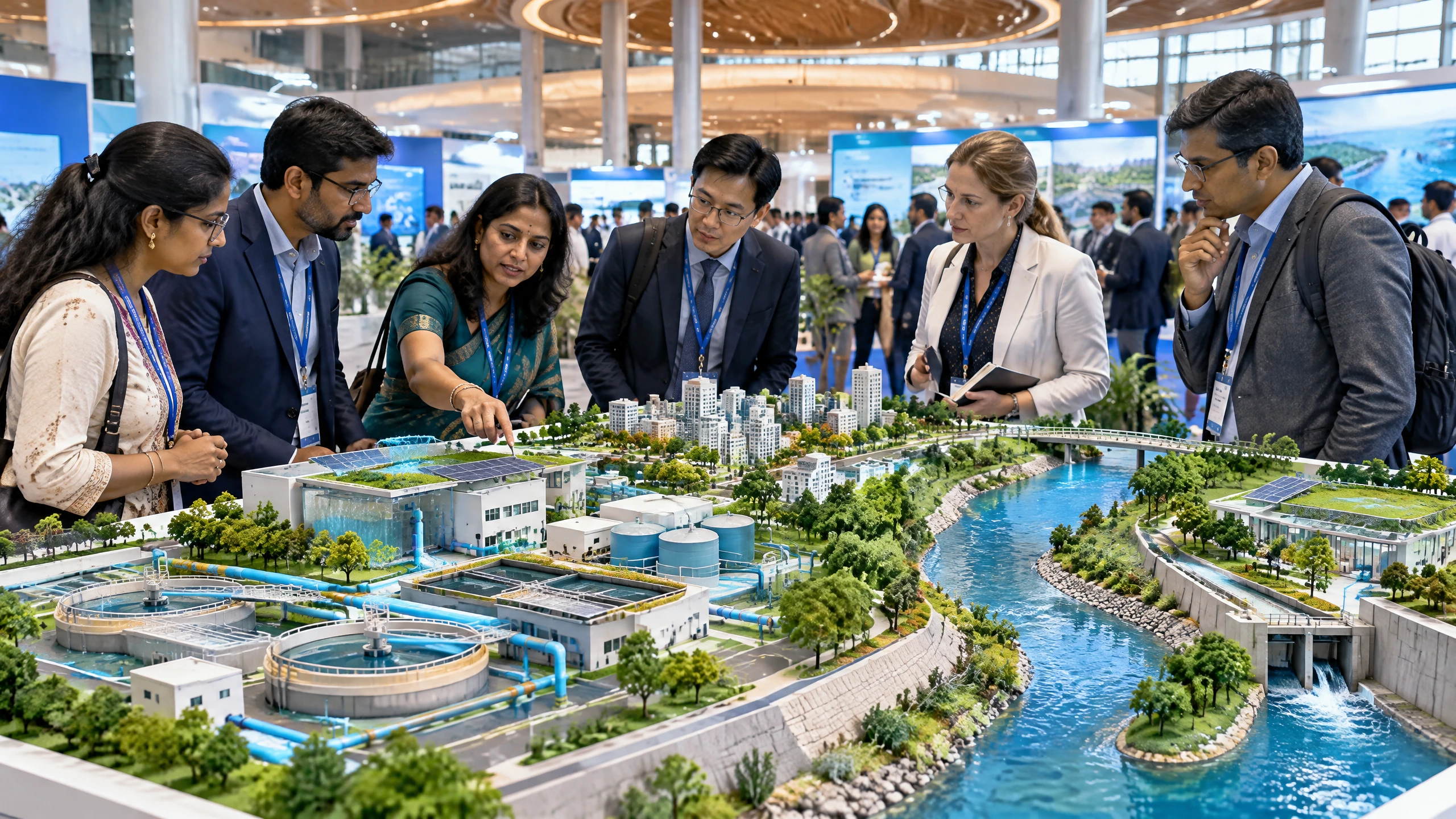
- The Ministry of Jal Shakti has scheduled the 9th India International Water Week 2026 at Bharat Mandapam, New Delhi, from 22 to 26 September 2026 under the theme “Climate Resilient Water Management.”
- Vice-President C. P. Radhakrishnan is scheduled to inaugurate the event on 22 September; this pre-event report does not treat the inauguration as completed.
- The announced programme includes ten forums and seven sub-themes spanning governance, water security, climate-related risk, technology, community participation, infrastructure modernisation and financing discussions.
- A four-day international exhibition and water-technology showcase is scheduled for 22–25 September, while the Second International WASH Conference 2026 is scheduled for 22–24 September.
- The Netherlands and Germany are announced as partner countries; 14 states are to participate as partner states, while six central ministries and departments have been invited. No funding, procurement, MoU or policy outcome has been confirmed before the event.
India International Water Week 2026: dates, venue and scheduled opening
The 9th India International Water Week 2026 is scheduled to run from 22 to 26 September at Bharat Mandapam in New Delhi. The Ministry of Jal Shakti says Vice-President C. P. Radhakrishnan is scheduled to inaugurate the five-day event on 22 September. Its stated focus is climate-resilient water management, with water technology, sanitation, infrastructure and water-security discussions on the programme.
That gives IIWW 2026 a practical set of near-term facts for visitors, policy observers and businesses: the venue is Bharat Mandapam; the opening is scheduled for 22 September; the valedictory session is planned for 25 September; and study tours are listed for 26 September. The article is a pre-event guide, so every programme item below is reported as scheduled or announced rather than as an accomplished result.
The Ministry is organising the event with central ministries, state governments, international organisations, research and academic institutions, industry bodies, development partners, civil society and private-sector partners. That broad organiser description explains why the agenda ranges from household drinking water and hygiene to technology, infrastructure modernisation and climate risk. It does not establish that every named category has confirmed delegates, a commercial role or a signed agreement.
What does the Climate Resilient Water Management theme cover?
“Climate Resilient Water Management” is the official theme for India International Water Week 2026. In plain terms, it places the management of water resources alongside climate-related pressures and the need for systems that can remain reliable under changing conditions. The Ministry’s announcement frames the event as a platform for dialogue, knowledge exchange, innovation and partnerships, not as a new law or national programme in itself.
The announced seven sub-themes are specific: inclusive and equitable water governance; collaboration for optimal use of water resources; technology and community for water security; water in climate-related risk; innovative financing models for water infrastructure and modernisation; sustainable water resources management; and water for people and planet. Taken together, they join technical, institutional and public-service questions rather than treating water only as an engineering issue.
The wording matters for readers assessing what is confirmed. The theme and sub-themes are published programme details. They are not proof that a particular technology has been adopted, that a community programme is operating, or that an infrastructure project has received money. Any post-event claim about a policy decision, project, partnership or investment needs its own dated official evidence.
Who is expected to participate in IIWW 2026?
The Ministry of Jal Shakti has announced the Netherlands and Germany as partner countries for the 9th India International Water Week. It says the international participation is to include ministers, policymakers, global water leaders, international organisations, experts, researchers, practitioners, industry representatives, civil-society participants, start-ups, youth and other stakeholders from India and abroad.
On the domestic side, the announcement says 14 states will participate as partner states. It also says six central ministries and departments have been invited as partner ministries and departments. This makes the planned event a Centre–State and cross-sector platform, rather than a conference confined to one city or one departmental function.
There is an important difference between these categories. The partner-country and partner-state statements are announced participation details. The six central bodies have been invited, which should not be converted into a claim that each has attended or made a commitment. Nor does the release publish a full attendance count, a list of state names, a signed partnership register or a final delegate roster.
Ten forums divide the water-security agenda
The official programme lists ten major forums: a Ministerial Plenary, Global Water Leaders’ Plenaries, Country Forums, Water Leaders’ Forums, Practitioners’ Forums, Thematic Forums, a Startup Forum, a Youth Forum, an Industrial Forum and Side Events. The format is designed to bring policy, research, implementation and business perspectives into the same scheduled event.
For water-technology and infrastructure companies, the Industrial Forum and Startup Forum are the clearest announced spaces for engagement with an agenda that includes technology, modernisation and climate resilience. For researchers, utilities and public agencies, the practitioner and thematic sessions appear more directly aligned with operational and governance questions. The announcement does not give session-by-session agendas, speaker lists or product specifications, so those details remain unknown at the pre-event stage.
The number of forums signals breadth, not a decision-making hierarchy. A plenary, a thematic discussion and a side event can serve different purposes and may produce different kinds of record. The Ministry says IIWW 2026 will seek actionable recommendations, partnerships and scalable solutions. That future-facing wording does not confirm that recommendations have been adopted or that any resulting partnership has been concluded.
Water technology exhibition is scheduled for 22–25 September
A four-day international exhibition and technology showcase is scheduled to run from 22 to 25 September 2026 during India International Water Week at Bharat Mandapam. The Ministry says it will provide a platform for technologies, products and solutions related to sustainable and climate-resilient water management. It is one of the programme components that gives the event a direct water-tech and infrastructure-business dimension.
The exhibition’s stated purpose allows readers to identify the likely problem areas under discussion: managing water resources, responding to climate-related risks, improving infrastructure and connecting technical solutions with wider water-security needs. Technologies can be relevant across monitoring, treatment, distribution, reuse, sanitation and utility operations, but the official announcement does not name particular exhibitors, products, contract values or technical standards. This report therefore does not assign commercial winners or claim adoption of a named solution.
An exhibition is also not a procurement notice. A company displaying equipment or a solution does not establish that a government agency, utility or state has bought it. Equally, a technology demonstration does not by itself establish performance in Indian operating conditions. Readers looking for investment, tender or deployment information should wait for specific, attributable documents from the relevant organisation rather than infer it from the scheduled showcase.
Second International WASH Conference: water, sanitation and public health
The Department of Drinking Water and Sanitation is scheduled to organise the Second International WASH Conference 2026 from 22 to 24 September. WASH commonly refers to water, sanitation and hygiene. According to the Government announcement, the conference will focus on drinking-water access, sanitation infrastructure, hygiene behaviour and public health, with an emphasis on scalable, affordable and sustainable solutions.
This strand widens the meaning of the India International Water Week agenda. A water-infrastructure discussion can involve treatment plants, networks, monitoring systems and financing, while a WASH discussion also connects those systems to household access, sanitation services, hygiene practices and health outcomes. The event’s announced structure places these connected issues alongside climate resilience rather than treating them as separate sectors.
The scheduled WASH conference should not be read as proof that a new sanitation scheme, public-health intervention or drinking-water target has been launched. The Ministry’s release establishes the dates and intended focus. It does not provide a new budget, implementation geography, baseline, outcome measurement or independently assessed health result. Those details would require later documentation from the Department or another competent authority.
Why water infrastructure finance is on the agenda — not a funding announcement
Innovative financing models for water infrastructure and modernisation are one of the seven announced IIWW 2026 sub-themes. That makes finance relevant to the event’s programme because water systems require long-lived assets, operations, maintenance and the ability to respond to climate-related risks. It does not mean the Government has announced a new fund, allocated a sum, selected a project or committed public expenditure through this event.
For businesses, the topic can be useful because it places financing alongside technology, governance and community participation. Providers of water equipment, sanitation services, engineering, digital monitoring and resilience solutions often depend on how projects are planned, financed, operated and maintained. Yet an agenda discussion is several steps removed from a procurement process. No tender, eligibility condition, award, concession, loan, grant or investment return should be inferred from the listed sub-theme.
The Ministry says the deliberations will seek actionable recommendations, partnerships and scalable solutions. “Will seek” is a crucial qualifier. It describes an objective for future discussions, not an outcome that has already been reached. A later announcement could contain actual commitments or recommendations, but until it is published, the defensible position is that IIWW 2026 has scheduled a conversation about financing models rather than announced finance.
Why climate-resilient water technology matters for India
Water technology matters in India because the country’s water challenges are simultaneously household, agricultural, urban, industrial, environmental and institutional. The IIWW 2026 programme reflects that overlap by pairing water security and community participation with infrastructure modernisation, sustainable resource management and climate-related risk. A platform bringing these themes together can help clarify where technical tools need to fit within governance, maintenance and public-service systems.
The value of a water technology depends on more than the device or process itself. A treatment, monitoring, reuse, efficiency or sanitation solution may require reliable operations, skilled people, compatible infrastructure, funding, data and a defined public or commercial need. This is why the official agenda’s inclusion of governance, community, infrastructure and financing alongside technology is significant. It recognises a system-level challenge, although it does not validate any particular solution or business model.
Climate resilience adds another lens: water systems need to be considered against variable availability, quality, demand and risk. The official announcement does not make performance claims or publish technical benchmarks for technologies at the event. Its confirmed contribution before the opening is to convene an announced programme on the subject. Whether discussions lead to deployment, standards, investment or measurable service improvements can only be assessed from subsequent verified records.
What is confirmed, and what remains unknown before the opening?
Confirmed from the Ministry of Jal Shakti’s 20 September release are the event identity, the 22–26 September schedule, Bharat Mandapam in New Delhi as the venue, the Climate Resilient Water Management theme, the scheduled 22 September inauguration, ten forums, seven sub-themes, partner-country and partner-state arrangements, and the dates for the exhibition and WASH conference. These are Government-announced programme facts.
Also confirmed as scheduled are the valedictory session on 25 September and study tours on 26 September. The distinction is important: a schedule can change, and a planned session is not evidence that it has been held. As of the source-check time for this article, the release does not establish the content of speeches, the final attendance, the products on display, signed agreements, awards, recommendations, or the results of any deliberation.
In particular, there is no verified pre-event evidence of a completed procurement, funding commitment, new policy decision, executed memorandum of understanding or infrastructure deployment arising from IIWW 2026. This boundary is not a minor technicality. It separates an accurate event agenda report from a claim about implementation. Readers should look for dated Ministry, department, state, utility or company documents before treating an announced discussion as an operational outcome.
Schedule, follow-up evidence and source transparency
The immediate timetable is clear in the official announcement: the event is scheduled from 22 to 26 September; the opening is scheduled for 22 September; the exhibition is due to run from 22 to 25 September; the Second International WASH Conference is due to run from 22 to 24 September; the valedictory is listed for 25 September; and study tours are listed for 26 September. These dates make the article useful for the opening window without implying that the programme has been completed.
The most meaningful follow-up evidence would be official releases, session documents, exhibitor lists, published recommendations, project-specific notices, agreements with identifiable parties and terms, or departmental and state records. A press statement that an intention was discussed would still be different from a signed contract, allocated budget or commissioned project. Reporting after the event should preserve those distinctions rather than turn conference language into a claim of delivery.
This report relies principally on the Press Information Bureau’s Ministry of Jal Shakti announcement, with national reporting used to corroborate the public schedule. Two related Reddy News articles are included below as internal reading, not as evidence for IIWW 2026 facts. The source list lets readers separate the primary record from secondary coverage and from related context on technology and urban infrastructure.
A practical way to follow the 9th India International Water Week
For a reader following the opening on 22 September, the most reliable first check is whether the Ministry of Jal Shakti or Press Information Bureau publishes an on-the-day account of the inauguration. That can confirm whether the scheduled event took place, identify the speakers and record any speech, document or announcement that is actually made. A pre-event release establishes intent and a timetable; an official post-event release is needed to establish what happened.
The next useful distinction is between event activity and project activity. A forum may discuss a technology, a state may present an approach, or a company may exhibit a product. None of those facts alone demonstrates a tender, an installation, a financing close or an improvement in water service. Evidence for those later stages normally has to identify the responsible authority or company, the place, the scope, the timing and, where relevant, the financial or contractual basis.
Readers interested in the WASH track can look for a published agenda or outcome note from the Department of Drinking Water and Sanitation; those interested in water technology can look for an official exhibitor or session record; and those tracking infrastructure finance can look for a specific Government, state, utility or project document. This approach keeps attention on the announced IIWW 2026 agenda while avoiding claims that could only be supported after the event.
Reader guide
Article questions, answered
Short answers to common reader questions based on the reporting above.
When and where is India International Water Week 2026 scheduled to take place?
The Ministry of Jal Shakti has scheduled the 9th India International Water Week 2026 for 22–26 September 2026 at Bharat Mandapam in New Delhi. The announced programme places the inauguration on 22 September, the valedictory session on 25 September and study tours on 26 September. These are scheduled programme dates, not evidence that those activities have already occurred.
Who is scheduled to inaugurate the 9th India International Water Week?
According to the Press Information Bureau release issued on 20 September, Vice-President of India C. P. Radhakrishnan is scheduled to inaugurate IIWW 2026 on 22 September, in the presence of the Union Minister of Jal Shakti and other dignitaries. The report is published before the opening, so it does not describe the inauguration as completed.
What is the theme of IIWW 2026?
The official theme is “Climate Resilient Water Management”. The announced sub-themes cover water governance, better use of water resources, technology and community for water security, climate-related risk, financing models for infrastructure modernisation, sustainable management, and water for people and planet. They are subjects for deliberation rather than announced policy decisions.
What are the dates for the water technology exhibition and the WASH conference?
The Ministry of Jal Shakti says an international exhibition and technology showcase is scheduled for 22–25 September 2026. The Department of Drinking Water and Sanitation is to organise the Second International WASH Conference 2026 from 22–24 September. The WASH programme is expected to address drinking-water access, sanitation infrastructure, hygiene behaviour and public health.
Does India International Water Week 2026 include announced water funding or procurement?
No completed funding, procurement award, signed partnership, MoU or policy outcome is established by the pre-event announcement reviewed for this report. Innovative financing models for water infrastructure and modernisation are listed as an agenda sub-theme. The Government says the deliberations will seek recommendations, partnerships and scalable solutions; that is not the same as a confirmed financial commitment or contract.
Sources and further reading
These references support the factual context used in this article. Links open the original publisher.
- Vice President Shri C. P. Radhakrishnan to Inaugurate 9th India International Water Week 2026 on 22 September in New DelhiPress Information Bureau, Ministry of Jal Shakti · accessed 21 September 2026
- India International Water Week 2026 to focus on climate-resilient water managementETGovernment / Press Trust of India · accessed 21 September 2026
- Global experts on water security to gather in India for climate resilience talksThe New Indian Express · accessed 21 September 2026
- Vice-president to inaugurate India International Water Week on September 22Hindustan Times / Press Trust of India · accessed 21 September 2026
- SEMICON India 2026 Ends: CDIL and Suchi Start Commercial Production as Semicon 2.0 Moves to ImplementationReddy News · accessed 21 September 2026
- Global Cities Redesigning StreetsReddy News · accessed 21 September 2026