National HPV vaccination campaign passes 80 lakh administered doses
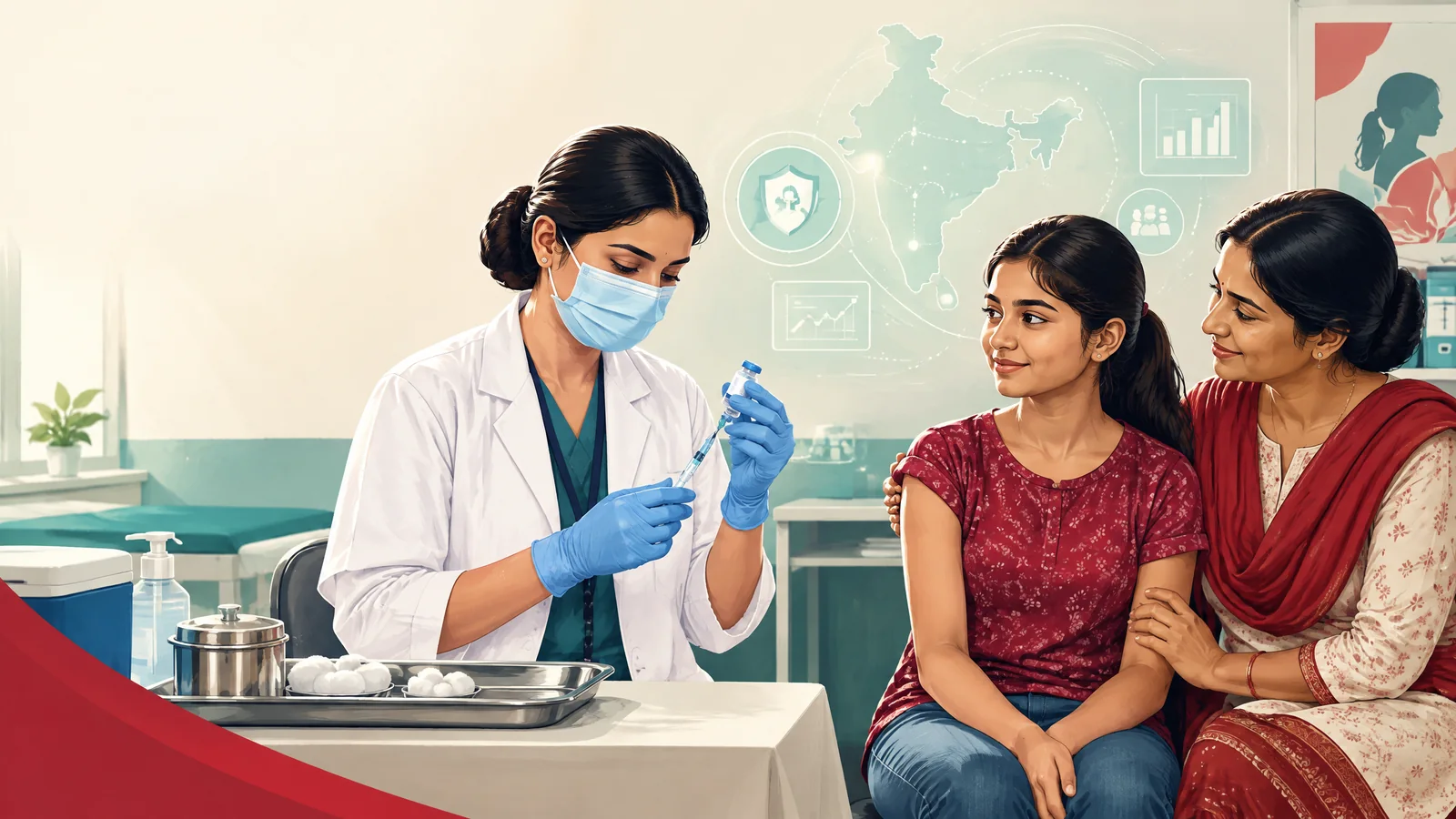
India’s national HPV vaccination campaign has crossed 80 lakh administered doses, with free, voluntary single-dose vaccination offered to 14-year-old girls with parental consent.
- The Health Ministry reported more than 80 lakh, or eight million, HPV vaccine doses administered since the national campaign began in February 2026.
- The offer is for 14-year-old girls at government health facilities and is free, voluntary, single-dose and subject to parental consent.
- Gujarat, Uttar Pradesh, Madhya Pradesh and Mizoram were reported at 100 per cent of their identified target cohorts; Uttar Pradesh was reported above 22 lakh girls vaccinated.
- Sessions are supervised by trained medical officers, with government facilities linked to 24×7 arrangements for managing rare adverse events following immunisation.
- The 80-lakh figure is an administered-dose total, not an independently audited national coverage percentage.
India reaches the 80-lakh administration mark
India’s national human papillomavirus vaccination campaign has passed 80 lakh, or eight million, administered doses since its February 2026 launch, the Ministry of Health and Family Welfare reported on 11 September. Two national news reports also carried the milestone and the principal terms of the rollout.
The update is a significant delivery marker for a campaign intended to support cervical-cancer prevention. It should, however, be described precisely. The figure is a count of doses administered under the programme. It is not, by itself, an independently audited estimate of the share of all eligible girls reached across India. The source set reviewed by Reddy News contains the Ministry’s administrative announcement and two news reports, but no separate national coverage audit.
Who is eligible and how the offer works
The campaign is directed at girls who are 14 years old. Vaccination is provided at government health facilities, free of charge and with parental consent. Participation is voluntary.
The programme uses a single-dose design. In practical terms, an eligible girl who takes part is offered one dose under this campaign rather than being enrolled in a scheduled multi-dose course. “Single-dose” describes the programme’s delivery design; “voluntary” means vaccination is offered rather than imposed; and parental consent is part of the eligibility and administration process reported by the Ministry.
These terms matter because they define what families are being asked to decide and where the service is available. They also keep the milestone in context: the announcement concerns a specific public programme for a defined age group, not every HPV vaccination delivered through every channel in India.
What 80 lakh administered doses does — and does not — show
An administered-dose total records programme activity. The Ministry says more than 80 lakh HPV vaccine doses have been given under the national campaign since launch. Business Standard, citing Press Trust of India, and The New Indian Express reported the same threshold.
A coverage rate answers a different question: what proportion of a defined target population has been reached. Reporting a national coverage percentage requires a stated denominator and a clear measurement basis. Those elements are not provided as an independently audited national measure in the supplied material, so the eight-million figure should not be converted into or presented as a verified nationwide percentage.
The distinction is especially important in a fast-moving rollout. Administrative totals can show scale and momentum, while audited coverage can test how completely and evenly a programme reached its intended population. The current announcement supports the former. It does not establish the latter.
How to read the Ministry’s state figures
The Ministry reported that Gujarat, Uttar Pradesh, Madhya Pradesh and Mizoram had each reached 100 per cent coverage of their respective identified target cohorts. It also said Uttar Pradesh had vaccinated more than 22 lakh adolescent girls, the highest state total cited in the release. The New Indian Express separately reported those official figures.
The wording “identified target cohorts” is essential. A claim of 100 per cent in that formulation refers to the target population identified for the campaign by the reporting authority. It should not be broadened into a claim that every 14-year-old girl in a state has necessarily been reached, or that the state result is an independently audited measure.
The national milestone and state figures also use different units in the source material. The national headline counts administered doses, while the Uttar Pradesh figure is expressed as adolescent girls vaccinated. Accurate reporting keeps those labels intact rather than treating every programme metric as interchangeable.
Final-phase delivery and safety safeguards
The Ministry described the campaign as progressing towards its final phase, with attention turning to remaining eligible beneficiaries. It said all campaign sessions are conducted under the supervision of trained medical officers at government health facilities.
Those facilities are linked with 24×7 healthcare arrangements for the management of rare adverse events following immunisation, commonly shortened to AEFI. The stated mechanism is intended to allow timely assessment, monitoring and management if an event occurs. Business Standard also reported medical-officer presence and links to round-the-clock AEFI management centres.
The official release says the campaign uses the U-WIN platform so programme managers can monitor district-level coverage, identify gaps and missed beneficiaries, and support planning and resource allocation. This is a delivery and tracking safeguard within the programme. It does not replace the separate question of whether national or state coverage figures have been independently audited.
What the milestone means in the closing stage
The immediate news is straightforward: a free, voluntary, single-dose HPV vaccination campaign for 14-year-old girls has recorded more than eight million administered doses, according to the Union Health Ministry. The final-phase task described in the official release is to reach eligible beneficiaries who remain outside the recorded total.
The most reliable way to follow that progress is to preserve the boundaries of each published measure. Administered doses show the scale of delivery. Ministry-reported state percentages show performance against identified cohorts. An independently audited national coverage estimate would be a separate measure, and none is included in the sources available for this report.
Reader guide
Article questions, answered
Short answers to common reader questions based on the reporting above.
Who is eligible for vaccination under the national HPV campaign?
The programme offers vaccination to girls aged 14. It is free at government health facilities, voluntary, delivered as a single dose and requires parental consent.
Does 80 lakh administered doses mean 80 lakh independently verified recipients?
The Ministry’s national milestone is stated as doses administered. Because the programme is designed as a single-dose offer, the count is a clear measure of administration activity, but the supplied sources do not include an independent audit establishing a unique-recipient total or a national coverage percentage. The precise description is therefore “more than 80 lakh doses administered.”
Which states were reported at 100 per cent coverage?
The Ministry named Gujarat, Uttar Pradesh, Madhya Pradesh and Mizoram. The claim applies to each state’s identified target cohort and is Ministry-reported; it should not be restated as independently audited coverage of every eligible girl in those states.
What safety arrangements apply during vaccination sessions?
Sessions are conducted under trained medical-officer supervision at government health facilities. The Ministry says those facilities are linked with 24×7 healthcare arrangements for the assessment and management of rare adverse events following immunisation.
Sources and further reading
These references support the factual context used in this article. Links open the original publisher.
- Press Information Bureau / Ministry of Health and Family Welfare — India Administers 80 Lakh HPV Vaccine Doses, Marking Major Milestone in Cervical Cancer PreventionPress Information Bureau / Ministry of Health and Family Welfare · accessed 12 September 2026
- Business Standard (PTI) — India crosses 8 million HPV vaccinations under nationwide campaignBusiness Standard · accessed 12 September 2026
- The New Indian Express — India crosses over 80 lakh HPV vaccinations in its fight against cervical cancerThe New Indian Express · accessed 12 September 2026