Brazil Election 2026: First-Round Date, Voting Rules and Results Guide
Brazil’s general-election first round is set for 4 October 2026. Here is a verified guide to offices, voting rules, timing and official results.
- Brazil’s general-election first round is scheduled for Sunday, 4 October 2026; an eventual second round is scheduled for 25 October.
- Polling sections will operate from 8am to 5pm Brasília time, with local clock times adjusted in places that use other time zones.
- The electronic ballot has six selections: federal deputy, state or district deputy, two senators, governor and president.
- President and governor require more than half of valid votes to win in the first round; blank and null votes are excluded from that calculation.
- The TSE reported 158.7 million eligible voters for 2026 and says result publication can begin from 5pm Brasília time on election day.
- As of 23 September, certified totals, turnout, winners and the contests that will require a second round remain pending.
Brazil election 2026: the confirmed first-round date
For Brazil election 2026, the general-election first round is scheduled for Sunday, 4 October 2026. Polling sections will operate from 8am to 5pm Brasília time under a nationally unified schedule. Official result disclosure can begin from 5pm Brasília time. If a second round is required for the presidency or a governorship, it is scheduled for Sunday, 25 October.
This is a nationwide general election, not a municipal vote. The Superior Electoral Court, known by its Portuguese initials TSE, set the 2026 calendar. Its electorate release reports 158.7 million eligible voters across 5,571 Brazilian municipalities and 186 cities abroad, using 517,206 polling sections in 2,641 electoral zones. These figures describe the electorate and voting structure; they do not indicate how people will vote or who will win.
For readers following the Brazil election 2026 from outside the country, Brasília time is the reference point for polling and the start of results publication. Brazil uses more than one time zone. In Rondônia, Mato Grosso, Mato Grosso do Sul and Roraima, polling runs from 7am to 4pm local time, matching 8am to 5pm in Brasília. Most of Amazonas follows the same local hours; Acre and Amazonas localities that use Acre time run from 6am to 3pm. Fernando de Noronha runs from 9am to 6pm local time.
Which offices are on the ballot
The first round covers six selections on the electronic ballot: federal deputy, state deputy or district deputy, first senator, second senator, governor and president. Voters make the selections in that order. Federal deputies sit in the Chamber of Deputies; state deputies sit in state legislatures, while district deputies serve the Legislative Chamber of the Federal District.
The Senate ballot is unusual in 2026 because each state and the Federal District will elect two senators. That produces 54 Senate seats across the country. The presidential and gubernatorial ballots also elect the corresponding vice-president and vice-governors as part of a ticket. The TSE advises voters to check the displayed photograph, name and party before pressing the confirmation key, and to use the correction key if a number has been entered incorrectly.
The order is relevant to the voting process, not to the weight of a vote. The TSE provides a voting simulator using fictional candidates and parties, and it has issued a paper reminder sheet on which voters may note chosen numbers before entering the polling place. Mobile phones are prohibited inside the voting booth, so a reminder used there must be on paper.
How Brazil’s majoritarian and proportional rules differ
Brazil uses two electoral systems in the same general election. President, governor and senator are majoritarian contests. Federal, state and district deputy seats are filled under proportional representation. The distinction matters when reading returns: an individual candidate’s vote total is not the only factor in allocating deputy seats, because party and federation votes also shape how many seats each group receives.
For president and governor, a first-round victory requires an absolute majority of valid votes: more than half after blank and null votes are excluded. If no candidate reaches that threshold, the two candidates with the most votes advance to the 25 October runoff. Senate races have no runoff. In 2026, the two Senate candidates with the highest vote totals in each state and the Federal District take the two seats at stake.
For deputy races, voters may choose a named candidate or cast a party vote. The TSE says candidate and party votes are combined to determine how many seats each party or federation receives, after which seats go to the most-voted candidates within that group under the applicable rules. Early candidate leaderboards therefore do not by themselves establish the final distribution of deputy seats.
Who votes and what to take to the polling station
Brazilian citizens aged 18 through 69 generally have compulsory electoral registration and voting, subject to their electoral status. Registration and voting are optional for 16- and 17-year-olds, people aged over 70 and people who are illiterate. Foreign nationals and people serving compulsory military service cannot register as electors. The TSE’s overall electorate figure includes registered people in categories where voting is optional.
To vote, a person presents an official photo document to the polling board. The TSE lists an identity card, driver’s licence, passport, physical work card, reservist certificate and legally recognised professional identity card among accepted documents. An e-Título app screen may also be used if it displays the voter’s photograph. A person whose e-Título does not show a photo needs a physical official photo document.
A paper voter title is not required at the polling station. Birth and marriage certificates are not accepted as proof of identity, and neither is the digital work card. In polling sections with biometric identification, a voter may be asked to use the reader; if it does not recognise the biometric data, officials verify identity details. A person still in the queue at 5pm Brasília time receives a token and may vote.
What happens on 4 October
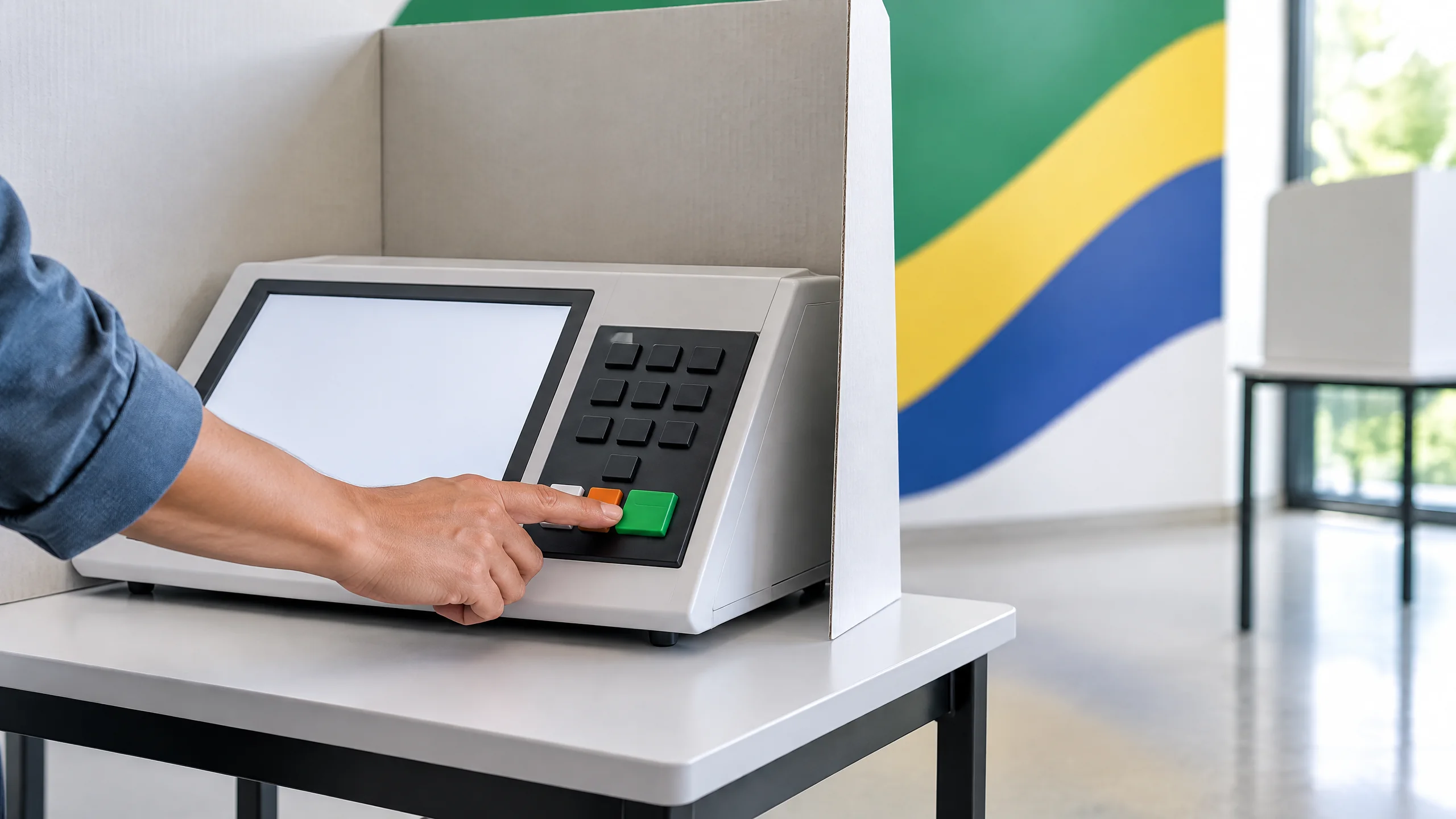
At the polling station, the voter locates the assigned section, presents valid identification and, where applicable, completes biometric identification. After signing the polling register or recording a fingerprint where signing is not possible, the voter enters the booth and uses the electronic ballot. The system presents the six offices in the official sequence. For each choice, the voter can verify the candidate’s photo, name and party or correct the entry before confirming it.
The TSE says a phone must be left with personal belongings before the voter enters the booth, even if it is switched off. The restriction protects ballot secrecy and prevents recording of the vote. Voters who need assistance have specific safeguards: a person with a disability or reduced mobility may be helped in the booth by a person of their choice, while voters with visual disabilities can use features including audio resources and Braille support.
A voter may cast blank or null votes, but neither counts as a valid vote when calculating the absolute-majority threshold in presidential and gubernatorial races. A voter who confirms at least one office and leaves without completing the ballot may be asked to return and finish. If that does not happen, the uncompleted choices are recorded as null.
How to follow official results
The TSE says it can begin releasing first-round results from 5pm Brasília time on 4 October, once voting closes under the unified national schedule. The start of publication is not a final result in every contest. Electronic-ballot data are transmitted and totals update as sections report, so initial figures can be partial. The relevant context is the share of polling sections totalled and the TSE’s totalisation status, not an isolated early percentage.
The official options are the TSE Resultados web service and its mobile app. The court says the app provides real-time monitoring of totalisation and allows searches by election, state and municipality. TSE technical information for 4 October identifies separate result environments for the federal general election and state-level general elections. The court also makes election data available through its open-data portal.
For a factual results update, the TSE platform identifies the office and jurisdiction, the number of sections totalled and whether totalisation is complete. Unofficial social-media graphics, reposted screenshots and media projections are not official totalisation data. As of 23 September, the election has not taken place and no certified totals, turnout figures or winners are available.
What is not yet confirmed
The calendar, offices, voting hours and result-publication arrangements are confirmed. The election outcome is not. As of 23 September 2026, this guide does not name a winner, forecast turnout, predict a presidential or gubernatorial runoff, or treat opinion polling as a result. It also does not make a claim about any individual candidate’s final legal status.
Candidate information, registration status, declared assets, party or federation affiliation, government proposals where applicable, and reported campaign accounts can be consulted through DivulgaCandContas, the TSE platform. It permits searches by office, state and municipality, and the TSE says campaign income and expenditure information is updated hourly. Its entries are the relevant official record to consult for current candidature information.
The number of contests proceeding to 25 October will be known only after first-round totalisation. Eventual turnout is also unknown before voting. The court’s formal totalisation and legal processes occur after the vote; those pending matters do not change the confirmed election schedule.
Key dates and post-vote guidance
The campaign period began on 16 August 2026, while first-round free radio and television election broadcasts run from 28 August to 1 October. The TSE calendar lists 3 October for verification of the result-totalisation management system. Election day is 4 October. The second round, if required, is 25 October. The electoral register is scheduled to reopen on 3 November, and the calendar sets 18 December as the deadline for diploma ceremonies for those elected.
A registered voter who is away from their electoral domicile on voting day may justify the absence through e-Título or at an authorised justification desk. A separate justification is required for each missed round. A voter who does not justify on the day has 60 days after each round: for the 4 October first round, the deadline is 3 December 2026; for a 25 October runoff, it is 8 January 2027. A post-election justification request requires documents supporting the reason for absence.
The TSE provides channels to check a voting place and electoral status, to consult candidate records through DivulgaCandContas, and to follow totalisation through Resultados after polls close. Certified vote totals, turnout and eventual winners are pending until the Electoral Justice completes official totalisation.
Reader guide
Article questions, answered
Short answers to common reader questions based on the reporting above.
When is Brazil’s 2026 general-election first round?
The first round is scheduled for Sunday, 4 October 2026. If required for the presidency or a governorship, the second round is scheduled for Sunday, 25 October 2026.
What time does voting start and end in Brazil?
Polling sections operate from 8am to 5pm Brasília time. In locations using another time zone, the local opening and closing times change so the nationwide schedule remains aligned with Brasília time.
What offices will Brazil elect in 2026?
Voters will choose federal deputies, state or district deputies, two senators, a governor and a president. The governor and president are elected with their running mates on a ticket.
When does Brazil hold a second round?
A presidential or gubernatorial candidate must receive more than half of valid votes to win in the first round. If no candidate does, the top two advance to a 25 October runoff. Senate races do not use a runoff.
How can I check Brazil election results officially?
The TSE Resultados website and mobile app provide official totalisation information. Result publication can begin from 5pm Brasília time on 4 October, and early totals may be partial until totalisation is complete.
What should a voter bring on election day?
An official photo document, such as an identity card, driver’s licence or passport, is accepted. An e-Título screen showing the voter’s photograph is also accepted. A paper voter title is not required.
Sources and further reading
These references support the factual context used in this article. Links open the original publisher.
- Eleições 2026: confira as principais datas do calendário eleitoralTribunal Superior Eleitoral · accessed 23 September 2026
- Faltam 26 dias: votação começa e termina no mesmo horário em todo o paísTribunal Superior Eleitoral · accessed 23 September 2026
- Faltam 25 dias: saiba qual é a ordem de votação na urna eletrônicaTribunal Superior Eleitoral · accessed 23 September 2026
- Faltam 22 dias: sistemas majoritário e proporcional definem a eleiçãoTribunal Superior Eleitoral · accessed 23 September 2026
- Faltam 19 dias: saiba para quem o voto é obrigatório ou facultativoTribunal Superior Eleitoral · accessed 23 September 2026
- Por Dentro das Eleições: o que fazer no dia da votaçãoTribunal Superior Eleitoral · accessed 23 September 2026
- Faltam 30 dias: Brasil tem mais de 158 milhões de eleitoras e eleitores aptos a votarTribunal Superior Eleitoral · accessed 23 September 2026
- Resolução TSE nº 23.751, de 26 de fevereiro de 2026Tribunal Superior Eleitoral · accessed 23 September 2026
- Informações técnicas sobre a divulgação de resultados 2026Tribunal Superior Eleitoral · accessed 23 September 2026
- Faltam 20 dias: onde consultar informações sobre candidatas e candidatosTribunal Superior Eleitoral · accessed 23 September 2026
- Faltam 13 dias: saiba como justificar a ausência nas Eleições 2026Tribunal Superior Eleitoral · accessed 23 September 2026