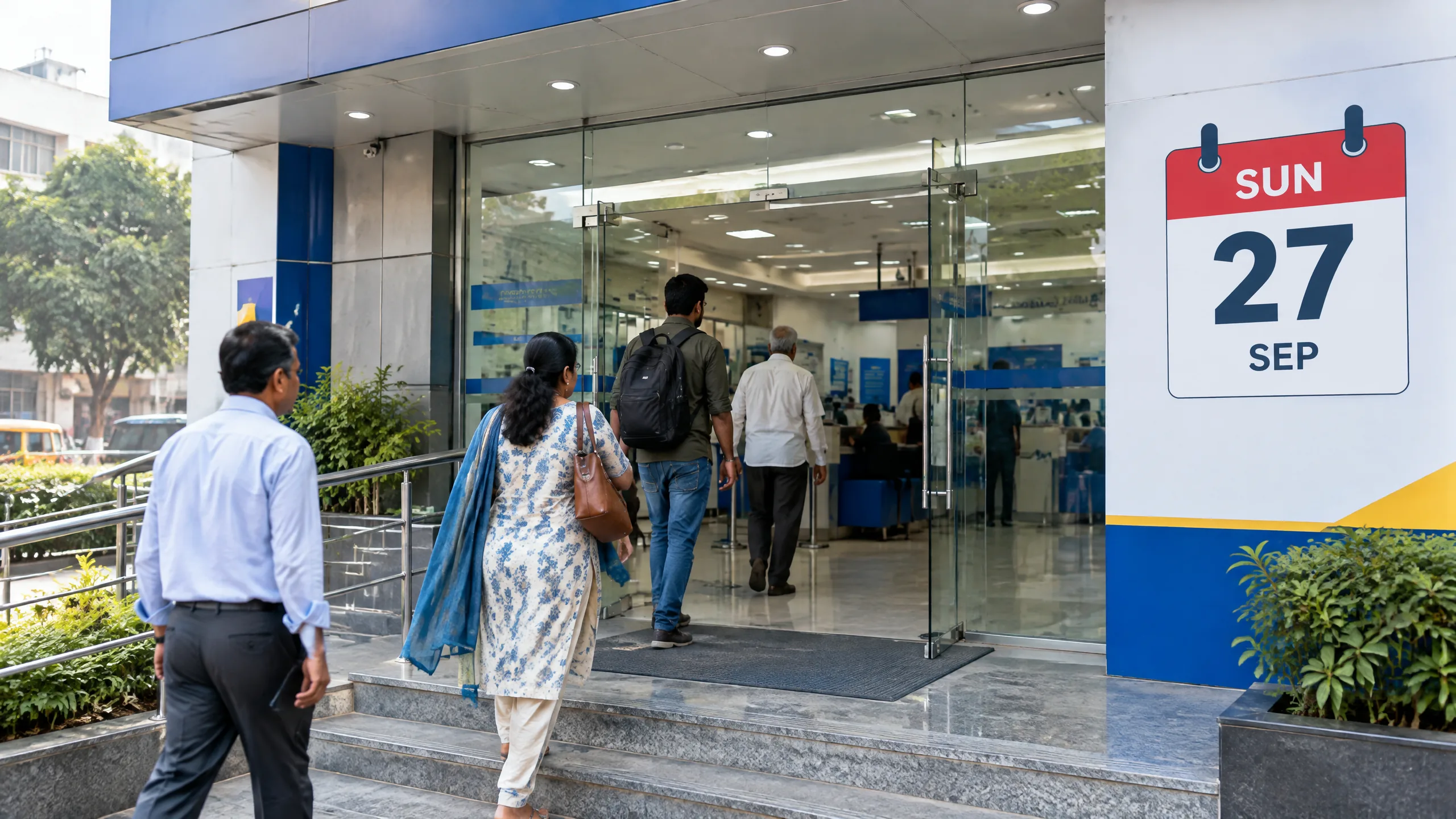
Bank strike deferred September 28, 2026: branches expected open; five-day week not approved
The UFBU deferred its 28–30 September bank strike after IBA talks. Branches should generally open, but no five-day banking week has been approved.

- The United Forum of Bank Unions has deferred the proposed nationwide strike scheduled for September 28–30.
- Branches are generally expected to operate on Monday, September 28, though a customer should still confirm with the relevant bank and local holiday calendar.
- The reported understanding is to form an IBA–UFBU committee to examine remaining Saturdays as holidays; it does not establish a five-day banking week.
- Published reports describe further discussions on performance-linked incentives for Scale IV and above officers and other pending issues.
- The deferral is not a permanent cancellation and no fresh strike date was announced in the reported agreement.
The direct answer for Monday
The bank strike deferred September 28, 2026, means the proposed three-day nationwide stoppage is not going ahead on its scheduled dates of September 28–30. For customers, the practical consequence is that branches are generally expected to function on Monday, September 28, rather than close because of the announced industrial action. That is the clearest correction to the disruption notices circulated before the late-night talks between bank unions and the Indian Banks’ Association, or IBA.
‘Generally expected’ matters. The deferral removes the proposed strike as the reason for a nationwide shutdown, but it is not a promise that every counter, branch or transaction will be available in every location. A bank’s own notice, branch hours and the local holiday calendar remain the best checks for a time-sensitive visit. The news is about the strike being deferred, not a blanket guarantee of identical service at every branch.
What was proposed before the talks
The United Forum of Bank Unions, or UFBU, had planned a nationwide strike for September 28, 29 and 30. The UFBU is a forum of bank-union organisations; the IBA is the industry body that represents member banks in discussions on sector-wide employment matters. Their late meeting changed the immediate customer question from how to prepare for a three-day stoppage to whether normal branch work could resume on Monday.
A strike of this kind can create uncertainty around work that depends on a staffed branch: in-person enquiries, document submission, cash-related assistance and processing that cannot be completed through a customer’s usual digital channel. The precise effect can differ by bank and task, so it would be wrong to assume that every service would have stopped everywhere. Equally, the deferral should not be read as a permanent settlement of every issue that led to the strike notice.
What the late agreement says
Reports say the IBA and UFBU met at 9:30 p.m. on September 27 and reached understandings that led the unions to defer the strike and related planned agitation. The All India Bank Employees’ Association, a union body within the wider labour movement, described the outcome as a forward movement on five-day banking, performance-linked incentives and residual issues. That language signals progress from the union side; it does not itself create a new bank timetable.
The most concrete reported step is the immediate formation of a high-level joint committee of the IBA and UFBU. Its task is to deliberate on declaring the remaining Saturdays bank holidays, consider alternatives, consult stakeholders and work toward a solution acceptable to those involved, including customers. Published accounts also say discussions can begin on proposed modifications to the performance-linked incentive scheme for Scale IV and above officers, alongside other pending matters.
A committee is not a five-day banking order
This distinction is central. The strike was deferred; there is reported movement on the five-day banking demand; and a joint committee is to examine the question of remaining Saturdays. Those are three separate propositions. None means that all Saturdays have already become bank holidays, that a five-day banking week is in force, or that customers should revise their routine branch plans on that assumption.
At present, banks commonly observe closures on the second and fourth Saturdays of a month, while the status of the remaining Saturdays is the subject assigned to the reported committee. India Today reported that the agreement sets no deadline for the committee to decide. Its work is therefore a process, not an announced outcome. Any eventual change would need to be communicated through the appropriate channels rather than inferred from the strike deferral.
Why the wording around five-day banking needs care
A five-day week has been a principal union demand, but a demand, an understanding to consider it and an approved operating schedule are not interchangeable. The Hindu reported that the committee would explore alternatives and consult stakeholders; NDTV similarly described a review through a committee that includes UFBU representatives. That is considerably narrower than saying a new Monday-to-Friday banking arrangement has been enacted.
There is also no need for customers to draw conclusions about long-term opening hours, staffing patterns or future Saturday transactions from this development. Those details have not been announced in the reported understanding. Keeping the language precise helps prevent a short-notice service update from becoming a misleading claim about a settled national policy. For now, the known result is an avoided September 28–30 strike and a process for further talks.
What customers can reasonably expect
For a planned Monday branch visit, the sensible working assumption is that routine operations can proceed because the proposed walkout has been deferred. That is particularly relevant for customers who postponed work after reports that the strike could affect the period around half-yearly account closing. It does not remove ordinary operational limits: a particular branch may have its own hours, a local closure may apply, and the availability of a specific service can depend on the bank’s procedures.
Customers do not need to treat this update as financial guidance. It says nothing about choosing an account, moving money, changing an investment or taking any product decision. It is a service-status explanation. If a task has a deadline or requires an original document, cash handling or a specialist desk, confirmation from the specific bank is more useful than relying on a national headline alone.
The matters still left for talks
The committee question is only one part of the reported understanding. The Hindu said discussions could start on proposed changes to the performance-linked incentive, or PLI, scheme for Scale IV and above officers. NDTV reported that other pending issues listed in minutes from March 8, 2024, would also be discussed. These references explain why the union statement mentions PLI and residual issues alongside five-day banking, but the reports do not establish that those issues have been finally resolved.
That is why the most accurate description is a negotiated pause in the announced industrial action. The parties have a stated route for further discussion, while the immediate September 28–30 strike has been deferred. Readers should be wary of two opposite overstatements: that nothing changed, or that every demand has been granted. The reports support neither. They support a specific near-term service expectation and a continuing dialogue on unresolved matters.
How to read the service update accurately
This update has two time horizons. The first is immediate: the scheduled three-day strike is deferred, so the reported expectation is that banks will function on September 28. The second is longer term: the IBA–UFBU committee is to examine the remaining-Saturday question and the parties are to continue discussions on other matters. Combining those horizons can create confusion, because an operational expectation for Monday is much more definite than the eventual shape or timing of a policy outcome.
The original plan covered September 28–30, and India Today said the union’s circular did not give the committee a deadline or announce a new strike date. So a later notice about negotiations should not be mistaken for a branch-closure instruction, and a report of a normal Monday should not be mistaken for a settled labour agreement. For practical purposes, use the bank’s own official message for the day of a visit and use reporting on the committee to follow the broader discussion.
A narrow checklist before visiting a branch
First, look at the bank’s official app, website, customer-care channel or branch notice for the branch you intend to visit. Second, check the holiday list that applies in the state or locality, because the strike deferral does not override a local bank holiday. Third, if the visit is for a particular counter service, ask whether that service and any required documents will be available that day. These are verification steps, not reasons to assume a disruption.
Finally, keep watching official communication for any follow-up to the IBA–UFBU committee. The September 27 understanding deferred the planned strike but did not announce a permanent resolution, an all-Saturday closure or a committee deadline. If negotiations produce a later operational change, banks and the relevant parties will need to communicate it. Until then, September 28 is best understood as a normal-working-day expectation after an avoided nationwide strike, subject to the usual bank-specific checks.
Reader guide
Article questions, answered
Short answers to common reader questions based on the reporting above.
Are bank branches open on Monday, September 28, 2026?
They are generally expected to operate because the UFBU deferred the proposed September 28–30 strike. Check the relevant bank’s official communication and the local holiday calendar before a time-sensitive visit, as a national deferral is not a guarantee of every branch service.
Was the bank strike cancelled permanently?
No. The reported outcome is a deferral of the planned strike and related agitation, not a permanent cancellation. The reports did not announce a new strike date, but the underlying issues remain subject to further discussions.
Have all Saturdays become bank holidays?
No. The reported understanding is to form an IBA–UFBU committee to examine the question of the remaining Saturdays, consider options and consult stakeholders. It is not an approved all-Saturday holiday rule.
Has a five-day banking week been approved?
No. Five-day banking remains a subject of discussion. The reported committee and the union’s description of forward movement do not amount to a new approved five-day schedule or a change in published branch hours.
Sources and further reading
These references support the factual context used in this article. Links open the original publisher.
- All India Bank Employees’ Association: UFBU strike deferred — understandings reachedAll India Bank Employees’ Association · accessed 2026-09-28
- Bank unions defer three-day nationwide strike after ‘understandings reached’ with IBAThe Hindu · accessed 2026-09-28
- 3-Day Bank Strike Deferred After Meeting Between Association, UnionsNDTV · accessed 2026-09-28
- 3-day nationwide bank strike deferred after talks, panel to examine all Saturdays as holidaysIndia Today · accessed 2026-09-28