Virat Kohli: Career, Records, IPL Journey and Legacy
Virat Kohli remains an active ODI batter for India and a Royal Challengers Bengaluru player after retiring from T20Is and Tests. This profile traces his Delhi beginnings, international rise, records, leadership, complete one-franchise IPL career and lasting influence.
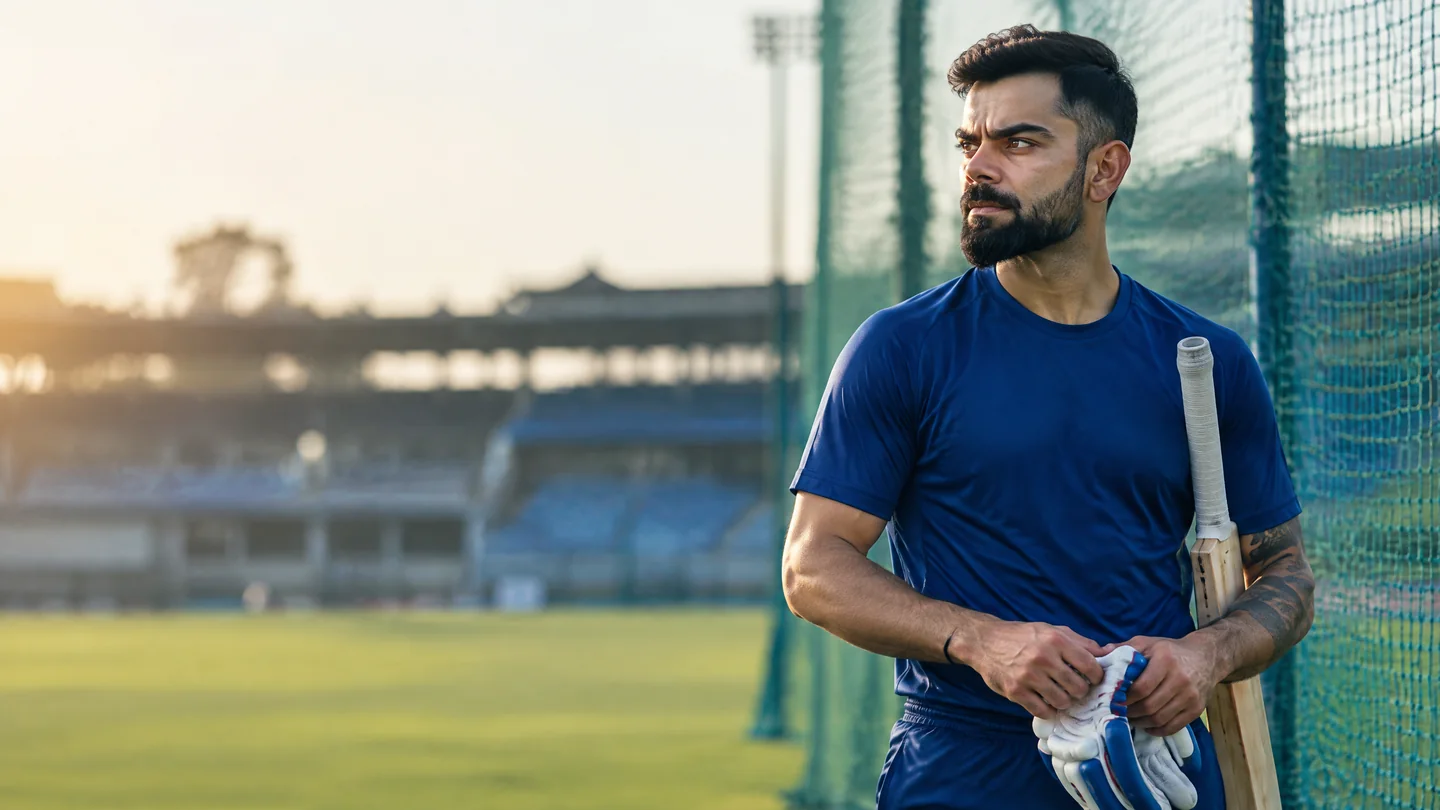
- As of 11 September 2026, Virat Kohli is active for India in ODIs, retired from T20Is and Tests, and remains a Royal Challengers Bengaluru player in the IPL.
- He led India to the 2008 Under-19 World Cup title before making his senior ODI debut against Sri Lanka at Dambulla on 18 August 2008.
- Kohli ended his Test career with 9,230 runs and a national-record 40 wins from 68 matches as captain.
- He became the first batter to reach 50 ODI centuries in 2023 and had 54 hundreds and 14,941 ODI runs after India’s July 2026 tour of England.
- Kohli has represented only Royal Challengers Bengaluru in every IPL season from 2008 through 2026, winning consecutive titles in 2025 and 2026.
- His legacy combines high-volume run-scoring with a visible emphasis on preparation, fitness, aggressive leadership and adapting his batting to changing formats.
Virat Kohli’s verified playing status in September 2026
As of 11 September 2026, Virat Kohli is an active international cricketer for India in one-day internationals. He retired from Twenty20 internationals immediately after India won the 2024 T20 World Cup and announced the end of his Test career on 12 May 2025. There has been no verified announcement that he has retired from ODIs. His status is therefore specific rather than ambiguous: active in the 50-over format, retired from India’s Test and T20I teams.
Kohli’s latest international appearance came in the third ODI against England at Lord’s on 19 July 2026. He scored 74 from 60 balls in India’s pursuit of 388, although England won the match by 27 runs and took the series 2-1. That innings followed his selection for the tour subject to fitness clearance and confirms that he returned to the side. It is the clearest recent evidence of his continuing place in India’s ODI plans.
In the Indian Premier League, Kohli’s current and only franchise remains Royal Challengers Bengaluru. RCB retained the title in May 2026 under captain Rajat Patidar, with Kohli making an unbeaten 75 from 42 balls and hitting the winning six against Gujarat Titans in the final. He finished the season with 675 runs, passed 9,000 career IPL runs and made a record-extending ninth IPL century. Those achievements came in his 19th season with the club.
The latest numbers add context to that status. Cricket Australia’s updated profile lists Kohli with 14,941 runs and 54 centuries from 314 ODIs, alongside his closed career totals of 9,230 Test runs and 4,188 T20I runs. The distinction matters because references to him as an international retiree are incomplete: he has left two formats, not all international cricket. Any claim about his eventual ODI exit or future tournament plans would go beyond what has been officially confirmed.
Early life, schooling and the West Delhi cricket route
Virat Kohli was born on 5 November 1988 in Delhi, India, and grew up in the western part of the city, with Uttam Nagar widely identified as his childhood area. That geography is relevant to his cricket story because his first structured training came close to home rather than through an elite national programme. Delhi’s competitive school, club and age-group system gave a young batter a demanding ladder to climb long before television audiences knew his name.
He began his education at Vishal Bharti Public School in Paschim Vihar. Reputable reporting says he studied there until about Class 8 or 9 before moving to Saviour Convent School as his cricket schedule became more intensive. He completed school but did not attend college, choosing to concentrate on a sporting career that was already producing representative opportunities. The useful point is not a celebrity’s qualification; it is how education and daily practice had to be organised around a rapidly advancing cricket pathway.
Kohli joined the newly established West Delhi Cricket Academy at about nine years of age and trained under coach Rajkumar Sharma. Britannica identifies him as one of the academy’s first trainees after its creation in 1998. He progressed to Delhi Under-15 cricket in 2002 and was the leading run-scorer in the 2003-04 Vijay Merchant Trophy for Delhi Under-17s. Those seasons show sustained age-group output, not a sudden rise based on one youth tournament.
His early development also helps explain traits that later became central to his batting. Repeated competition in Delhi age-group cricket rewarded scoring under pressure, while academy work gave structure to a technically ambitious right-hander. It would be interpretation to claim that one school or coach created the finished player. The verified sequence is simpler: local training led to Delhi selection, youth runs led to higher honours, and performance kept moving him toward senior cricket.
From Delhi debuts to three-format international cricket
Kohli entered senior domestic cricket in stages. He made his Delhi one-day debut against Services in February 2006 but did not bat, then scored 10 on his first-class debut against Tamil Nadu in November. His domestic T20 debut followed against Himachal Pradesh in April 2007. These beginnings were modest, yet they placed him in three different formats while still a teenager and exposed him to the adjustments required between long innings and limited-overs urgency.
The decisive youth milestone arrived in 2008, when Kohli captained India to the ICC Under-19 World Cup title in Kuala Lumpur. Leadership made him more visible, but selection for senior cricket still rested on runs and readiness. Royal Challengers Bengaluru signed him for the inaugural IPL season, and India chose him for the ODI tour of Sri Lanka. The Under-19 win was therefore a gateway rather than the conclusion of his development.
Kohli made his senior international debut in the first ODI against Sri Lanka at Dambulla on 18 August 2008. Used as an opener, he scored 12 in an Indian defeat. His T20I debut came against Zimbabwe at Harare on 12 June 2010. Exact dates matter because his international career did not begin as an all-format appointment: he first had to establish himself in ODIs, then earn opportunities in the newer short format and finally in Test cricket.
His Test debut was against West Indies at Kingston on 20 June 2011. He made 4 and 15, and the tour produced only 76 runs in five innings. That difficult start contrasts with the authority of his later Test career. It is also a reminder that early selection and immediate mastery are different things. Kohli’s route involved youth success, uneven senior debuts and repeated adaptation before he became a permanent top-order figure for India.
The rise from promising batter to India’s central run-maker
Kohli’s first ODI century, against Sri Lanka in Kolkata in December 2009, helped turn opportunity into a regular role. At the 2011 World Cup he made a hundred against Bangladesh in his first match at the tournament and contributed 35 in the final as India won the trophy. For a young player in a senior batting line-up, those innings established that he could contribute in matches carrying unusual public and competitive pressure.
The next phase defined his reputation in chases. In Adelaide in January 2012 he scored his first Test hundred and was India’s only century-maker in a 4-0 series defeat. Weeks later, his unbeaten 133 from 86 balls at Hobart drove India past Sri Lanka’s 320 inside 37 overs. His 183 against Pakistan at the 2012 Asia Cup was another demanding pursuit. The label ‘chase master’ grew from this repeated control of target, tempo and risk, not from marketing alone.
His Test growth was less linear. Kohli took over as captain during the 2014-15 tour of Australia and scored 692 runs in four Tests, including four centuries. An outstanding 2018 tour of England brought 583 runs after he had struggled badly there in 2014. For cricket readers, the improvement matters as much as the aggregate: it showed a leading batter revising his method against seam movement and returning successfully to conditions that had previously exposed him.
Captaincy expanded his influence from personal output to team culture. India won 40 of the 68 Tests he led, reached No. 1 and stayed there for 42 consecutive months, and became the first Asian team to win a Test series in Australia in 2018-19. The BCCI credits his tenure with higher standards of fitness, discipline and overseas belief. That is an official assessment; the broader interpretation is that his visible intensity gave those standards a recognisable public face.
Records, titles and achievements in their proper context
Kohli’s team honours span distinct generations of Indian cricket. He was part of the 2011 ODI World Cup and 2013 Champions Trophy winners, delivered the decisive 76 in the 2024 T20 World Cup final, and played in India’s unbeaten 2025 Champions Trophy campaign. In the 2024 final against South Africa, his innings earned the player-of-the-match award before he confirmed his T20I retirement. The titles matter because they connect his statistical career with successful tournament teams.
His defining ODI landmark came in the 2023 World Cup semi-final against New Zealand at Mumbai, where he scored his 50th century in the format and passed Sachin Tendulkar’s previous record of 49. By September 2026, his published record stood at 54 ODI hundreds and 14,941 runs. The scale is exceptional, but the context is equally important: many of those innings were built at No. 3, where a batter must repair early damage or control a chase without allowing the required rate to escape.
Kohli retired from Tests with 9,230 runs in 123 matches at an average of 46.85, including 30 hundreds and 31 fifties. His captaincy record of 40 wins is the most by an Indian Test captain. He also finished T20Is with 4,188 runs from 125 matches at an average of 48.69. These are closed-format totals, while his ODI figures can still change. Keeping that distinction prevents a current profile from presenting active-career numbers as final.
The ICC named him Male Cricketer of the Decade and Men’s ODI Cricketer of the Decade for the 2010s. He was also captain of the ICC Men’s Test Team of the Decade. Individual awards cannot settle cross-era arguments, because schedules, rules and conditions change. They do, however, record how consistently he performed across formats during a period when international cricket demanded frequent switching between defensive technique, one-day pacing and T20 acceleration.
Complete IPL career: one franchise from 2008 to 2026
Kohli has represented Royal Challengers Bengaluru in every IPL season from 2008 through 2026 and has never played for another IPL franchise. His debut came in the league’s first match, against Kolkata Knight Riders at the M. Chinnaswamy Stadium on 18 April 2008. RCB retained him before the 2011 auction, when he was the only player the club kept. He developed from a young middle-order selection into the franchise’s most enduring batter and public figure.
RCB reached the final in 2009 and again in 2011, but the most important structural change in Kohli’s role came when he became captain in 2013. He led the team for nine seasons before relinquishing the position after 2021. The peak individual campaign was 2016: 973 runs, four centuries and the Orange Cap, with RCB losing the final to Sunrisers Hyderabad. That season remains a reference point for sustained T20 batting across a full league campaign.
After Faf du Plessis took over the captaincy in 2022, Kohli continued as a specialist senior batter. The long wait for a trophy finally ended in 2025 when RCB beat Punjab Kings in the final. The club then defended the title in 2026 under Rajat Patidar, becoming only the third franchise to win consecutive IPL crowns. The sequence changes the story of his IPL career: three early final defeats no longer stand without a championship answer.
The 2026 season also showed that longevity had not reduced his relevance. Kohli became the first player to reach 9,000 IPL runs, made an unbeaten 105 against Kolkata for his ninth league hundred and finished fourth in the season’s run list with 675. In the final he accelerated to a 25-ball fifty, ended on 75 not out from 42 and completed the chase with a six. His verified latest IPL status is therefore RCB batter and back-to-back champion, not franchise captain.
Training, leadership habits and Kohli’s cricket legacy
Kohli has repeatedly described elite performance as a product of routine, work ethic and sacrifice. In a long-form SportsPro interview, he spoke about learning from senior India players who repeated unglamorous training habits throughout their careers. The BCCI’s Test-career tribute similarly highlighted fitness, discipline and mental toughness. These are public statements about professional preparation; they do not justify speculation about his private diet, home routine or personal relationships.
His preparation has continued despite a reduced international schedule. Reporting before the 2026 England ODIs described net sessions at Lord’s and quoted RCB director of cricket Mo Bobat on Kohli’s focus on mental and physical readiness. During the 2026 IPL final, Kohli explained that younger players had pushed him to attack high-quality bowlers earlier. His faster approach was therefore presented as a deliberate adjustment to the modern T20 game, not a rejection of the game management that built his reputation.
Leadership remains visible even without a captain’s title. Kohli has publicly credited team depth for freeing him to bat more aggressively, and team-mates have described his willingness to offer technical and mental guidance. His on-field involvement can be intense, but his public comments also emphasise preparation and collective responsibility. Readers should separate those observed habits from personality claims: television can show energy and tactical engagement, but it cannot provide a complete account of a person away from competition.
Kohli’s legacy is strongest where evidence and influence meet. He combined elite output in three formats, India’s most successful Test captaincy record, the ODI-century benchmark and unmatched continuity with one IPL club. He also made fitness and fielding central to the image of India’s leading batter. Statistical rankings will continue to move, and active ODI totals may rise, but his larger significance is already clear: he helped define how a modern Indian batter could pursue volume, intensity, adaptation and longevity at the same time.
Reader guide
Virat Kohli questions, answered
Short answers to common reader questions based on the reporting above.
Is Virat Kohli retired from international cricket?
No. As of 11 September 2026, Kohli remains active for India in one-day internationals. He retired from T20 internationals after India won the 2024 T20 World Cup and retired from Test cricket on 12 May 2025. His latest international appearance was the Lord’s ODI against England on 19 July 2026, where he scored 74. No ODI retirement has been officially announced.
Which IPL teams has Virat Kohli played for?
Kohli has played for only one IPL franchise: Royal Challengers Bengaluru, formerly called Royal Challengers Bangalore. He debuted for RCB in the first IPL match in 2008 and remained with the club through the 2026 season. He captained the side for nine seasons, stepped down after 2021, and was part of its first two title-winning teams in 2025 and 2026.
What are Virat Kohli’s biggest international achievements?
Kohli won the 2011 ODI World Cup, the 2013 and 2025 Champions Trophy tournaments, and the 2024 T20 World Cup with India. He became the first batter to score 50 ODI centuries, finished as India’s most successful Test captain with 40 wins, and received the ICC Male Cricketer of the Decade and Men’s ODI Cricketer of the Decade awards for the 2010s.
When did Virat Kohli make his India debut?
Kohli made his senior India debut in an ODI against Sri Lanka at Dambulla on 18 August 2008, opening the batting and scoring 12. His T20I debut followed against Zimbabwe at Harare on 12 June 2010. He entered Test cricket against West Indies at Kingston on 20 June 2011, scoring 4 and 15 in a difficult first series.
Where did Virat Kohli study and learn cricket?
Kohli grew up in West Delhi and began school at Vishal Bharti Public School in Paschim Vihar. Reporting says he later moved to Saviour Convent School as cricket commitments increased, completed school and did not attend college. He joined the West Delhi Cricket Academy at about age nine, trained under Rajkumar Sharma and advanced through Delhi’s Under-15 and Under-17 teams.
What was Virat Kohli’s role in RCB’s 2026 IPL title?
Kohli remained a senior opening batter rather than captain. He scored 675 runs in the season, became the first player to pass 9,000 IPL runs and made his ninth IPL century. In the final against Gujarat Titans, he hit an unbeaten 75 from 42 balls, earned player-of-the-match honours and struck the winning six as RCB retained the trophy under Rajat Patidar.
Sources and further reading
These references support the factual context used in this article. Links open the original publisher.
- BCCI congratulates Virat Kohli on a legendary Test careerBoard of Control for Cricket in India · accessed 2026-09-11
- India’s ODI squad for the England tour announcedBoard of Control for Cricket in India · accessed 2026-09-11
- It was now or never: Retiring Kohli celebrates India’s triumphInternational Cricket Council · accessed 2026-09-11
- Virat Kohli breaks Sachin Tendulkar’s landmark record for most ODI centuriesInternational Cricket Council · accessed 2026-09-11
- The ICC Awards of the Decade winners announcedInternational Cricket Council · accessed 2026-09-11
- India edge New Zealand to win the Champions Trophy 2025International Cricket Council · accessed 2026-09-11
- TATA IPL 2026, Final: RCB v GT – Match ReportIndian Premier League · accessed 2026-09-11
- TATA IPL 2026, Match 39: DC vs RCB – Match ReportIndian Premier League · accessed 2026-09-11
- TATA IPL 2026, Match 57: RCB vs KKR – Match ReportIndian Premier League · accessed 2026-09-11
- Virat KohliRoyal Challengers Bengaluru · accessed 2026-09-11
- Virat KohliEncyclopaedia Britannica · accessed 2026-09-11
- Virat KohliCricket Australia · accessed 2026-09-11
- England vs India, 3rd ODI at London, July 19, 2026 – Full ScorecardESPNcricinfo · accessed 2026-09-11
- Virat Kohli Educational Qualification: Started At Vishal Bharti School, Never Attended CollegeNews18 · accessed 2026-09-11
- In the middle: An exclusive interview with Virat KohliSportsPro · accessed 2026-09-11
- Catch him while you can: Virat Kohli brings stardust to ODI seriesThe Guardian · accessed 2026-09-11
- Thus far and then a little further – Kohli chases his dream and catches up with itESPNcricinfo · accessed 2026-09-11