MS Dhoni: The Wicketkeeper-Captain Who Changed Indian Cricket
MS Dhoni's journey from school sport and Bihar cricket to India's three ICC titles and a defining Chennai Super Kings career, updated with his verified playing status through 11 September 2026.
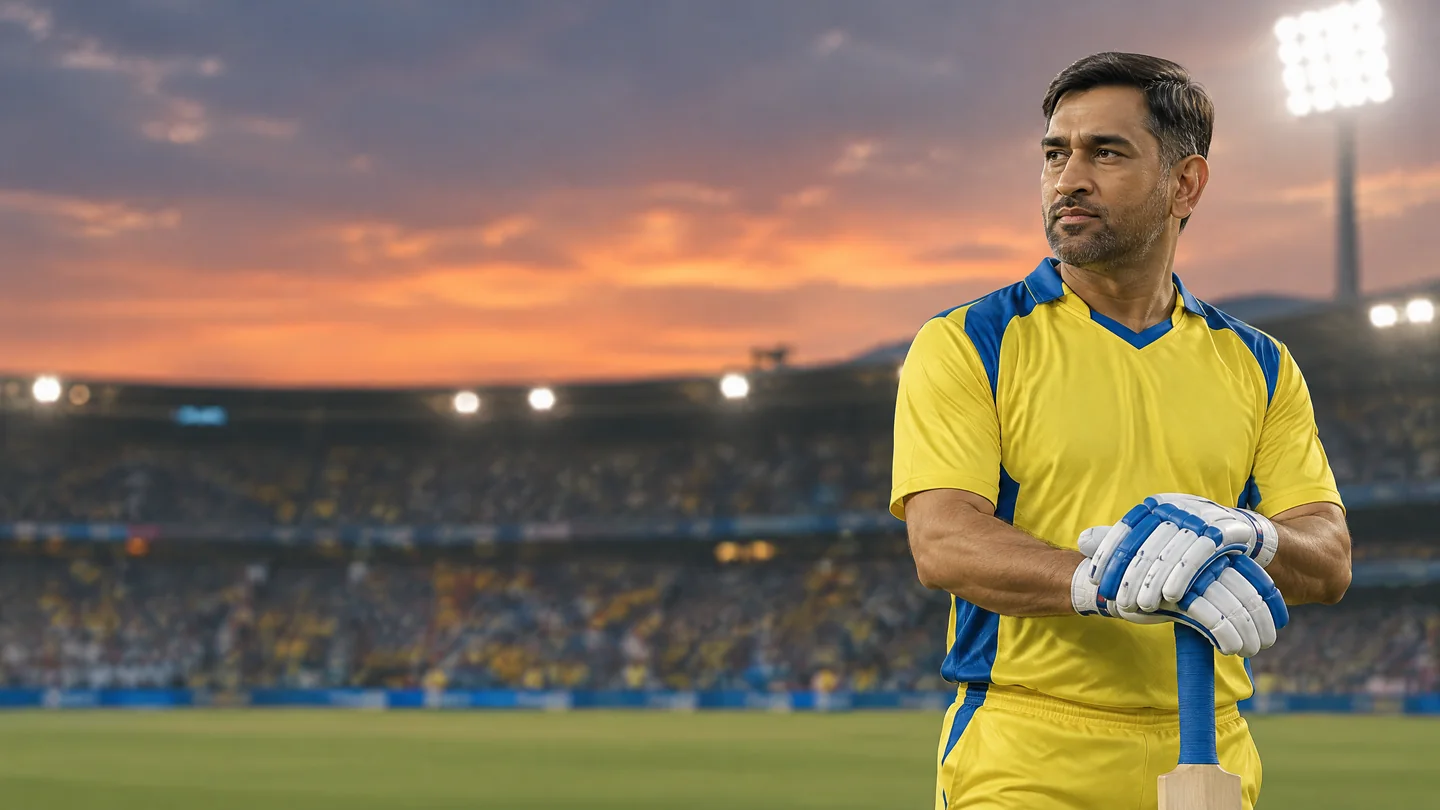
- Dhoni retired from international cricket on 15 August 2020; his final India appearance was the 2019 World Cup semi-final against New Zealand.
- As of 11 September 2026, Chennai Super Kings still listed him as a wicketkeeper in their 2026 squad, although injury kept him out of every IPL 2026 match.
- He is the only captain to have won the ICC Men's T20 World Cup, Cricket World Cup and Champions Trophy.
- His IPL franchises are Chennai Super Kings and Rising Pune Supergiant, the latter during CSK's 2016-17 suspension.
- Dhoni captained CSK to five IPL championships and two Champions League T20 titles, making the franchise relationship central to his post-international career.
- The ICC inducted him into its Hall of Fame in June 2025.
MS Dhoni's verified status in September 2026
As of 11 September 2026, Mahendra Singh Dhoni is retired from international cricket but has not publicly confirmed retirement from the Indian Premier League. Chennai Super Kings' official 2026 squad page continued to list him as a wicketkeeper. That roster status needs an important qualification: Dhoni did not play a match in IPL 2026 after a calf injury disrupted his preparation and recovery. No reliable official statement had committed him to playing in 2027, so any claim about another season would go beyond the verified record.
CSK announced on 28 March 2026 that Dhoni was undergoing rehabilitation for a calf strain and was likely to miss the opening two weeks. His absence eventually lasted the whole season. Team staff said he could bat and keep in training, but running at match intensity remained the obstacle. At the end of CSK's campaign, bowling coach Eric Simons said Dhoni would judge whether he was physically ready and decide in the team's interest. That was a description of an unresolved decision, not a retirement announcement or a promise to return.
His latest completed IPL season as a player therefore remains 2025. He returned to the CSK captaincy after Ruturaj Gaikwad was ruled out, and the side finished last, an outcome that belongs beside rather than beneath the five championships he had previously delivered. He still produced a sharp reminder of his finishing value, winning Player of the Match for an unbeaten 26 from 11 balls against Lucknow Super Giants. For readers assessing the present rather than the mythology, the distinction is clear: CSK retained him on the 2026 playing roster, but injury meant his last competitive appearance remained CSK's final league match of May 2025.
Dhoni has been an ICC Hall of Famer since June 2025 and an international retiree since 15 August 2020. Those two facts define his current place in cricket: his India career is closed and formally honoured, while his IPL future was still unannounced on the publication date. The uncertainty itself reflects his later career, in which availability has depended less on reputation than on whether his body can still meet the demands of wicketkeeping, sprinting between wickets and finishing innings.
Ranchi roots, school sport and the long route outward
Dhoni was born on 7 July 1981 in Ranchi, then part of Bihar and now the capital of Jharkhand. That geography matters to his story because Ranchi was outside the traditional centres that supplied most India players at the time. His rise broadened the imagination of where an elite Indian cricketer could come from. The later image of Dhoni as a self-contained problem-solver was built in a sporting environment where visibility had to be earned through school, club, state and representative cricket rather than assumed through proximity to a major metropolitan system.
He attended DAV Jawahar Vidya Mandir in Shyamali, Ranchi. School coach Keshav Ranjan Banerjee is publicly credited as an early mentor who helped direct him into cricket. Contemporary accounts of his school years describe a multi-sport background and, most famously, work as a football goalkeeper before wicketkeeping became his specialist cricket role. A documented inter-school final in 1997 showed that batting ambition was already developing: at 16, he opened for his school and made an unbeaten 213 in a 378-run stand.
The route was not a single leap from a school ground to India. Dhoni travelled regularly from Ranchi to Bokaro as a junior cricketer in 1997-98, later represented Bihar, and made his first-class debut in the 1999-2000 season. After Jharkhand became a state, he represented Jharkhand. He also worked as a railway ticket collector at Kharagpur before his cricket career became established. These details are relevant not as a sentimental detour but because they show the practical compromises behind a late-blooming international debut at 23.
Dhoni's education is most reliably described through his completed schooling at DAV Jawahar Vidya Mandir. Claims about degrees, marks or unfinished courses vary across popular retellings and are not necessary to understand his cricket. What can be said securely is that school sport gave him the athletic base for wicketkeeping, while the Bihar-Jharkhand pathway forced him to produce performances beyond a less fashionable domestic circuit. His career would later make that route visible to players from smaller Indian cities.
Domestic performance, India A and an imperfect international start
Dhoni's national breakthrough came through sustained domestic work and a decisive India A tour rather than one isolated trial. On the 2004 India A visit to Kenya, he scored 362 List A runs in six innings at an average of 72.40. The sequence included an unbeaten 119 against Pakistan A. Those runs mattered because they demonstrated that his power and wicketkeeping could transfer from eastern Indian domestic cricket to a higher representative level against strong second-string international opposition.
India handed him his one-day international debut against Bangladesh at Chattogram on 23 December 2004. The beginning was almost anti-climactic: he was run out for a duck. The selectors persisted, and in only his fifth ODI he was promoted to No. 3 against Pakistan at Visakhapatnam in April 2005. His 148 from 123 balls turned selection promise into a public statement, combining raw bat speed with the willingness to attack before bowlers could settle.
Later in 2005, he made an unbeaten 183 against Sri Lanka in Jaipur while chasing, a score that remains the highest individual ODI innings by a wicketkeeper. His Test debut followed against Sri Lanka in Chennai on 2 December 2005, and his Twenty20 international debut came against South Africa in Johannesburg on 1 December 2006. The sequence shows unusually fast expansion: within two years of a scoreless ODI debut, he was India's wicketkeeper across all three formats and one of the most destructive batters in the limited-overs side.
The value of the early centuries was larger than spectacle. India had often treated wicketkeepers primarily as glovemen who added runs; Dhoni made match-changing batting central to the position. His technique was visibly unconventional, but the outcomes were repeatable. He could attack the new ball when promoted, rebuild in the middle order and later control chases. That range, not merely the helicopter shot associated with him, made his place secure.
From explosive wicketkeeper to India's decision-maker
Dhoni reached No. 1 in the ICC men's ODI batting rankings in his 40th match, the fastest ascent to the top position recorded by the ICC. Yet his development was not a simple story of ever harder hitting. As bowlers adjusted, he became a middle-order manager who could absorb pressure, protect less experienced partners and leave himself a calculable target at the end. The approach sometimes made a chase look slow before it became decisive, but it turned game awareness into a batting skill.
In 2007, India chose the 26-year-old to lead a young squad at the inaugural ICC Men's T20 World Cup. India had exited the 50-over World Cup early that year and travelled without several senior names. Dhoni's side beat Pakistan in the final, making him a world champion in his first major assignment as captain. The victory gave India an early tactical vocabulary for Twenty20 cricket and made Dhoni the natural choice to take over the ODI leadership before eventually becoming Test captain.
His captaincy was built around reading players and situations rather than defending convention. That interpretation is supported by his own reflections: he said he learned humility, conduct in success and ways through difficult periods from the senior players around him. On the field, his choices could be startling, such as entrusting Joginder Sharma with the final over of the 2007 World Cup final or promoting himself in the 2011 final. The outcomes made those calls famous, but their deeper significance was his willingness to match responsibility with risk.
There were limits. India's Test record away from home deteriorated after the 2011 World Cup, including heavy series defeats in England and Australia, and his defensive spells as a red-ball captain drew criticism. Even so, India first reached No. 1 in the ICC Test rankings under him in December 2009 and remained there for roughly 18 months. A fair reading holds both truths: his methods were most naturally suited to limited-overs cricket, while his Test tenure still contained a historic rise to the summit.
The trophies, numbers and moments that define the record
Dhoni's central captaincy achievement is unique. He led India to the 2007 ICC Men's T20 World Cup, the 2011 ICC Cricket World Cup and the 2013 ICC Champions Trophy, making him the only captain to win all three ICC men's white-ball titles. The 2011 final at Mumbai carries the strongest image: promoted to No. 4 with India 114 for three, he added 109 with Gautam Gambhir, finished unbeaten on 91 and ended a 28-year World Cup wait with a six.
The numbers explain why the trophies cannot be separated from his individual value. Across 538 internationals for India, he scored 17,266 runs. His format totals were 4,876 Test runs, 10,773 ODI runs and 1,617 T20I runs. He played 350 ODIs, averaging 50.57 despite spending much of his career in the middle and lower order. The unbeaten 183 against Sri Lanka remains the highest ODI score by a wicketkeeper, and his 123 ODI stumpings remain a format record.
Behind the stumps, speed was only the visible part of his method. Dhoni often collected the ball with minimal backward movement and broke the wicket in one compact action. The technique was not textbook, yet it was exceptionally effective against spin and in run-out situations. Official career summaries credit him with 829 dismissals across his international appearances, while the ICC's standalone Hall of Fame page currently displays 839; the format-by-format figures published in the ICC's 2025 induction release total 829, so this profile uses the internally consistent official breakdown rather than repeating the discrepancy.
His Test career ended immediately after the drawn Melbourne Test on 30 December 2014, with the BCCI citing the strain of playing all formats. He relinquished India's ODI and T20I captaincy in January 2017 but continued as wicketkeeper. His final international appearance was the World Cup semi-final defeat by New Zealand on 10 July 2019, and he announced his international retirement on 15 August 2020. ICC Hall of Fame induction in 2025 then placed an official institutional seal on a career already central to modern Indian cricket.
A complete IPL career: Chennai, Pune and five titles
Chennai Super Kings bought Dhoni at the inaugural IPL auction in 2008, and he became the franchise's defining player. Under his captaincy, CSK won the IPL in 2010, 2011, 2018, 2021 and 2023, as well as the Champions League T20 in 2010 and 2014. By repeatedly reaching the knockout rounds and ten finals across their first 14 seasons, his teams made continuity, clearly assigned roles and calm under tournament pressure part of CSK's identity.
Dhoni has represented only two IPL franchises. He played for Chennai Super Kings from 2008 to 2015 and again from 2018 onward. When CSK were suspended for the 2016 and 2017 seasons, he joined the Pune franchise branded Rising Pune Supergiants in 2016 and Rising Pune Supergiant in 2017. He captained Pune in 2016, played under Steven Smith in 2017 and reached that season's final. Naming both versions matters because they were the same franchise under a one-word rebrand, not two additional teams.
The 2018 comeback was the emotional and sporting peak of his franchise career. Dhoni scored 455 runs at an average of 75.83 and a strike rate above 150 as returning CSK won the title. He later guided them to championships in 2021 and 2023, the latter after briefly handing the captaincy to Ravindra Jadeja in 2022 and taking it back mid-season. He stepped down again before IPL 2024, when Gaikwad became captain, then resumed leadership during IPL 2025 after Gaikwad's injury.
Through the end of IPL 2026, in which he played no matches, ESPNcricinfo's current record lists Dhoni with 278 IPL appearances and 5,439 runs at an average of 38.30, plus 158 catches and 47 stumpings. Those totals include CSK and Pune. Raw run volume tells only part of his IPL value: he generally batted late, kept wicket and made tactical decisions. His 2018 season shows how devastating the full package could be; the difficult 2025 team finish and injury-hit 2026 season show why current evaluation must not rely only on past titles.
The latest verified team position is therefore precise. CSK listed Dhoni among its 2026 wicketkeepers, and staff described him as a source of knowledge and calm around training, but he did not appear during the season. The club did not announce an IPL retirement, while neither Dhoni nor CSK guaranteed a 2027 playing return by 11 September 2026. For an evergreen profile, that is more accurate than treating roster membership as proof of future availability.
Leadership habits, public interests and an enduring legacy
Dhoni's public leadership language is consistently about process, observation and responsibility. In a 2014 interview, he described learning personal qualities from senior teammates almost subconsciously rather than collecting formal captaincy rules. In 2025, speaking to CSK's young players, he stressed consistency, reading the game, resisting pressure from expectations and continuing to learn. These comments support an interpretation of his calmness as disciplined attention, not an absence of competitive intensity.
Reliable public reporting also shows a preference for practical team standards over status. When he captained Jharkhand in the 2017 Vijay Hazare Trophy, he chose to travel with the squad by train and was quoted as saying the captain should travel with the team. The same report said his accommodation requirements were simply a clean room, clean bathroom and hygienic food. Such episodes should not be expanded into claims about his private life; they are useful because they illustrate the low-drama operating style teammates and coaches associate with him.
His interest in motorcycles is public and longstanding, but it is secondary to the cricket. More significant for the sport is what his career changed. He made a wicketkeeper's batting ceiling look much higher, normalised unorthodox but efficient glovework, and showed that a captain from outside India's traditional power centres could lead across formats. For later players from Jharkhand and other smaller cities, his route supplied a visible precedent rather than a guarantee.
Dhoni's legacy is not that every gamble worked or that every finish was successful. It is that he combined three demanding jobs—wicketkeeper, middle-order closer and captain—over an unusually long period while producing India's most complete collection of white-ball trophies. His 2025 Hall of Fame induction recognises the closed international chapter. His CSK association remains the live edge of the story, but as of 11 September 2026 its next playing chapter had not been written.
Reader guide
Mahendra Singh Dhoni questions, answered
Short answers to common reader questions based on the reporting above.
Is MS Dhoni retired from cricket?
Dhoni retired from Test cricket in December 2014 and from all international cricket on 15 August 2020. As of 11 September 2026, he had not announced retirement from the IPL. Chennai Super Kings still listed him in their 2026 squad, although injury kept him out of every match that season and his plans for 2027 remained unconfirmed.
Which IPL teams has MS Dhoni played for?
Dhoni has played for two IPL franchises: Chennai Super Kings and Rising Pune Supergiant. He represented Pune in 2016 and 2017 while CSK were suspended; the team used the plural name Rising Pune Supergiants in 2016 and the singular Rising Pune Supergiant in 2017. He returned to Chennai when CSK re-entered the league in 2018.
Did MS Dhoni play in IPL 2026?
No. CSK announced before the season that Dhoni was rehabilitating a calf strain. Although he later trained and remained on the squad list, the injury limited his running readiness and he did not appear in any IPL 2026 match. His latest competitive game therefore remained CSK's final league match of the 2025 season.
How many major ICC trophies did Dhoni win as captain?
Dhoni captained India to three senior ICC men's white-ball titles: the inaugural T20 World Cup in 2007, the Cricket World Cup in 2011 and the Champions Trophy in 2013. He remains the only captain to win all three competitions. India also reached No. 1 in the ICC Test rankings under his leadership in December 2009.
Where did MS Dhoni go to school?
Dhoni attended DAV Jawahar Vidya Mandir in Shyamali, Ranchi. School coach Keshav Ranjan Banerjee is credited as an important early mentor. Dhoni's school sports background included football goalkeeping before wicketkeeping became his cricket specialty, and in a 1997 inter-school final he made an unbeaten 213 as an opening batter.
What are MS Dhoni's most important cricket records?
Dhoni scored 10,773 ODI runs at an average of 50.57, made the highest men's ODI score by a wicketkeeper with 183 not out, and completed a record 123 ODI stumpings. He captained India in 332 internationals and became the fastest player to reach No. 1 in the ICC ODI batting rankings, doing so in his 40th match.
Sources and further reading
These references support the factual context used in this article. Links open the original publisher.
- MS Dhoni retires from international cricketBoard of Control for Cricket in India · accessed 2026-09-11
- MS Dhoni retires from Test cricketBoard of Control for Cricket in India · accessed 2026-09-11
- MS Dhoni: A captain, wicketkeeper and batter beyond numbersInternational Cricket Council · accessed 2026-09-11
- Mega induction sees seven new names added in ICC Hall Of FameInternational Cricket Council · accessed 2026-09-11
- MS Dhoni Hall of Fame profileInternational Cricket Council · accessed 2026-09-11
- MS Dhoni player profileESPNcricinfo · accessed 2026-09-11
- Official statement: MS Dhoni calf strainChennai Super Kings · accessed 2026-09-11
- Chennai Super Kings SquadChennai Super Kings · accessed 2026-09-11
- Gaikwad 'really proud' of CSK's performance in 'transition phase'ESPNcricinfo · accessed 2026-09-11
- India A tour of Kenya 2004ESPNcricinfo · accessed 2026-09-11
- When Dhoni hit his first double tonHindustan Times · accessed 2026-09-11
- MS Dhoni: One-time ticket collector, now a VVIP passengerThe Indian Express · accessed 2026-09-11
- Inside the mind of MS DhoniESPN · accessed 2026-09-11
- IPL 2025 M30: LSG vs CSK - Player of the Match - MS DhoniIndian Premier League · accessed 2026-09-11