IOM says Yemen displacement has topped 85,000 as more than 2,000 flee to Djibouti
IOM’s latest Yemen displacement update records 85,818 people displaced, including 82,164 this month, while more than 2,000 have reached Djibouti.
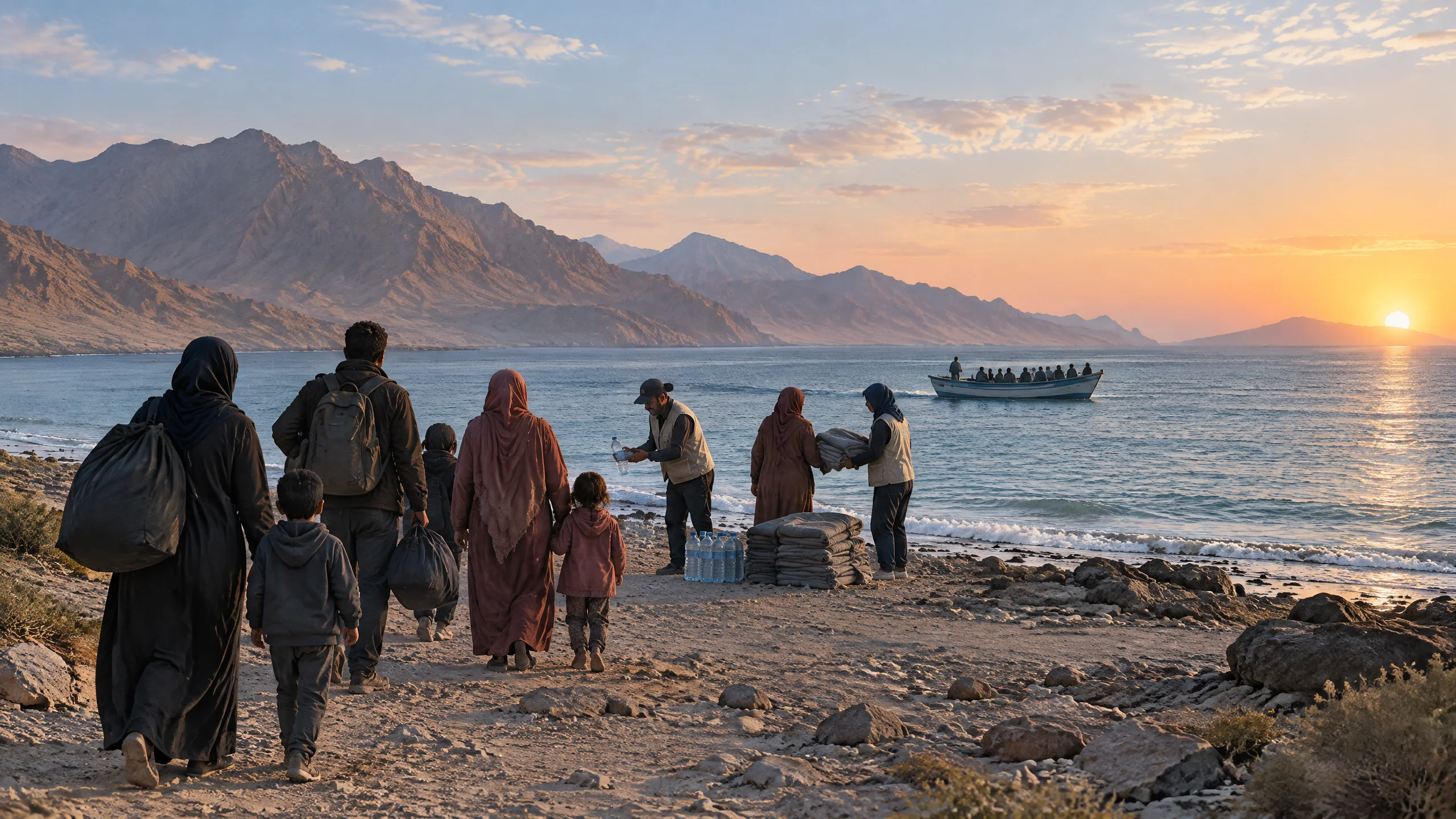
- IOM’s Displacement Tracking Matrix recorded 85,818 people displaced in Yemen, including 82,164 since the beginning of September.
- IOM said more than 2,000 people fleeing hostilities had reached Djibouti’s northern shore near Obock.
- The agency said fighting was escalating on Yemen’s West Coast and South Taiz frontlines, while inaccessible roads and disrupted communications were constraining access and assessment.
- IOM describes conditions as volatile and unpredictable, so the figures are current operational estimates rather than a final displacement count.
IOM records a sharp displacement update
The International Organization for Migration says 85,818 people have been displaced in Yemen, according to a new update from its Displacement Tracking Matrix. The agency said 82,164 of those people had been displaced since the beginning of September, placing the overwhelming share of the recorded movement within the current month.
The update, issued on 13 September, is a humanitarian assessment rather than a final accounting of a crisis that IOM says remains volatile and unpredictable. Its value is in documenting a current operational picture: people are moving at a scale that has passed 85,000 in the agency’s tracking, and the assessment points to a rapid acceleration during September.
The precise numbers should therefore be read with the attribution IOM gives them. They are figures recorded by the agency’s tracking system in a conflict environment, not an independently settled total for every person who may have left home or may yet need assistance. IOM says it will continue monitoring developments.
More than 2,000 people reach Djibouti
IOM also said more than 2,000 people fleeing hostilities had reached Djibouti’s northern shore near Obock. That movement across the water is an important part of the update because it shows the humanitarian impact is not confined to the locations where IOM is recording displacement inside Yemen.
The threshold is deliberately not a fixed total: IOM reported that more than 2,000 people had arrived near Obock. Associated Press reporting published through PBS NewsHour and an Al Jazeera report carrying AFP reporting independently described the same cross-border movement while attributing the figure to IOM.
The available reporting supports the fact of this reported arrival and its location near Obock. It does not establish how many more people may leave, how long those who arrived will remain there, or what the eventual scale of cross-border movement will be. Those questions depend on conditions that IOM itself says are changing quickly.
Where IOM says pressure is intensifying
In its update, IOM said fighting was escalating along Yemen’s West Coast and South Taiz frontlines. The agency linked that worsening environment to the displacement it was tracking, but its notice also makes clear that the conditions for gathering information are constrained.
IOM said inaccessible roads and disrupted communications were limiting access to affected people and making it harder to assess needs. That caveat matters as much as the headline figure. When roads cannot be reached and communications are interrupted, responders can face delays in confirming new movements, understanding what people need and identifying places that may be receiving new arrivals.
The report therefore separates a humanitarian finding from claims about battlefield events. IOM provides its operational assessment of displacement and access. Other reporting described active military claims on 13 September, but those claims require attribution and do not turn into independently verified conclusions about territorial control, casualties or the course of the fighting.
Why the September figure matters
The 82,164 people recorded as displaced since the start of September account for nearly all of IOM’s 85,818 total in this update. That comparison is a clear indication of how concentrated the recorded displacement has been over a short period. It is also why the agency’s continuing field monitoring and its access constraints deserve close attention alongside the headline number.
A displacement estimate is not simply a measure of movement. It is a warning that people may be leaving places where their needs can no longer be assessed easily and, in some cases, are reaching a new shore near Obock. IOM has not presented the update as a forecast, and the available evidence does not support projecting the number of future arrivals or people displaced.
For readers, the most reliable conclusion is narrower but significant: IOM’s current tracking has identified a large, recent movement of people inside Yemen and a reported cross-border arrival of more than 2,000 people in Djibouti. Both figures are humanitarian indicators that require ongoing verification as access conditions evolve.
Limits on what the numbers can show
IOM’s figures bring needed definition to an unfolding situation, but they do not remove uncertainty. The agency warns that the situation is volatile and unpredictable, and it specifically identifies inaccessible roads and disrupted communications as barriers to reaching people and assessing needs. In practice, those limitations mean the reported figures should be treated as a snapshot taken under difficult conditions.
The distinction is especially important in coverage of conflict. A current displacement total is not a final total, and an account of people arriving near Obock is not evidence of what will happen next. Nor do the figures resolve competing military accounts. Keeping those categories separate prevents an official humanitarian estimate from being stretched beyond what IOM has said.
That approach also preserves the practical meaning of the update. IOM’s Displacement Tracking Matrix is recording people who have been forced to move amid conditions that are hampering assessment. Its numbers are consequential precisely because they describe an immediate humanitarian problem while openly acknowledging the gaps that remain.
What to watch next
The next meaningful developments will be IOM’s subsequent tracking updates: whether the total recorded displacement rises, whether the number displaced since the beginning of September changes, and whether the agency can gain better access to affected people. Any revised figures should continue to be presented as IOM estimates and alongside the agency’s caveat about communications and road access.
It will also be important to watch for further IOM reporting on arrivals near Obock and on humanitarian needs that can be assessed there or in areas inside Yemen. The current update establishes that more than 2,000 people had reached Djibouti’s northern shore; it does not provide a basis for predicting the next phase of movement.
For now, the clearest verified picture is the one IOM has set out: 85,818 people recorded as displaced in Yemen, 82,164 of them since the start of September, and more than 2,000 people reported to have reached Djibouti near Obock. The operational limits around those figures are part of the story, not a reason to overlook their urgency.
Reader guide
Article questions, answered
Short answers to common reader questions based on the reporting above.
What displacement figure did IOM report for Yemen?
IOM’s Displacement Tracking Matrix recorded 85,818 people displaced in Yemen. IOM said 82,164 of those people had been displaced since the beginning of September. The agency describes the situation as volatile and says it will continue monitoring developments.
Where have people fleeing Yemen reached?
IOM said more than 2,000 people fleeing hostilities had reached Djibouti’s northern shore near Obock. The figure is an IOM operational estimate, not a projection of how many people may cross in the future.
Why could the displacement figures change?
IOM warned that inaccessible roads and disrupted communications are making it harder to reach people and assess needs. In a volatile and unpredictable situation, its displacement numbers are a current operational snapshot rather than a final count.
Sources and further reading
These references support the factual context used in this article. Links open the original publisher.
- Yemen Displacement Tops 85,000 as Conflict Continues, 2,000 Flee to DjiboutiInternational Organization for Migration · accessed 14 September 2026
- Fighting in Yemen intensifies, and Houthis launch more attacks on Saudi ArabiaAssociated Press via PBS NewsHour · accessed 14 September 2026
- More than 2,000 Yemenis flee to Djibouti as fighting intensifiesAl Jazeera/AFP · accessed 14 September 2026