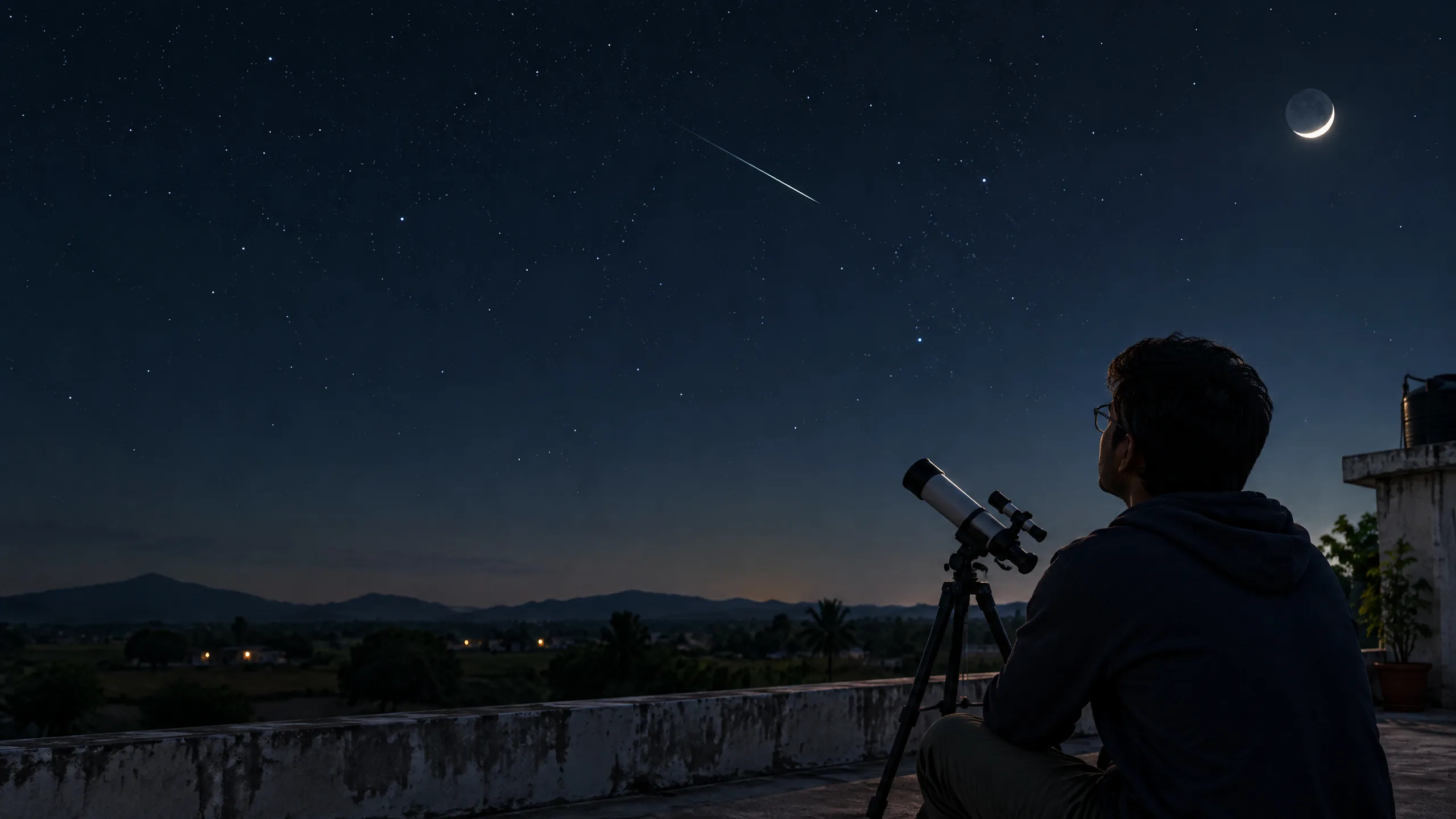
Saturn Reaches Opposition on October 4, 2026: India Time and How to See the Ringed Planet
Saturn is due to reach opposition on Sunday, 4 October 2026, at about 5:30 PM IST. From India, the practical viewing opportunity begins after sunset: look for the bright, steady planet rising in the east and climbing toward the southern sky through the night.
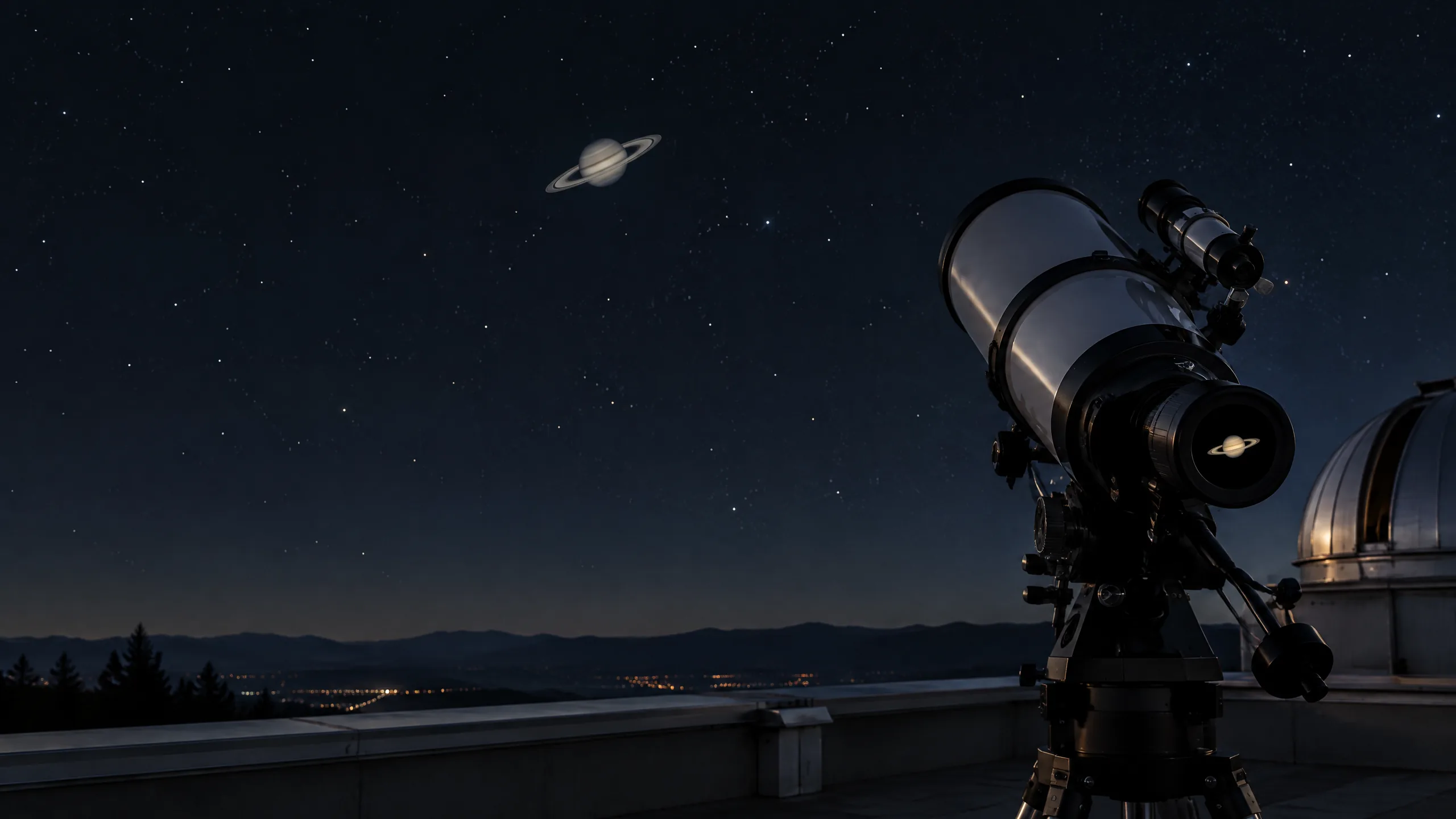
- Saturn is scheduled to reach opposition on Sunday, 4 October 2026; the calendar moment is about 5:30 PM IST (12:00 UTC).
- For observers in India, the useful viewing period is after local sunset, not the afternoon clock time of opposition.
- Around opposition, Saturn rises near sunset, is highest around local midnight and remains available until near sunrise, subject to a clear horizon and sky.
- Saturn can look like a steady, yellowish point to the unaided eye; its rings require a telescope and will appear relatively narrow this year.
- A planetarium app set to your location is the best way to confirm Saturn’s precise direction and altitude before going outside.
## Saturn opposition on 4 October 2026: the direct answer for India
**Saturn is scheduled to reach opposition on Sunday, 4 October 2026, at about 5:30 PM IST** (12:00 UTC). That clock time is before dark across India, so it is not the moment to expect a visible planet in a bright afternoon sky. The useful answer to ‘when can I see Saturn?’ is simpler: go out after your local sunset on 4 October, face generally east and give the sky time to darken. Saturn should then be available for much of the night, moving higher toward the south before midnight and heading west before dawn. NASA lists 4 October as Saturn’s 2026 opposition, while Royal Observatory Greenwich describes the event as a particularly favourable date to look for the planet. [1] [2]
The 5:30 PM IST figure is a conversion of the 12:00 UTC calendar time used in the supplied event slate and in EarthSky’s event listing. Precise ephemeris services can show a slightly different minute depending on their calculation and convention: In-The-Sky.org’s JPL DE440-based listing places the alignment at 12:21 UTC, or 5:51 PM IST. That 21-minute difference has no practical effect on an evening observing plan. The important fixed detail is the **4 October 2026** date, while darkness, local horizon and weather determine when an individual observer can actually see it. [3] [4]
This is an upcoming skywatching guide, not an observation report. It does not claim that Saturn has already been seen from a particular Indian city, and it cannot promise a clear view from every location.
## What ‘opposition’ means—and why it helps skywatchers
An outer planet is at opposition when Earth is positioned between the Sun and that planet. From Earth, Saturn therefore sits roughly opposite the Sun in the sky. The geometry explains the convenient schedule: as the Sun sets in the west, Saturn is near rising in the east; around local midnight Saturn is broadly at its highest; and it approaches setting around sunrise. Royal Observatory Greenwich says Saturn will rise around sunset, set around sunrise and be visible in the southern sky all night around this date. [2]
Opposition is also when an outer planet is near its closest annual approach to Earth, so its apparent disk is comparatively large and bright. EarthSky and In-The-Sky.org put Saturn near magnitude 0.3 at the 2026 opposition, a brightness that is within naked-eye range under suitable skies. ‘Bright’ should not be mistaken for ‘obvious everywhere’: city lights, haze, low altitude and a blocked eastern view can still make the first part of the evening difficult. [3] [4]
The annual event does not make Saturn suddenly enormous. It is a distant world, and the difference in apparent size across its observing season is modest. Opposition gives a generous all-night window and the best yearly geometry, rather than a short spectacle that must be watched at one exact minute.
## What time and direction should I look from India?
Start after **local sunset**, once twilight has faded enough for the brighter stars and planets to stand out. On 4 October, look low to mid-height in the **eastern** part of the sky first. As the evening advances, Saturn will climb. Its highest, generally clearest position will be around local midnight in the **southern** sky for much of India; it then shifts toward the west before morning. Exact rise time, altitude and compass bearing differ between Srinagar, Delhi, Mumbai, Kolkata, Chennai, Bengaluru and every other location, so do not use a single city’s timing as a national schedule. [2]
For a reliable finder, open a reputable planetarium app or web sky map, allow location access or enter your town, set the date to 4 October 2026 and look for Saturn. The app’s screen should be aligned with the real horizon and compass, not held flat. In-The-Sky.org identifies Saturn as being in Cetus at opposition and offers location-specific finder charts; that constellation is useful context, but an app is easier than trying to trace a faint constellation from a bright neighbourhood. [4]
Choose a place with an unobstructed east-to-south view: a terrace, open park or field can work if it is lawful and safe to use after dark. Avoid looking across hot rooftops, bright floodlights or a line of trees. Give your eyes several minutes away from phone glare, then compare the steady candidate with the app. Planets normally twinkle less than stars, though atmospheric shimmer near the horizon can blur that clue.
## Can Saturn be seen with the naked eye, binoculars or a telescope?
Yes—**Saturn can be seen without optical aid** around opposition if it is above the horizon and the sky is sufficiently transparent. To the naked eye it will still look like a bright, steady, star-like point; do not expect to see rings, cloud bands or moons. NASA notes that Saturn is the farthest planet from Earth discovered by the unaided human eye, a distinction that matches the practical experience of spotting it as a point of light. [5]
Binoculars may make Saturn appear more distinctly non-stellar or slightly oval when they are well supported, but they will not give a satisfying ring view. A small telescope is the appropriate tool for that. Start with a low-to-medium magnification, centre the planet and focus carefully. Increase magnification only while the image remains sharp: poor atmospheric steadiness, not the telescope’s advertised maximum power, is often the limit. Never point binoculars or a telescope near the Sun; all Saturn observing in this guide is for the darkening or night sky.
Expect the rings to look **relatively narrow in 2026**. In-The-Sky.org calculates that their tilt at this opposition is only about 7 degrees to our line of sight, so they are closer to edge-on than in years when their oval is wider. That is a useful expectation-setter, not a reason to skip the view: a crisp image of Saturn’s disk with a thin ring line can still be memorable. NASA explains that the planet’s conspicuous ring system is made of billions of icy and rocky pieces, even though a small telescope shows it as a delicate structure rather than individually resolved particles. [4] [5]
## A practical 4 October observing checklist
Before leaving home, check your local sunset time and use a planetarium app to preview Saturn’s path for your exact location. Charge your phone, but dim its screen or use a red-screen mode once you are outside. Take binoculars only if you can hold them steady or mount them; take a telescope only if you are familiar with its basic setup. A simple chair, a warm layer where needed, water and a non-glare torch can make a longer session more comfortable.
Arrive early enough to identify your horizon in daylight or twilight. Once the sky darkens, begin with the naked-eye search rather than sweeping randomly with a telescope. When you have confirmed Saturn with the app, observe it at several points during the night. The low eastern view may be affected by haze, while the later, higher view may be sharper. If you are sharing a telescope, let each person refocus gently rather than assuming one focus setting suits everyone.
The viewing window is not limited to one night. EarthSky says Saturn remains readily placed in the evening sky after the 4 October opposition and through the rest of 2026, gradually becoming an earlier-evening object. If cloud, family plans or a poor horizon defeat the first attempt, another clear evening close to the date can still be worthwhile. [3]
## Weather, light pollution and safety: what can change the view
A local forecast is **time-sensitive and conditional**, not a guarantee of visibility. For the evening of 4 October, a clear interval would improve the chance of seeing Saturn; cloud, rain, haze, smoke or humidity could prevent or soften the view. Check a trusted local forecast again on the afternoon and evening of the event rather than relying on an earlier prediction. This guide intentionally does not make a city-specific weather claim three days in advance.
Light pollution usually affects the number of faint stars you can see more than it affects Saturn itself, but a bright, unobstructed view is still preferable. Move away from direct lamps, let your eyes adapt and use a building or your hand to block glare without blocking the sky. If the planet is low, wait for it to climb rather than assuming it is absent. On an unsafe roof, roadside or restricted property, choose a safer public or private location instead of chasing a better horizon.
Do not use unfiltered solar equipment, and do not look for Saturn before sunset with binoculars or a telescope. The planet is not a reason to take risks near traffic, water, a roof edge or an unfamiliar dark area. A local astronomy club or public observing session can be a good alternative for first-time telescope users.
## Why Saturn is worth a look this October
Saturn is the solar system’s second-largest planet and the sixth from the Sun. NASA describes it as a giant made mostly of hydrogen and helium, with a ring system extending hundreds of thousands of kilometres from the planet even though the main rings are remarkably thin vertically. Those facts help explain why the telescopic view is so distinctive: the familiar rings are a vast, flat structure viewed from an enormous distance. [5]
The 4 October opposition is therefore a useful prompt to look up, not a promise of a rare one-minute show. It places the ringed planet in an observer-friendly position for an entire night and gives beginners a straightforward project: find the naked-eye point, confirm it with an app, then compare that view with binoculars or a telescope if available. For readers following other scheduled space coverage, see our guide to the [NASA-SpaceX Crew-13 launch time, crew and ISS docking plan](https://metalscommoditytrading.com/technology/nasa-spacex-crew-13-launch-time-astronauts-iss-docking/); it is a separate event with its own schedule.
Reader guide
Article questions, answered
Short answers to common reader questions based on the reporting above.
What is the Saturn opposition 2026 time in India?
The event slate converts 12:00 UTC on Sunday, 4 October 2026 to about 5:30 PM IST. In-The-Sky.org’s JPL DE440 calculation gives 12:21 UTC (5:51 PM IST), a small difference that does not affect the practical plan: watch after local sunset. [3] [4]
Can I see Saturn from India on 4 October without a telescope?
Yes, Saturn should be visible to the unaided eye as a steady, star-like point when it is above the horizon under a sufficiently clear sky. You will need a telescope to see the rings as a distinct feature. [3] [5]
Which direction should I face to see Saturn in India?
Look generally east after sunset. Saturn then climbs and is generally highest toward the southern sky around local midnight before moving toward the west before dawn. Use a location-enabled sky map for your city’s exact bearing and altitude. [2] [4]
What does Saturn opposition mean?
It means Earth is between the Sun and Saturn, putting Saturn opposite the Sun in the sky. That geometry lets Saturn rise near sunset, remain visible for much of the night and set around sunrise. [2]
Will Saturn’s rings be easy to see in 2026?
A small telescope can show Saturn’s ring structure, but the rings will appear relatively narrow because they are tilted only about 7 degrees to our line of sight at this opposition. Binoculars are not expected to provide a clear ring view. [3] [4]
What if it is cloudy on 4 October?
Cloud, haze or rain could block the view, and any local forecast should be treated as conditional and time-sensitive. The event is not confined to one minute: Saturn remains well placed in the evening sky after opposition, so try another clear night close to 4 October. [3]
Sources and further reading
These references support the factual context used in this article. Links open the original publisher.
- Most Notable 2026 Astronomical Events: A Year of Watching the SkiesSource · accessed 2026-10-01T13:25:00+05:30
- Space and astronomy highlights in 2026Source · accessed 2026-10-01T13:25:00+05:30
- Saturn at opposition – brightest for 2026 – on October 4Source · accessed 2026-10-01T13:25:00+05:30
- Saturn at oppositionSource · accessed 2026-10-01T13:25:00+05:30
- Saturn FactsSource · accessed 2026-10-01T13:25:00+05:30