Open Source India 2026: Bengaluru dates, NIMHANS venue, AI tracks and planning guide
Open Source India 2026 is scheduled for 7–8 October at NIMHANS Convention Center in Bengaluru. Here are the confirmed hours, Open Source + AI theme, six tracks, focus areas and official venue guidance.
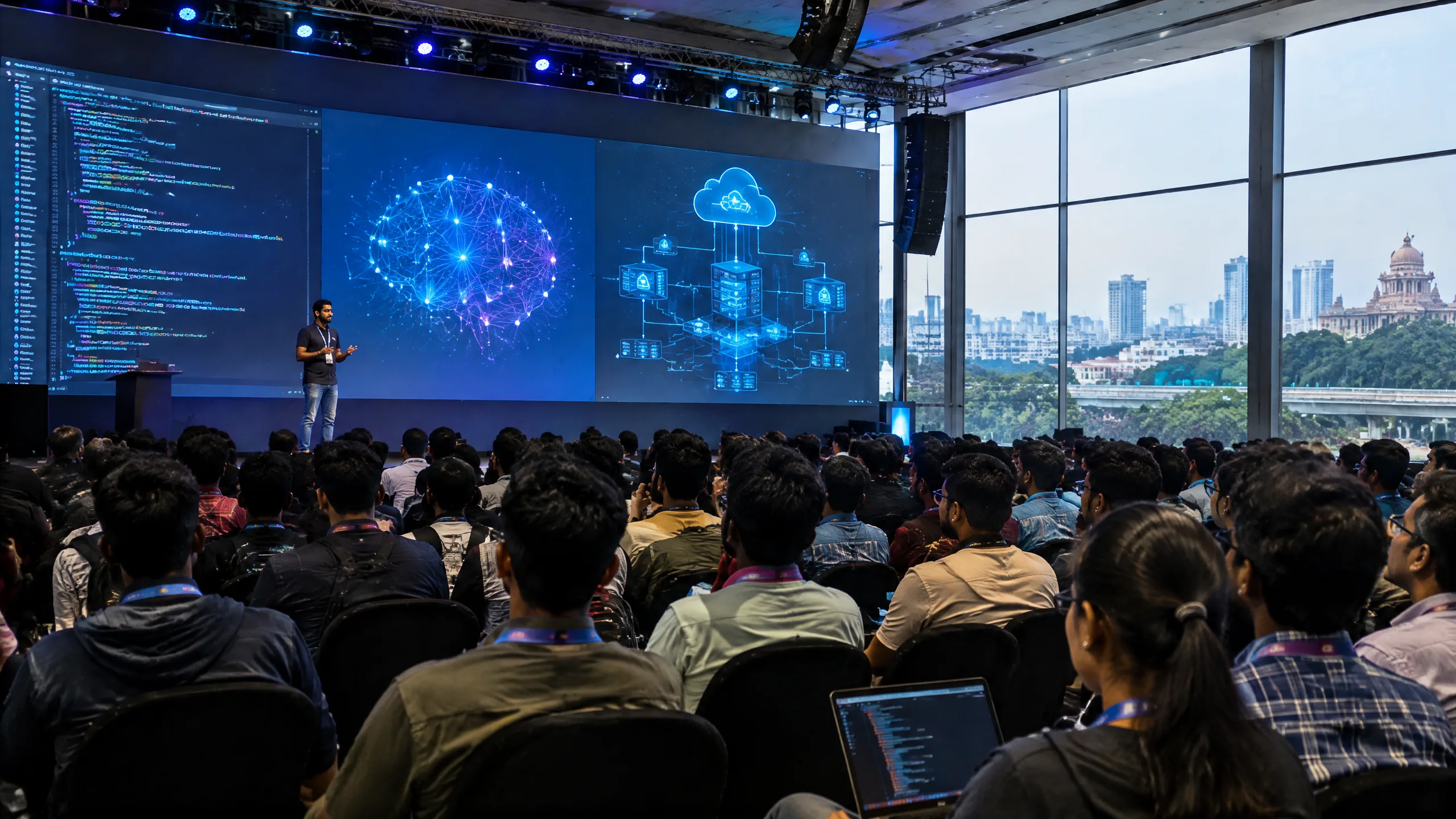
- Open Source India 2026 is scheduled for 7–8 October 2026 at NIMHANS Convention Center in Bengaluru.
- The organiser lists a daily event window of 9:30 AM–6 PM.
- The 2026 theme is “Open Source + AI: Build the Future of Intelligent Software.”
- The six listed tracks are FOSS for Everyone, Developer’s Meet, Data & Bases, DevOps, Open Source Hardware and AI & ML.
- Official focus areas include open models, GenAI apps, AI agents, RAG, LLMOps, cloud-native infrastructure, cybersecurity and open hardware.
- Check the official agenda and venue pages again before travel or registration decisions because operational details can change.
Open Source India 2026 at a glance
**Open Source India 2026** is scheduled for **7–8 October 2026** at the **NIMHANS Convention Center in Bengaluru**. The organiser’s event information lists the daily window as **9:30 AM–6 PM** and gives the theme as **“Open Source + AI: Build the Future of Intelligent Software.”** For a developer, engineering leader, student or open-source contributor trying to establish the practical basics quickly, those are the key confirmed answers: two days, Bengaluru, NIMHANS Convention Center, and a programme framed around the intersection of open technologies and artificial intelligence.
This is a planning guide based on the official Open Source India homepage, agenda page and venue page, checked on 2 October 2026. It deliberately separates published event information from anything not confirmed in those sources. In particular, it does not assume a particular speaker, session time, workshop place, pass price, travel availability or personal outcome from attending. The conference pages identify the overall theme, the six tracks and the topics the organisers say the event will cover; they should be the starting point for anyone deciding whether the event’s direction fits their work.
For people searching **Open Source India 2026 dates**, the concise answer is 7 and 8 October. For an **Open Source India Bengaluru venue** query, the answer is NIMHANS Convention Center. For the question of what the 2026 edition is about, the organiser’s wording is useful: it positions open source and AI together rather than treating AI as a separate add-on. That framing connects the conference’s stated interest in open models and GenAI applications with the infrastructure, data, operations, security and hardware work required to use them responsibly.
The event may be especially relevant to people who need a clearer picture of how open-source software choices connect to AI delivery in practice. The official site identifies developers, AI and ML engineers, DevOps and platform teams, cloud architects, data teams, cybersecurity professionals, founders, product leaders, technical decision-makers, contributors, students and community builders among the people it is built for. That is a broad audience, but the six-track structure gives attendees a way to focus their time rather than approach the two days as one undifferentiated technology event.
Confirmed dates, hours and Bengaluru location
The confirmed Open Source India 2026 dates are **Wednesday, 7 October, and Thursday, 8 October 2026**. The official site’s contact information lists the event at NIMHANS Convention Center, Bengaluru, from **9:30 AM to 6 PM**. Treat that published time range as the practical daily planning window, rather than as a guarantee that every individual activity will begin or end at the same time. People arranging work, travel or meetings around the conference should recheck the organiser’s current information shortly before leaving, particularly if a change is announced.
The venue page calls the site **NIMHANS Convention Centre, Bangalore**, while the event homepage and contact block use Bengaluru. They refer to the same official venue description in the organiser’s material. To avoid confusion in map searches, use the full venue name, NIMHANS Convention Centre or NIMHANS Convention Center, together with Bengaluru. It is sensible to allow time for arrival, security procedures and navigating a large conference venue; however, this guide does not state a gate-opening time because the cited pages do not establish one.
The official venue guidance offers several public-transport starting points. From the airport, it suggests KIA-5 or KIA-14 to Shanthi Nagar bus stand, followed by an auto or app-based cab to the convention centre. From KSR Bengaluru City Junction, the page describes either buses from Majestic towards Shanthi Nagar or Wilson Garden, or the Green Line metro from Majestic to Lalbagh followed by an auto or cab. It describes Lalbagh as the closest metro station and says it is about 4 km from the venue. These are organiser-provided orientation notes, not a live transport service guarantee, so route, traffic and operating information should be checked on the day.
For city-bus users, the venue page points visitors towards Shanthi Nagar bus stand or Wilson Garden bus stop, with direct buses to both from Majestic. That practical detail can make the **Open Source India 2026 Bengaluru** trip less opaque for an out-of-town attendee, but it should not replace a current map or local transit check. The useful planning principle is simple: save the venue name, work back from the 9:30 AM published start window, and leave a buffer rather than build a schedule around a last-minute connection.
What “Open Source + AI” means for this edition
The theme, **“Open Source + AI: Build the Future of Intelligent Software,”** is the clearest guide to Open Source India 2026’s editorial centre of gravity. The official homepage says AI is becoming part of products, platforms and workflows, and that much of this change is powered by open-source models, frameworks, databases, infrastructure and communities. That makes the event relevant not only to people training or using language models, but also to those maintaining the software foundations around them.
The stated programme focus includes open models, GenAI apps, AI agents, retrieval-augmented generation (RAG), LLMOps, DevOps, cloud-native infrastructure, databases, cybersecurity and open hardware. Those terms point to a full lifecycle rather than a single tool. An organisation may experiment with an open model, for example, but still need data management, evaluation, deployment, observability, security, licensing and infrastructure skills before it can rely on an AI-enabled application. The official focus list makes room for those connected decisions.
For readers asking about **Open Source India 2026 AI tracks**, it is helpful not to reduce the event to a generic AI conference. The published approach includes AI and ML, but it also explicitly covers DevOps, data and bases, open-source hardware and a general FOSS track. That breadth matters for people whose daily work is not labelled “AI” but who increasingly support model-serving infrastructure, protect software supply chains, operate databases, build embedded products or contribute to reusable open tools.
The site also identifies practical subject areas within the focus: open-source LLMs, smaller language models and multimodal models; RAG, vector databases and knowledge graphs; deployment, evaluation and observability; AI coding tools; security, governance, privacy and licensing; data platforms; Kubernetes and cloud-native infrastructure; edge AI; embedded systems; and real-world product or enterprise deployment. These are official areas of coverage, not promises that every subtopic will appear in a particular room or at a particular hour. Readers should use the agenda page for the latest published scheduling information.
The six Open Source India 2026 tracks
Open Source India lists **six conference tracks across two days**: **FOSS for Everyone, Developer’s Meet, Data & Bases, DevOps, Open Source Hardware, and AI & ML**. The track names are a helpful first filter for anyone trying to decide where their goals fit. They also reflect a people-first reality of open source: useful technology work does not occur only in one role or one programming discipline. Communities, maintainers, students, application developers, operators, data specialists and hardware builders all face different questions.
**FOSS for Everyone** is the broadest of the published names. It is the likely starting point for people who want a wider conversation about free and open-source software, communities, adoption or access. It should not be read as an assurance of a specific session, certification or beginner class; the official information confirms the track but does not make such promises. Someone new to the event can use the track as an organising label and check the agenda for current detail before making a personal schedule.
**Developer’s Meet** speaks directly to people building software and tools. The organiser’s larger focus on AI coding tools and developer productivity makes this track relevant to developers who want to examine how AI changes everyday creation, review and maintenance work without losing sight of open-source practices. The confirmed information does not say which language, framework or development environment will dominate, so attendees should avoid assuming a technology-specific programme before checking the official agenda.
**Data & Bases** aligns naturally with the published attention to modern database stacks, open data platforms, vector databases and knowledge graphs. Data practitioners can use it as a signal that the conference acknowledges the data layer beneath AI applications and general software systems. The track’s name is intentionally broad: it does not confirm a product comparison, a particular database workshop or a recommendation to adopt any one platform.
**DevOps** links the conference to the operational side of software delivery. The event’s stated focus on cloud-native infrastructure, Kubernetes, LLMOps, deployment, evaluation and observability helps explain why this track sits beside AI and data. For platform engineers and operations teams, it offers a route into questions that are often essential to AI use but are not model training itself: repeatable deployment, safe change management, monitoring and resilient infrastructure. The source material establishes these as focus areas, not a published run sheet for a named session.
**Open Source Hardware** broadens the scope beyond code. The official list includes edge AI, embedded systems and open-source hardware, recognising that intelligent software can depend on devices, sensors and compute close to where data is created. Finally, **AI & ML** brings the model and machine-learning dimension into direct view, alongside open models, GenAI apps, agents, RAG and LLMOps. The practical takeaway is not that attendees must choose a single identity. A developer working on an AI product may find relevant questions across Developer’s Meet, Data & Bases, DevOps and AI & ML.
How to plan a useful two-day visit without over-assuming the programme
A good Open Source India 2026 plan starts with a specific question rather than a vague intention to “learn AI.” A developer might ask how open models fit into an application they already maintain. A platform engineer might focus on LLMOps, cloud-native deployment and observability. A data practitioner might concentrate on RAG, vector databases, knowledge graphs or data-platform choices. A security professional may want to track governance, privacy, licensing and cybersecurity. An embedded or hardware builder may look for the edge AI and open-hardware thread. The official focus list supports these questions without requiring a visitor to assume any unannounced programme details.
Next, use the track names to create a flexible shortlist. Put the one or two tracks closest to your current responsibilities first, but keep adjacent tracks available. This is especially useful when an issue crosses organisational boundaries. An AI agent project, for example, can raise application-design questions, data-access questions, operational questions and security questions at the same time. The event’s published structure is valuable because it reflects that overlap rather than treating AI adoption as the concern of one isolated team.
The official homepage says workshops and masterclasses are intended as smaller, hands-on formats and that registrants will receive a reservation link as individual offerings are announced. It also says these formats are usually limited to 20 seats per session. That is a reason to follow official communications if hands-on learning is central to your visit, not a guarantee of a particular workshop, topic or place. This guide does not list workshop content, availability or prices because those details should be confirmed through the organiser’s current information.
Finally, define what you want to take back. For an individual contributor, it might be a clearer learning path or a project idea. For a team lead, it could be a set of questions about model selection, evaluation or operational ownership. For a founder or technical decision-maker, it might be a more realistic view of the work between an AI prototype and a dependable product. These are planning outcomes, not event claims. They make the published Open Source + AI theme concrete while keeping expectations grounded in the information actually available.
What is confirmed, and what attendees should check themselves
The verified core of this guide is narrow by design. Open Source India 2026 is scheduled for 7–8 October at NIMHANS Convention Center in Bengaluru, with the organiser listing 9:30 AM–6 PM. The theme is “Open Source + AI: Build the Future of Intelligent Software.” The six tracks are FOSS for Everyone, Developer’s Meet, Data & Bases, DevOps, Open Source Hardware and AI & ML. The official site also sets out its AI, data, operations, security and hardware focus areas. Those are the facts readers can rely on from the cited pages as checked on 2 October.
By contrast, this article does not present speakers, ticket prices, seating, food, hotel recommendations, access rules, session-by-session selections, networking formats, recordings or commercial terms as confirmed. People may encounter those claims elsewhere, but they need their own current official evidence. The same discipline applies to a detailed personal itinerary: a calendar or agenda can change, so do not treat an older graphic, a reposted schedule or a third-party listing as a final operational notice.
The official agenda page is the best source to check before the event for the programme that has been published. The homepage is the primary starting point for the theme, tracks and overall focus. The venue page is the practical source for official directions and transit suggestions. If a detail materially affects a trip or a registration decision, confirm it directly with the organisers rather than relying on an article summary, including this one.
That source hierarchy helps readers get a useful answer quickly while retaining control over important decisions. It is also a better way to evaluate an event in a fast-moving area such as open-source AI. Attractive phrases such as agents, RAG, open models and LLMOps only become useful when they connect to a person’s actual work, constraints, responsibilities and learning needs. Open Source India 2026’s published framing gives attendees a structured place to begin that evaluation.
Source and verification notes
This article was checked on **2 October 2026**, five days before the first day of the event. The official Open Source India homepage is the primary source for the dates, venue, daily time window, theme, audience, six tracks and programme-focus descriptions. The official agenda page is used to confirm the 2026 agenda context and track names. The official venue page is used for the NIMHANS Convention Centre naming and the travel guidance from the airport, railway station, metro and bus connections.
The source list below preserves the direct official URLs so a reader can check the latest information. No FAQPage structured-data markup is associated with this draft; the FAQ entries are intended as visible reader help only. The draft uses an Event and Place as topical entities for article metadata and does not represent a booking offer, ticket inventory or a formal registration action.
Reader guide
Article questions, answered
Short answers to common reader questions based on the reporting above.
When is Open Source India 2026?
Open Source India 2026 is scheduled for 7–8 October 2026. This guide was checked on 2 October 2026.
Where is Open Source India 2026 being held?
The official site lists NIMHANS Convention Center in Bengaluru as the venue. The venue page also uses the spelling NIMHANS Convention Centre, Bangalore.
What are the Open Source India 2026 hours?
The organiser’s event information lists 9:30 AM–6 PM. Recheck the official site before travel for any update.
What is the theme of Open Source India 2026?
The theme is “Open Source + AI: Build the Future of Intelligent Software.”
What tracks are listed for Open Source India 2026?
The official site lists FOSS for Everyone, Developer’s Meet, Data & Bases, DevOps, Open Source Hardware and AI & ML.
Which AI and open-source topics will Open Source India 2026 focus on?
The published focus includes open models, GenAI applications, AI agents, RAG, LLMOps, cloud-native infrastructure, cybersecurity, databases and open hardware, among other connected topics.
How can I reach NIMHANS Convention Center for Open Source India 2026?
The official venue page gives airport bus, rail, metro and city-bus suggestions. It identifies Lalbagh on the Green Line as the closest metro station and recommends checking current routing before travel.
Sources and further reading
These references support the factual context used in this article. Links open the original publisher.
- Open Source India 2026Open Source India · accessed 2026-10-02
- Agenda 2026Open Source India · accessed 2026-10-02
- Venue: NIMHANS Convention CentreOpen Source India · accessed 2026-10-02