What is the Fair Play Award in IPL? Meaning, Points, Rules and Winners
Understand the IPL Fair Play Award, the 4+2+2+2 points framework, bonus entries, winners history, dated 2026 standings and what KKR’s actual figures show.
- The IPL began in 2008; 2004–2007 had no IPL Fair Play Award.
- The familiar allocation is 4+2+2+2; separately reported bonus entries require care.
- Punjab Kings won in 2026; CSK won their seventh award in 2025.
- KKR is not bottom of the checked 2026 table; the publisher lists them fourth.
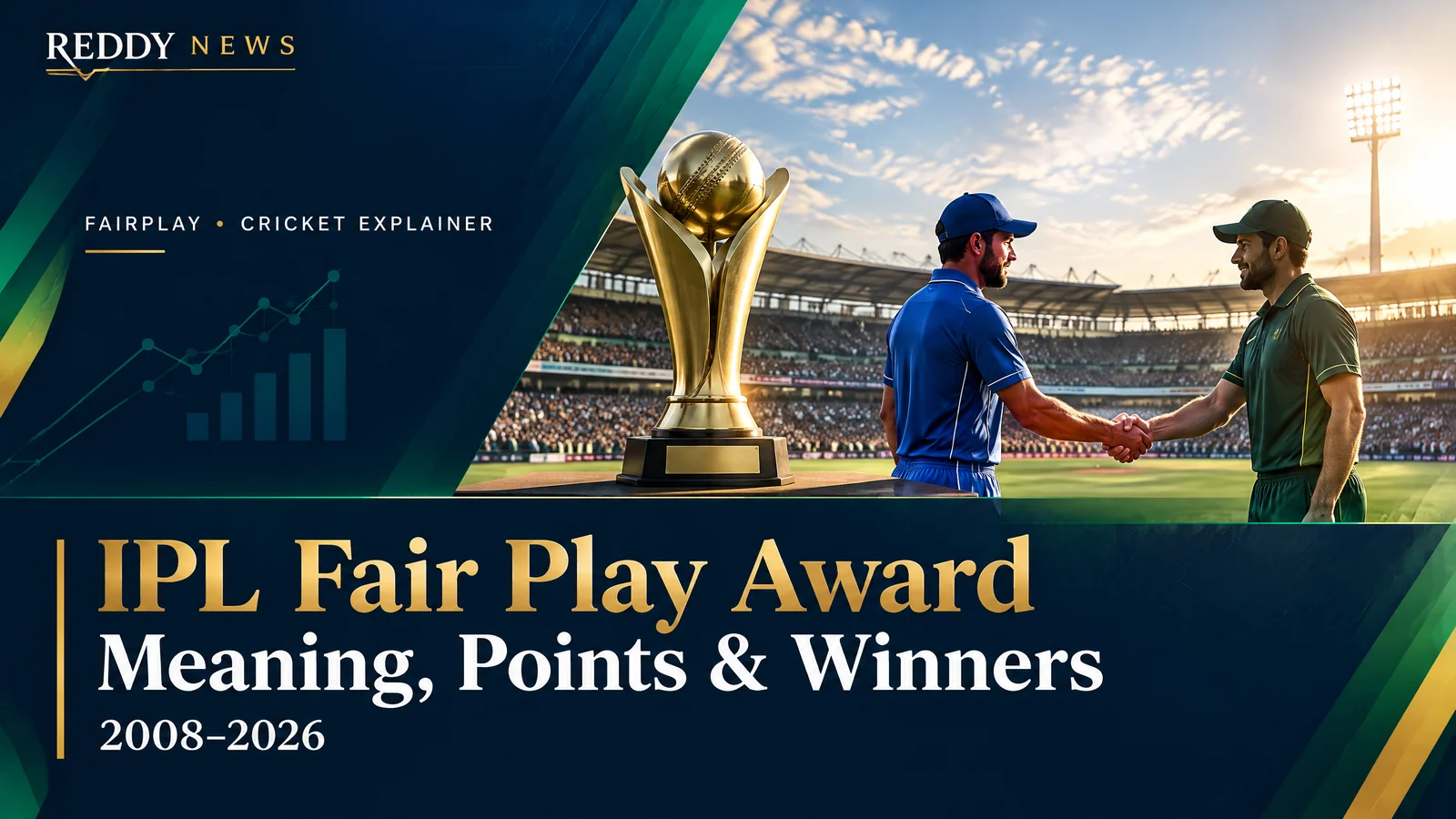
The IPL Fair Play Award recognises a team's sportsmanship across a season. Match officials assess the spirit of the game and respect for opponents, cricket's laws and umpires. The familiar base allocation is 4 + 2 + 2 + 2 = 10 points. Published standings also contain bonus-point entries, so ten should not be presented as an absolute ceiling for every recorded score.
Updated: 8 October 2026. Punjab Kings are the 2026 winners, confirmed by the official IPL homepage. This guide explains the rules, covers the historical period from 2004 onward, and separates a dated published points table from an actual live feed. It also answers a frequently repeated question: why is KKR at the bottom? The available 2026 table does not support that premise.
What is fair play in cricket, and how does it work?
Fair play means competing within the Laws and the Spirit of Cricket. A bowler can attack a batter's technique; a captain can set an aggressive field; a team can celebrate an important wicket. None of those actions automatically conflicts with fair play. The distinction is how players behave toward other people and the game's rules while trying to win.
The MCC's Spirit of Cricket preamble makes respect central. It asks players to respect teammates, opponents and the authority of umpires, accept decisions, show self-discipline when events go against them, and thank officials and opponents whatever the result. Captains carry the major responsibility, but the responsibility extends beyond them.
Consider a close run-out. The fielding captain may request a permitted review or ask an appropriate question. A lawful review does not itself demonstrate disrespect. Persistent hostile conduct after a decision is a different matter. That distinction is useful because short clips often erase the surrounding conversation and procedural context.
In the IPL, the award turns these broad expectations into a season-long assessment. It does not replace the match result. A team can lose a game while earning a strong conduct score, and a winning team can receive a lower score. Read Fairplay cricket analysis for match-performance analysis; conduct ratings answer a separate question.
What is the Fair Play Award in IPL?
The Fair Play Award is the IPL's team sportsmanship honour, introduced with the tournament in 2008. It rewards sustained conduct rather than runs, wickets, net run rate or the number of victories. The two on-field umpires and the third umpire assess both teams after a match, according to published scoring explanations.
This is a team award, not an individual batting or bowling award. Its season table must therefore be read independently of the league points table. Punjab Kings' 2026 award and the tournament championship are separate results. One does not establish the other.
There is also a language distinction. Fairplay is the name of this website's editorial category. Fair Play Award is the IPL sportsmanship award being explained here. The category label does not make its articles an official IPL announcement. Clear naming helps readers find the right information without mixing an award, a general cricket principle and a page label.
How is the Fair Play Award calculated in IPL?
The widely published base framework gives four points to the spirit of the game and two points each to respect for opponents, the Laws of Cricket and umpires. Match officials judge the conduct. Runs and wickets do not generate Fair Play points, and winning the toss has no role in the calculation.
On mobile, scroll sideways to view the full table.
| Assessment area | Base allocation | What the assessment concerns |
|---|---|---|
| Spirit of the game | 4 | The overall manner of competing and maintaining sporting conduct |
| Respect for opponents | 2 | Behaviour toward the other team, including restraint during confrontation |
| Respect for cricket's laws | 2 | Conduct within the rules and accepted match procedures |
| Respect for umpires | 2 | Behaviour toward officials and their authority |
| Base total | 10 | The sum of the four allocations before any separately recorded bonus |
These are assessment categories, not a public menu of fixed incident penalties. Do not turn an individual fine into an automatic deduction unless an authoritative scoring record actually makes that connection. A match report can establish that an incident happened; it may still not establish which Fair Play category changed or how much was deducted.
Published explanations describe two points as good, one as average and zero as poor for the three two-point respect criteria. The four-point spirit category must not be squeezed into that same two-point scale. Nor does a total of five mean that five points were awarded for the spirit of the game.
On mobile, scroll sideways to view the full table.
| Score or expression | Correct interpretation | Common mistake to avoid |
|---|---|---|
| 4 for spirit | The standard published spirit allocation | Calling it four league-table points |
| 2 in a respect category | A good assessment in that category | Assuming it means two wins |
| 1 in a respect category | An average assessment in that category | Treating it as a one-run penalty |
| 0 in a respect category | A poor assessment in that category | Inventing an incident without evidence |
| 5 as a match total | A combined score across the categories in an example | Describing five as the standard spirit allocation |
| BP in a published table | A separately displayed bonus-point field | Assuming every ten-point score is a hard maximum |
Worked examples: ten points, eight points and five points
The following examples are illustrative calculations, not ratings from a real match. Start by adding the four category entries. Then, if the source actually includes a bonus entry, keep it visible as a separate field rather than hiding it in another category.
On mobile, scroll sideways to view the full table.
| Illustrative team | Spirit | Opponents | Laws | Umpires | Bonus | Match total |
|---|---|---|---|---|---|---|
| Team A | 4 | 2 | 2 | 2 | 0 | 10 |
| Team B | 4 | 2 | 1 | 1 | 0 | 8 |
| Team C | 3 | 1 | 1 | 0 | 0 | 5 |
| Team D, bonus illustration only | 4 | 2 | 2 | 2 | 2 | 12 |
Team B's calculation is 4 + 2 + 1 + 1 = 8. Team C's is 3 + 1 + 1 + 0 = 5. Those examples teach addition; they do not imply a universal published schedule that assigns exactly those totals to a named incident. The last row demonstrates how an explicitly recorded bonus would affect a total, not when officials must grant a bonus.
Why include this qualification? Some explainers say ten is the maximum, yet their own historical tables show averages above ten. A 17 April 2025 Sporting News snapshot listed CSK with 74 points in seven matches. That is 10.57 per match. Meanwhile, myKhel's 2026 match breakdown explicitly includes a BP column. The careful description is a ten-point base framework with separately reported extras where present, not an invented explanation of every extra point.
Total points versus average: how to read the Fair Play points table
Use the arithmetic average = recorded Fair Play points ÷ rated matches. Keep the denominator attached to its source. Matches played in the competition, matches completed and matches carrying award ratings are not automatically interchangeable, especially when weather interruptions or different stages are involved.
Here is another hypothetical comparison. Team A records 140 points across 14 rated matches: 10.00 per match. Team B records 157 across 16: 9.81. Team B has the larger total, but Team A has the larger average. Raw totals alone can reward a team merely for having more rated opportunities.
That is why the average is essential when reading standings across teams with different match counts. A News18 scoring explanation discusses averaging in this context. Use the organiser's declared award result to identify the winner rather than selecting one from an incomplete third-party ledger.
Equal displayed averages do not prove an official tie. Rounding can conceal differences, and an official ordering rule may involve information not shown in a summary. Do not create a tie-break formula from league net run rate. Net run rate measures match performance; it is not the Fair Play average.
IPL Fair Play history from 2004 to 2014: why the first four years are blank
There was no IPL Fair Play Award in 2004, 2005, 2006 or 2007 because the IPL had not begun. Cricket's broader sporting principles existed before the tournament, but they should not be mislabelled as an IPL award. The first IPL season was 2008, when Chennai Super Kings won the inaugural Fair Play honour.
On mobile, scroll sideways to view the full table.
| Year | IPL Fair Play Award result | Historical context |
|---|---|---|
| 2004 | Not applicable | No IPL season |
| 2005 | Not applicable | No IPL season |
| 2006 | Not applicable | No IPL season |
| 2007 | Not applicable | No IPL season |
| 2008 | Chennai Super Kings | Inaugural IPL Fair Play winners |
| 2009 | Kings XI Punjab | The franchise is now called Punjab Kings |
| 2010 | Chennai Super Kings | Second award for CSK |
| 2011 | Chennai Super Kings | Consecutive award after 2010 |
| 2012 | Rajasthan Royals | First award for Rajasthan |
| 2013 | Chennai Super Kings | Start of CSK's 2013–2015 sequence |
| 2014 | Chennai Super Kings | Second year in that three-season sequence |
The winners in these historical tables are cross-checked against CricTracker's season list and the historical awards compilation. Names retain their period meaning: Kings XI Punjab and Punjab Kings identify the same franchise across a rename, while Gujarat Lions and Gujarat Titans must not be merged.
IPL Fair Play Award winners from 2015 to 2026
This table covers every completed season from 2015 through the latest completed IPL season available on 8 October 2026. It is a winners history, not a fabricated table of season points. An award result can be verified even when a complete category-by-category historical scoring ledger is unavailable.
On mobile, scroll sideways to view the full table.
| Season | Fair Play Award winner | Useful historical distinction |
|---|---|---|
| 2015 | Chennai Super Kings | Completed the 2013, 2014 and 2015 consecutive-award sequence |
| 2016 | Sunrisers Hyderabad | First Fair Play award for SRH |
| 2017 | Gujarat Lions | Gujarat Lions, not Gujarat Titans |
| 2018 | Mumbai Indians | First Fair Play award for MI |
| 2019 | Sunrisers Hyderabad | Second award for SRH |
| 2020 | Mumbai Indians | Second award for MI |
| 2021 | Rajasthan Royals | Second award for Rajasthan |
| 2022 | Rajasthan Royals and Gujarat Titans | Shared award; two winner credits for one season |
| 2023 | Delhi Capitals | First award for Delhi |
| 2024 | Sunrisers Hyderabad | Third award for SRH |
| 2025 | Chennai Super Kings | Seventh award for CSK |
| 2026 | Punjab Kings | Winner confirmed by the official IPL homepage |
The recurring four-category explanation is documented in the sources read for this guide. That does not prove that every administrative detail, bonus rule or tie-break instruction remained unchanged throughout 2015–2026. No verified annual rule-change ledger was located, so this article does not invent one.
IPL 2026 Fair Play points table: a dated published snapshot
Punjab Kings' 2026 award is confirmed on the official IPL homepage. The detailed table below is a separate, attributed snapshot from CricTracker, labelled updated 31 May 2026 after RCB versus GT, checked for this article on 8 October. It is not an official API stream and is not presented as an independently audited match-by-match final ledger.
On mobile, scroll sideways to view the full table.
| Source-listed order | Team | Source-listed matches | Points | Average, recalculated |
|---|---|---|---|---|
| 1 | Punjab Kings | 14 | 140 | 10.00 |
| 2 | Gujarat Titans | 17 | 169 | 9.94 |
| 3 | Chennai Super Kings | 14 | 138 | 9.86 |
| 4 | Kolkata Knight Riders | 14 | 138 | 9.86 |
| 5 | Lucknow Super Giants | 14 | 138 | 9.86 |
| 6 | Rajasthan Royals | 16 | 157 | 9.81 |
| 7 | Sunrisers Hyderabad | 15 | 145 | 9.67 |
| 8 | Mumbai Indians | 14 | 135 | 9.64 |
| 9 | Royal Challengers Bengaluru | 16 | 150 | 9.38 |
| 10 | Delhi Capitals | 14 | 130 | 9.29 |
The averages above are points divided by the source-listed matches, rounded to two decimal places. CricTracker prints CSK's average as 9.85, but 138 ÷ 14 rounds to 9.86. Its displayed order is preserved rather than claiming a new official tie-break. Some teams' listed match counts also should not be assumed to equal every fixture they played.
Other publishers can show a different stage of the season. myKhel's retrieved page, for example, lists Gujarat at 157 from 16 and Bengaluru at 142 from 15. Combining those rows with CricTracker's later-labelled figures would create a mixed-date table. This is why a points table needs its publisher, update date and match coverage, even when its headline says the same year.
Why is KKR at the bottom of the IPL Fair Play table?
KKR is not at the bottom of the 2026 table reproduced above. CricTracker lists Kolkata fourth, with 138 points in 14 matches and a 9.86 average. Delhi appears last in that publication's displayed order. An older search question or a social-media image should not be recycled as a current claim.
Even within 2025, the answer depends on the date. The Sporting News snapshot from 17 April placed KKR fifth, not last. A team can occupy different places at different stages; the question needs a season and a timestamp before anyone explains it.
There is a useful numerical check in myKhel's 2026 KKR breakdown. Relative to fourteen ten-point base entries, its displayed rows show a one-point spirit shortfall against Rajasthan, a two-point laws shortfall against Lucknow, and a one-point umpires shortfall against Gujarat. A separately recorded two-point bonus against Bengaluru offsets part of those differences. The arithmetic is 140 − 1 − 2 − 1 + 2 = 138.
Those rows explain the displayed total, not the incidents behind it. They do not establish which player caused a category score, why the bonus was recorded, or that an unrelated video proves misconduct. KKR's absence from the historical winners list is also not evidence that it has always been last. Not winning a season honour and finishing bottom are different facts.
Analytical trends and insights from the winners history
Across 2008–2026 there are 19 seasons and 20 winner credits, because 2022 was shared. CSK accounts for seven credits, including a three-season sequence in 2013–2015 and a return in 2025. SRH's awards are spread across 2016, 2019 and 2024; Rajasthan's include the shared 2022 award.
On mobile, scroll sideways to view the full table.
| Franchise | Winner credits through 2026 | Winning seasons |
|---|---|---|
| Chennai Super Kings | 7 | 2008, 2010, 2011, 2013, 2014, 2015, 2025 |
| Rajasthan Royals | 3 | 2012, 2021, 2022 shared |
| Sunrisers Hyderabad | 3 | 2016, 2019, 2024 |
| Mumbai Indians | 2 | 2018, 2020 |
| Kings XI Punjab / Punjab Kings | 2 | 2009, 2026 |
| Gujarat Lions | 1 | 2017 |
| Gujarat Titans | 1 | 2022 shared |
| Delhi Capitals | 1 | 2023 |
The long gap between CSK's 2015 and 2025 awards is ten calendar years; that description should not be turned into ten consecutive unsuccessful playing seasons without checking participation. Historical counts describe awards, not a permanent character rating for players or a forecast of the next season.
The 2026 published figures offer another practical insight. Punjab has fewer total points than Gujarat in the CricTracker snapshot, yet its average is higher. This makes the comparison useful for teaching why sample coverage matters. It does not justify a causal claim that a particular captain, coach or incident alone determined the award.
Live Fair Play standings: what should readers expect now?
On 8 October 2026, the 2026 IPL season has finished. Its award is a completed-season result, not a match currently receiving conduct ratings. Calling the table “live” without a real refresh source would be misleading.
A useful current-season tracker should identify the season, publisher or organiser, last update time, rated match count, total, average and any bonus field. A general cricket score feed can show scores and fixtures without supplying the umpires' award assessments. It cannot safely be used to manufacture those ratings from wickets, penalties or team wins.
For ongoing matches, use our Fairplay cricket information and IPL coverage. For statistical interpretation, the Fairplay IPL stats section covers a different set of measures. The award history here will remain separate from those match-performance modules, with a new season added only when its result is supported.
Frequently asked questions
What is the Fair Play Award in IPL in simple words?
It is the team sportsmanship award. Officials assess conduct across the season, including the spirit of the game and respect for opponents, cricket's laws and umpires.
How are IPL Fair Play points calculated?
The published base allocation is four points for spirit and two each for opponents, laws and umpires. Where a table separately records bonus points, keep those entries distinct. The average is total recorded points divided by the table's rated match count.
Can a team have an average above ten?
Published historical tables have shown it, and some match breakdowns explicitly include a bonus field. Ten is the familiar base allocation; the complete source record is needed to explain any additional entries.
Is KKR last in the 2026 Fair Play table?
No. The dated CricTracker table checked for this guide lists KKR fourth. A claim about another season or date needs that specific table; it should not be assumed from a search phrase.
Who won the IPL Fair Play Award in 2026 and 2025?
Punjab Kings won in 2026, confirmed by the official IPL homepage. Chennai Super Kings won in 2025, their seventh award in the historical record.
Did IPL Fair Play awards exist in 2004?
No. The IPL began in 2008. The years 2004–2007 are marked not applicable rather than assigned invented winners.
Are Fair Play points used for playoff qualification?
No. Fair Play is a separate sportsmanship award table. Match-result points and the competition's qualification rules decide playoff places, not the conduct figures in this article.
Sources and further reading
- The Preamble — The Spirit of CricketMCC · checked 2026-10-08
- Official IPL homepage: 2026 Fair Play Award winnerIPL · checked 2026-10-08
- IPL Fair Play Award winners 2008–2026 and dated 2026 tableCricTracker · checked 2026-10-08
- IPL 2026 Fair Play table and category/bonus breakdownmyKhel · checked 2026-10-08
- How Fair Play points are calculatedNews18 · checked 2026-10-08
- Fair Play rules and the 17 April 2025 standings snapshotSporting News · checked 2026-10-08
- Historical Indian Premier League awards compilationWikipedia, corroborating compilation · checked 2026-10-08