Reddy Anna Cricket ID and Reddy Anna IPL ID: Mobile Game Profiles, Coins and Friend Matches
Reddy Anna Cricket ID and Reddy Anna IPL ID explained: mobile game profiles, virtual coins, friend matches, IPL-style teams and tactical play.

- A Reddy Anna Cricket ID in this guide means a mobile cricket game profile or player handle, not an official league account or a REDDY NEWS login.
- The profile can organize a gamer name, avatar, saved progress, settings, achievements, friends and multiplayer activity when the chosen game supports them.
- An IPL game simulation becomes more useful when powerplay scoring, middle-over control, wickets, required rate and death-over resources are read together.
- Game points, ratings and achievements are defined by each game and should not be confused with official IPL statistics.
- Players should share only public handles or temporary room codes and keep passwords, account recovery details and verification codes private.
What Reddy Anna Cricket ID means in a mobile game
A Reddy Anna Cricket ID, as the term is used in this guide, is a player profile or public handle inside a mobile cricket game. A Reddy Anna IPL ID or Reddy Anna Cricket IPL ID describes the same profile when the player uses it in an IPL-style season or friendly match. It can connect a nickname, avatar, control settings, saved progress, match history, achievements, friends, virtual coins and leaderboard points. The exact features depend on the selected game. Some titles use their own account system, while others can connect with Google Play Games on Android or Game Center on Apple devices.
The boundary matters. Reddy Anna Cricket is the cricket editorial section of Reddy News. Reddy News does not currently issue a gaming ID, host a mobile cricket simulation or provide an IPL-authorized account. The phrases Reddy Anna Cricket ID, Reddy Anna Cricket IPL ID and Reddy Anna IPL ID are used here to explain the type of game profile a reader may encounter in cricket games. They do not describe an official league credential, a team membership or a product issued by this publication.
A useful game ID solves a simple problem: it gives the game a stable way to recognize the player. The public part may be a gamer name and avatar. Behind that display name, the game may save progress, chosen difficulty, camera controls, batting assistance, bowling controls, personal records and the friends connected to the profile. A player can then return on the same device, and supported services may help restore progress on another device.
A cricket game ID is different from an official IPL account
A mobile cricket game can model an IPL-style season, but its profile remains part of that game. The official IPL website and app publish tournament information such as matches, teams, reports, highlights and season statistics. A third-party game's player ratings, points table, fictional fixtures or simulation outcomes can differ because the developer controls the game model.
That distinction prevents confusion when a dashboard uses familiar cricket language. A game may show a powerplay chart, pitch icon, team table or player card. Those elements can help someone play a simulation, but they are not automatically official live data. Before treating a schedule, injury update, playing XI or score as a real-world fact, check the official IPL source or another reliable cricket record.
The same rule applies to names and visual design. A game profile can be called an IPL game ID in ordinary conversation because the player is using it during an IPL-themed season. That wording does not create an affiliation. Players should check the publisher name, store listing, permissions, terms and privacy controls before making an account.
How mobile game identity works on Android and Apple devices
Google describes a Play Games profile as a unique gaming identity that can bring together progress, statistics, achievements, experience points, a gamer name and an avatar across supported Android and PC games. Google also distinguishes the platform Player ID from a game's own in-game account. A developer can use the platform identifier for Play Games features, while the game remains responsible for its own account, saved inventory and game-specific progress.
Apple's Game Center follows a similar player-facing idea. A player can choose a nickname and avatar, control who can see game activity, compare scores and achievements, connect with friends and join supported multiplayer sessions. Game Center can support leaderboards, real-time or turn-based multiplayer, matchmaking and saved games, but only when the game developer has implemented those features.
This means one person can have more than one relevant identifier. The Google Play Games or Game Center identity belongs to the platform. The in-game profile belongs to the mobile cricket game. A private room code belongs to one multiplayer session. Do not assume that changing one automatically changes the others, and do not use the same weak password across separate accounts.
The mechanics of a Reddy Anna Cricket IPL ID dashboard
A well-designed cricket game dashboard should answer four questions quickly: who is playing, what season or match is active, what has changed, and what the player can do next. The profile area normally shows the gamer name, avatar, level and points. A season panel can show completed fixtures, the next simulation, standings and personal objectives. A team screen can show the selected squad, roles, form ratings and tactical presets.
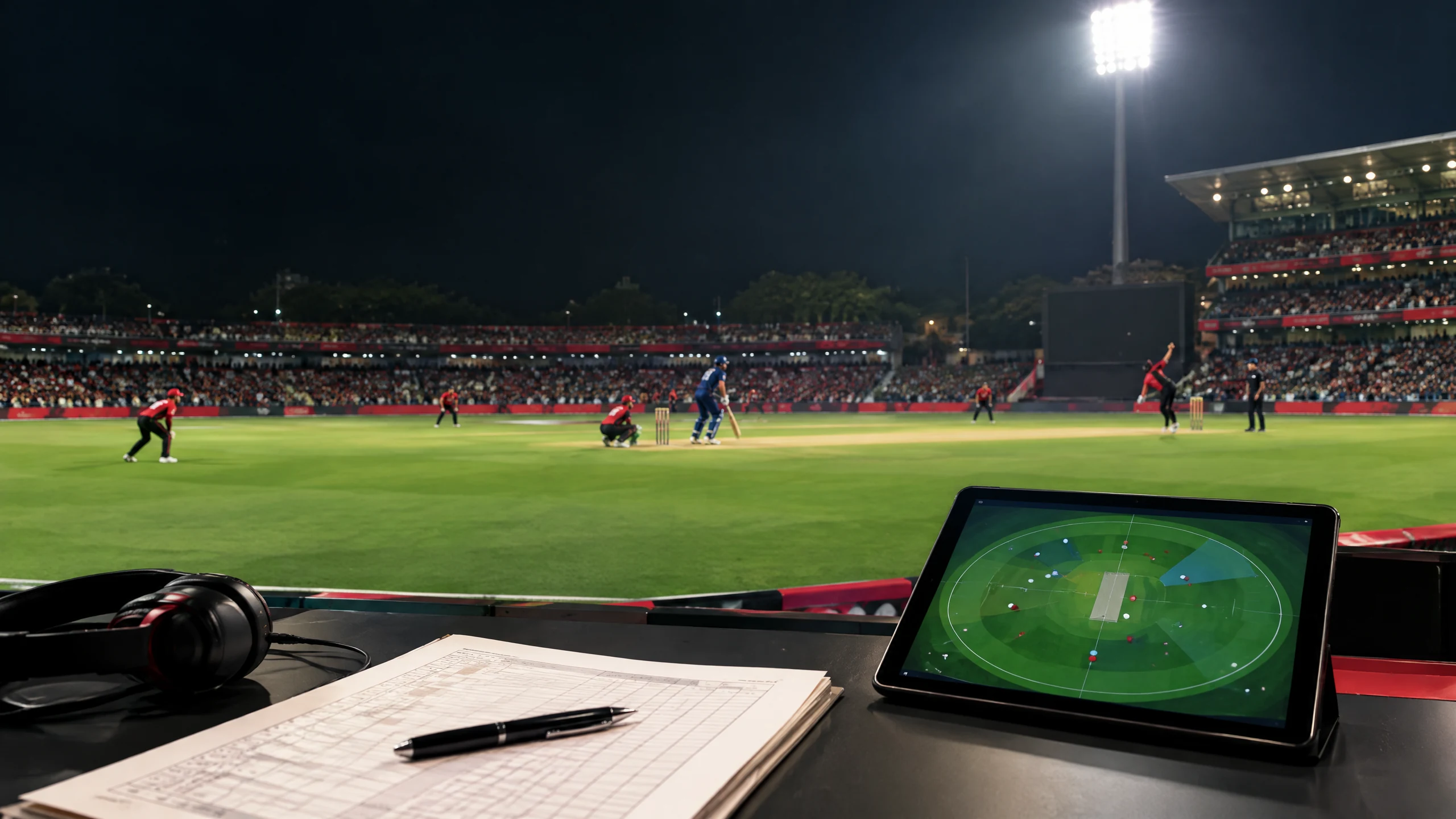
The match centre is where an IPL ID becomes useful during play. It may display the innings score, overs, wickets, target, required run rate, current batters, available bowlers and field map. A game can also show shot zones, bowling lengths, partnership progress and phase summaries. These are simulation tools. Their accuracy depends on the game's rules, player ratings and data updates.
The social area can contain friends, invitations, private-match rooms and leaderboards. A public handle helps another player find the profile. A room code can connect two friends for one match. A leaderboard compares game-defined scores over a stated period. Good design keeps these functions separate from account security: a friend does not need the player's password, email access or recovery code to start a match.
How IPL schedules, pitch reports and standings fit the game
A seasonal cricket simulation often mirrors the rhythm of a real tournament. The player moves from fixture to fixture, watches a game table develop and adjusts the virtual team for different conditions. Schedules help with planning. Standings show which simulated teams have collected points. A match preview can add venue, pitch type, weather setting and expected field dimensions if the game supports those variables.
Pitch reports need careful reading. A label such as dry, hard, green or slow is a simplified game setting unless it comes from a dated real-world report. In a simulation, the label may change bounce, turn, swing, timing windows or stamina. In a real match, pitch behaviour develops ball by ball and can be affected by preparation, weather, wear and the skills of the players. A one-word pitch label cannot capture every condition.
Use official tournament information for real schedules and completed results. Use the game's own season screen for its fixtures and points. If a game says it updates ratings from current form, look for a dated update note from the publisher. A Reddy Anna Cricket IPL ID guide should keep those two records separate so a fan knows which screen is a simulation and which source documents the competition.
Reddy Anna analysis starts with the match state
A cricket simulation becomes more analytical when the player stops choosing every action by instinct. Start with the match state: score, wickets, overs completed, target, balls remaining, required rate, current batters and bowlers still available. Then add game-specific information such as stamina, confidence, player rating and field restrictions. The next decision should respond to that combined state.
Consider a clearly hypothetical chase. A virtual team needs 72 from 48 balls with seven wickets left. The required rate is nine per over. If the strongest death bowler still has two overs, attacking every middle-over ball may create unnecessary wicket risk. The player can target the weaker matchup, preserve a set batter and plan for the difficult overs. If two wickets fall, the same required rate becomes harder because the remaining batting resource has changed.
The point of Reddy Anna analysis is not to claim that a game predicts a real result. It is to make the player's reasoning visible. Record the position before a choice, the chosen tactic and what happened. Over several games, that log shows whether the player repeatedly loses wickets in the same phase, holds bowlers too long or misreads the required rate.
Powerplay run rate and early-wicket risk
The powerplay is the opening phase in which fielding restrictions shape scoring options. A game may reward boundary hitting because fewer fielders can protect the boundary, but early wickets still reduce later flexibility. Track both runs and wickets. A fast start at 55/0 and the same score at 55/3 create very different middle-over plans.
Powerplay run rate is runs scored divided by overs used. In a simulation, it helps compare starts across matches, but it does not explain everything. Add dot-ball percentage, boundary frequency and wicket cost. A player who scores through controlled gaps may be more repeatable than one who depends on several high-risk shots, even if the two six-over totals match.
Use the dashboard to test plans rather than chase one target number. One session can use aggressive opening settings. Another can protect wickets for two overs before increasing intent. Keep the same difficulty and similar conditions when possible. The comparison then tells the player something about method instead of mixing several rule and rating changes into one result.
Middle-over economy, matchups and team balance
Middle overs are often where a simulation tests control. Batters must keep the score moving when boundary options reduce, while captains try to create pressure through spin, pace changes and field placement. Bowling economy is runs conceded per over. It becomes more informative when paired with wickets, dot balls, matchup quality and the strength of the batters faced.
A low economy rate is not automatically the best outcome. A bowler can concede few runs after the match is already controlled, while another can take two important wickets at a higher cost. When reviewing a Reddy Anna Cricket ID match history, mark the overs that changed the equation. Then identify whether the change came from a tactical decision, an execution mistake or a random game event.
Team balance also matters. Selecting eleven high-rated players without clear roles can leave the simulation short of overs, finishing skill or batting depth. Build a lineup with opening options, middle-over players, finishers, new-ball bowlers, control bowlers and death-over choices. The best combination depends on the game's rating model and the current conditions, not only on the largest overall numbers.
Death-over batting averages and resource planning
The final overs compress every decision. The batting side values boundary access, strike retention and wickets in hand. The fielding side values reliable lengths, protected scoring zones and bowlers with overs remaining. A game dashboard can summarize a player's death-over scoring rate or average, but the sample size and difficulty setting must be visible before the number has meaning.
Average and strike rate answer different questions. Batting average describes runs per dismissal under the game's calculation. Strike rate describes runs per 100 balls. In a short simulation phase, a high strike rate can be useful even when the average is modest. A player comparing profiles should not merge the two into one quality score without understanding the game's formula.
Resource planning begins earlier than the last four overs. If the player uses every specialist bowler before the finish, the final phase may be left to a weak matchup. If the player sends every high-impact batter early, a wicket cluster can expose the tail. Good IPL game strategy reserves at least one credible answer for the match state that is most likely to arrive.
How points, levels and achievements should be read
Points and virtual coins in a mobile cricket game are defined by the game publisher. One title may award points for wins, another for objectives, and another for a mixture of match performance, difficulty and fair-play completion. Experience points can raise a profile level. Achievement badges can mark milestones. Non-cash virtual coins may unlock cosmetic items, practice modes or game-defined team options. They should have no monetary or exchange value, and the current game rules should state exactly what they can do. Leaderboard points can reset by season. These systems are not interchangeable.
Before comparing two Reddy Anna IPL ID profiles, check the scoring rules and period. A player with 4,000 lifetime points may have played for a year, while another with 1,200 seasonal points may have performed better in the current ladder. The dashboard should show matches played, difficulty, mode and reset date beside the total whenever possible.
Treat points as feedback, not as the only goal. A player can improve tactical quality even when a close match reduces the leaderboard score. Review decision accuracy, phase control, dismissal patterns and bowling use. That produces a better learning record than repeatedly selecting the easiest mode to increase a total.
How two Reddy Anna IPL ID profiles play one match
The clearest model is a private head-to-head match. Player 1 opens a supported mobile cricket game with a Reddy Anna Cricket ID profile, chooses an IPL-style team and creates a room. The game generates a temporary room ID or invitation. Player 2 opens the same game with a separate Reddy Anna IPL ID profile, enters the room code and selects another available team. The profiles identify the players; the room code connects this one match.
Before the toss, both players confirm the overs, difficulty, assistance settings, weather, pitch type and team-rating limits. Player 1 might use a profile level of 18 with 2,400 season points, while Player 2 uses level 17 with 2,320 points. Those totals describe game progress, not the likely winner. The match should begin from equal rules even when the profiles have different histories.
During the game, each profile records its own decisions and results. Player 1 may attack in the powerplay and save two specialist overs for the finish. Player 2 may use a defensive field, rotate bowlers and protect wickets during the chase. After the match, the game can award experience points, achievement progress or non-cash virtual coins according to its published scoring system. Friends can compare the scorecard, phase charts and tactical choices, then start a rematch with teams or roles reversed.
The public ID is enough for supported friend discovery. A temporary room code is enough for the private match. Neither player needs the other person's password, verification code, email access or device account. That separation keeps the friendly competition tied to the game profile without exposing the account behind it.
How to play with a Reddy Anna Cricket ID step by step
Step 1: choose a legitimate mobile cricket game from the official app store for the device. Read the publisher name, age rating, update date, requested permissions, privacy policy and recent support information. This guide does not designate a specific app as the Reddy Anna Cricket ID platform.
Step 2: create the profile using the game's supported method. The game may offer a guest profile, its own account, Google Play Games or Game Center. Choose a public gamer name that does not reveal a phone number, birth date, address or other private detail. Select an avatar and review who can see activity, friends and achievements.
Step 3: set gameplay preferences before the first serious match. Choose batting and bowling controls, camera angle, sound, accessibility options and difficulty. If the game has automatic assistance, note which settings are active. Results from different assistance levels should not be compared as if they came from identical conditions.
Step 4: select the season or tournament mode. Check whether the fixtures are fictional, based on a completed season or updated from current tournament data. Set a preferred virtual team, review the squad roles and confirm the rules used by the game. Real IPL playing conditions and game mechanics can differ.
Step 5: open the match dashboard. Check the pitch setting, target, innings length, field restrictions, available substitutions and review system offered by the game. Build the playing combination around those rules. Save a tactical preset only after checking that the selected bowlers can complete the required overs.
Step 6: start a solo simulation or create a supported private multiplayer room. Player 1 shares only the public Reddy Anna Cricket IPL ID handle, friend invitation or temporary room code. Player 2 joins with a separate Reddy Anna IPL ID profile. Confirm the mode, difficulty, team restrictions and connection quality before play so both profiles are being compared under the same settings.
Step 7: track the match by phase. Record the powerplay score and wickets, middle-over run rate and economy, and death-over scoring. Watch the required rate during a chase. Use field and bowling changes to answer the current matchup rather than repeating the same plan after conditions change.
Step 8: review the post-match report. Check points gained, objectives completed, dismissals, dot balls, boundary zones, partnership changes and bowling usage. Write down one decision to keep and one to change. A short review after each match turns the IPL game ID from a display name into a useful learning profile.
Playing with friends, room IDs and community features
Multiplayer cricket games can connect players through friend lists, invitations, matchmaking or private room codes. Google Play Games can expose supported community and achievement features, while Game Center can support friends, leaderboards and real-time or turn-based multiplayer when a developer enables them. Each cricket game decides which of those functions appears.
Agree on the match rules before comparing skill. Use the same teams or a balanced draft, identical difficulty, the same number of overs and the same assistance settings. If the connection is unstable, record whether the game uses a pause, reconnection or automatic result rule. A fair comparison needs the conditions to be visible.
Community features should remain respectful. Use the report, mute and block controls when available. Do not publish another person's private information or account details. A room code is for joining a session; it is not a reason to share the account password or let another person take control of the profile.
Profile privacy and account safety
A gaming profile can contain more activity data than its public screen suggests. Google says Play Games may process installed-game activity, play time, achievements, leaderboard rankings, events and saved progress, while participating developers handle game-specific data under their own privacy policies. Apple lets Game Center players choose a nickname, avatar and who can see game activity.
Review visibility before connecting with a large community. Keep the gamer name separate from sensitive personal identifiers. Use the device account's security controls, keep recovery methods current and install updates from the official store. If a game requests permissions that do not match its functions, pause and read the explanation before accepting.
Never give another player a password, one-time verification code, device unlock code or account recovery link. Do not install unofficial files sent through chat to unlock a team, restore points or join a room. If progress disappears, use the game's support channel and the platform's account-recovery process rather than handing account access to a stranger.
How to build a useful tactical dashboard
A useful dashboard keeps official context, game settings and personal results in separate blocks. The tournament block can link to official fixtures and completed results. The simulation block should show the game's rules, difficulty, squad ratings and version. The player block should show points, achievements, match history and privacy controls. Clear labels reduce the chance that a simulated statistic is mistaken for a real IPL record.
For analysis, prioritize a small set of connected measures. Show runs, wickets and overs first. Add current and required run rate for chases. Then show phase splits, batter strike rates, bowler economy, dot-ball percentage, boundary frequency and partnerships. A field map or wagon wheel is useful only when the game records the underlying shot or delivery location consistently.
The post-match screen should explain point changes. If a profile gained 120 points, the player should be able to see whether they came from the result, difficulty, an objective or a seasonal bonus. Transparent scoring makes comparisons more meaningful and helps a player decide whether tactical improvement, match completion or a specific challenge changed the total.
What this Reddy Anna Cricket IPL ID guide can and cannot do
This guide can explain how mobile cricket profiles, points, multiplayer rooms and tactical dashboards commonly work. It can also show how powerplay, middle-over and death-over statistics help someone review a simulation. The Reddy Anna Cricket Analysis hub provides a separate method for reading real scorecards, playing conditions and completed-match decisions.
The guide cannot create an official league identity or confirm features for every cricket game. It cannot turn a simulation score into a real tournament record. A game's current store page, help centre and privacy policy remain the controlling sources for account functions. The official IPL website and app remain the appropriate sources for league schedules, results, reports and season statistics.
Used carefully, a Reddy Anna Cricket ID is simply a memorable game profile: the place where a player keeps settings, progress, friends, points and match reviews. Its value comes from clear rules, secure account use and honest analysis—not from pretending that a virtual profile has authority outside the game.
Reader guide
Article questions, answered
Short answers to common reader questions based on the reporting above.
What is a Reddy Anna Cricket ID in this guide?
Reddy Anna Cricket ID is a descriptive term for a player profile or public handle used in a mobile cricket game. It can identify the player's nickname, avatar, progress, points, achievements and multiplayer activity. Reddy News does not issue this ID, and it is not an official IPL or BCCI account.
Is a Reddy Anna Cricket IPL ID an official IPL account?
No. The IPL has its own official website and app. A Reddy Anna Cricket IPL ID, as described here, means a profile inside a mobile cricket simulation that a fan may use while following an IPL season. The game publisher controls the account, rules and data.
What can an IPL game ID store?
Depending on the game, an IPL game ID may store a nickname, avatar, team preferences, control settings, achievements, leaderboard position, match history, saved progress and friends. Features differ between games, so players should read the app's current help and privacy pages.
How do points work in a mobile cricket game?
Points and non-cash virtual coins are game-defined progress units. A game may award them for completing matches, achieving objectives, improving a personal best or moving through a season ladder. The formula and permitted uses vary by title, and they should be treated as in-game progress rather than official cricket statistics or money.
How can two friends play using cricket game IDs?
A supported game may let one player share a public gamer name, friend request, party code or private room code. The other player joins through the game's multiplayer screen. Players should never share passwords, recovery codes or one-time verification codes.
Can live IPL statistics improve a cricket simulation?
Official schedules, results, player records and playing conditions can help a fan understand tactics, but a game's ratings and simulation model remain separate. Check the official IPL website or app for tournament facts and use the game dashboard only for its stated simulation data.
Does the Reddy Anna IPL ID guide promise match results?
No. This is an educational guide to game profiles, cricket statistics and tactical simulations. A simulation is a model built from rules and assumptions; it cannot guarantee what will happen in a real match.
Sources and further reading
These references support the factual context used in this article. Links open the original publisher.
- Create or change your Play Games profileGoogle Play Help · accessed 18 September 2026
- Play Games profile privacy and other settingsGoogle Play Help · accessed 18 September 2026
- Platform authenticationAndroid Developers · accessed 18 September 2026
- Game CenterApple Developer · accessed 18 September 2026
- Set up your Game Center profile in the Apple Games app on iPhoneApple Support · accessed 18 September 2026
- IPL 2026Indian Premier League · accessed 18 September 2026
- TATA IPL 2026 Match Playing ConditionsIndian Premier League · accessed 18 September 2026
- Reddy Anna IPL Analysis: How to Read an IPL Match Beyond the ScoreReddy News · accessed 18 September 2026