SEMICON India 2026 Ends: CDIL and Suchi Start Commercial Production as Semicon 2.0 Moves to Implementation
SEMICON India 2026 ended with commercial lines at CDIL and Suchi Semicon, 56 initiatives and a Semicon 2.0 plan for domestic chip manufacturing.
- SEMICON India 2026 ran from 17 to 19 September at Yashobhoomi, New Delhi, and the Government said it concluded with 51,656 registrations and cumulative footfall of about 40,000.
- Commercial production lines at CDIL Semiconductor in Mohali for discrete devices and Suchi Semicon in Surat for packaging took the official count to five operational commercial units among 12 Semicon 1.0-approved projects.
- CDIL's line and Suchi's OSAT operation are back-end and discrete-device milestones, not new wafer-fabrication fabs.
- Semicon 2.0 was approved and notified before the conference; its ₹1,27,500 crore fiscal outlay is organised around design, machines and materials, more fabs, ATMP and OSAT, research and development, and talent.
- Investment statements from Applied Materials and Lam Research, and Tata Electronics' construction and MoU update, remain announced plans or progress reports rather than proof of commissioned plants, deployed capital or guaranteed outcomes.
SEMICON India 2026 ended with two verified commercial-production milestones
SEMICON India 2026 concluded on 19 September with a concrete operational outcome: commercial production lines at CDIL Semiconductor in Mohali and Suchi Semicon in Surat were inaugurated during the three-day event. The Ministry of Electronics and Information Technology said the two lines lifted the number of operational commercial semiconductor units among the 12 projects approved under Semicon 1.0 to five. That is the clearest verified result from the conference, held from 17 to 19 September at Yashobhoomi in New Delhi.
The lines matter because they add working capacity in parts of the chip value chain that India has identified for development. CDIL's Mohali line is for discrete devices, while Suchi's Surat line is for packaging. In the official count, the two join Micron, Kaynes and CG Semi. The evidence supports a change from approved projects to a larger group of operating commercial units; it does not show that all 12 approved projects have reached production.
The conference also placed those operating lines beside Semicon 2.0, the next phase of the national semiconductor programme. Semicon 2.0 had already been approved and notified before the event. The post-event significance is therefore about implementation: a policy framework, commercial back-end operations and a series of company announcements are now being discussed together. Each has a different status and should be read accordingly.
The final event figures show scale, not completed investment
The final Press Information Bureau release recorded 51,656 total registrations and cumulative footfall of about 40,000. It said more than 600 exhibitors participated, including around 300 international participants, and representatives came from 52 countries. The event included six country pavilions, 12 state pavilions, a startup pavilion, a workforce development zone, an innovation showcase and a student hackathon.
Those numbers establish the scale of the conference as an industry and policy gathering. They do not measure factory output, capital deployed, export sales or the number of supplier contracts concluded. The same release counted 56 MoUs, announcements and strategic initiatives over the three days. An MoU, an announcement and a commissioned production line are different stages of activity, so grouping them together as completed investment would misstate what the official record says.
CDIL and Suchi add production capacity, but they are not new wafer fabs
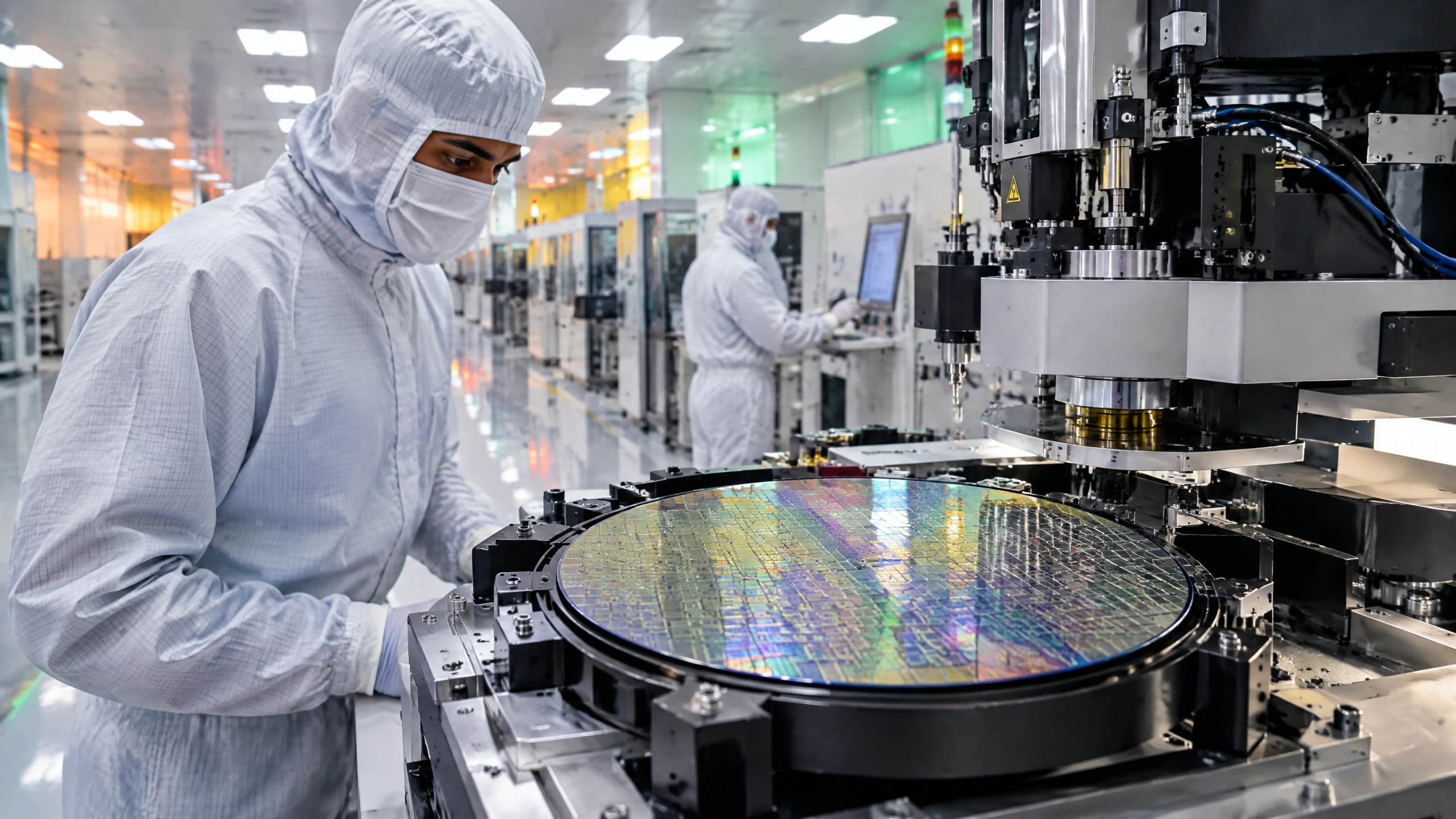
The distinction between back-end semiconductor operations and a wafer fab is central to the SEMICON India 2026 outcome. A wafer fab makes semiconductor devices on silicon wafers through a series of highly specialised processing steps. By contrast, assembly, test, marking and packaging activities prepare chips or devices for use, verify performance and place them in protective packages. Both are important manufacturing capabilities, but they describe different parts of the supply chain.
The Government identified CDIL Semiconductor's Mohali commercial line as a discrete-device operation. CDIL describes itself as a manufacturer of silicon chips and devices and lists products including diodes, transistors, rectifiers, thyristors, TVSs and regulators. The official conference release counts the new activity within the group of operational commercial semiconductor ATMP units. ATMP refers to assembly, test, marking and packaging, and this classification should not be converted into a claim that the newly inaugurated line is a wafer fab.
Suchi Semicon identifies its Surat facility as an OSAT operation, short for outsourced semiconductor assembly and test. Its own description focuses on IC packaging and testing, including package development, assembly and test. The Government's event release calls the Surat commercial line packaging and reported the first batch of commercial devices exchanged by Suchi Semicon and eInfochips. This is direct evidence of a packaging-and-test operation entering commercial production, rather than evidence of a new wafer-fabrication plant.
Why five commercial units is a meaningful but limited benchmark
India Semiconductor Mission and PIB describe five operational commercial semiconductor units among 12 Semicon 1.0-approved projects after CDIL and Suchi came online. Micron's commercial DRAM and NAND production at Sanand, Gujarat, Kaynes Semicon and CG Semi are the other three named in the official event account. The figure is useful because it reports an operational count instead of only a pipeline of approvals or proposals.
It is still a narrow benchmark. The count does not mean five wafer fabs are operating, nor does it establish identical technologies, output volumes, utilisation rates, customer mix or financial performance across the units. Packaging, testing, discrete devices and memory production serve different technical and commercial roles. The Government's count is best read as a marker of commercial activity across approved projects, not as a single measure of national chip self-sufficiency.
Semicon 2.0 was already in force; the conference set out its implementation frame
Semicon 2.0 was not created at SEMICON India 2026. India Semiconductor Mission says the Union Cabinet approved the next phase of the Semicon India Programme with a fiscal outlay of ₹1,27,500 crore. The scheme was notified in the Gazette of India on 31 August 2026, before the 17 September opening of the conference. ISM also posted implementation guidelines for the machines and materials, fabs, and ATMP and OSAT pillars on 16 September.
This timing changes how the conference should be understood. Ministers and industry leaders used the event to discuss how the programme could be implemented across the value chain, while the event also provided a venue for production launches, partnerships and plans. The existence of a notified scheme does not mean each later proposal has been approved for support, received funding or started work. Project-level documents remain necessary to establish those later steps.
The programme's fiscal outlay is a policy allocation for Semicon 2.0, rather than a statement that the full amount has already reached companies. Equally, a company investment announcement is not the same thing as public fiscal support. Keeping these amounts and categories separate makes it possible to assess what has been formally notified, what a company has announced, and what has actually entered commercial operation.
The six Semicon 2.0 pillars widen the focus beyond individual fabs
India Semiconductor Mission sets out six pillars for Semicon 2.0: design; machines and materials; setting up more fabs; further strengthening the ATMP and OSAT industry; research and development; and talent development. Together, they cover work before a chip is made, production itself, back-end operations and the technical base needed to support them. The framework is broader than a programme that would focus only on a small number of fabrication plants.
That wider scope explains why the commercial lines at CDIL and Suchi sit alongside discussions about equipment, chemicals, gases, precision manufacturing, design tools, research and training. Semiconductor manufacturing depends on specialised inputs and process knowledge as well as buildings and machinery. The pillars establish policy areas for development, but they do not guarantee that every category will immediately have domestic suppliers, qualified facilities, trained workers or commercial orders.
Company announcements need to be separated from commissioned capacity
Several large announcements at SEMICON India 2026 point to possible upstream and ecosystem activity. Applied Materials announced India Vision 2035, described by PIB as a US$5 billion investment over the next decade and a tenfold expansion of India-based supply-chain capacity by 2035. Lam Research announced approximately ₹10,000 crore for its first Indian silicon-component manufacturing and vertical-ingot-processing plant. Both statements are forward-looking company commitments, not confirmation that the facilities are complete or that the stated capital has already been deployed.
Tata Electronics said construction of its Dholera 300mm fab and Jagiroad OSAT facility was on track. It also said it would sign seven MoUs spanning areas such as wafer manufacturing, assembly and test, advanced packaging, materials and talent. The later PIB implementation release records specific MoUs and announcements involving Tata, Suchi, Kaynes, Intel and others. An agreement can create a framework for work, but it does not disclose every commercial term, prove a factory is producing or establish how much business will result.
The conference outcome is strongest where it uses operational language: CDIL and Suchi commercial lines, and the official five-unit count. It is weaker where only an announcement, intention, MoU or construction update is available. This does not diminish the relevance of the later-stage plans; it identifies the evidence boundary. Announced capacity becomes operating capacity only after subsequent steps such as approvals, construction, equipment installation, qualification, customer engagement and commercial production are independently established.
What the outcome could mean for India’s chip supply chain and skills base
The immediate industrial implication is stronger activity in packaging, testing and discrete devices. These stages can connect chip design, component makers, electronics manufacturers and end-product assemblers. Suchi says its packaging and test services cover IC packaging, assembly and test; CDIL's product range includes devices used in applications such as power management and solar equipment. Their commercial operation gives suppliers and engineering teams a domestic manufacturing reference point, without proving that supply will replace imports in any particular product category.
The Semicon 2.0 emphasis on machines, materials and talent highlights the dependencies around manufacturing lines. Facilities require qualified materials, gases, chemicals, test equipment, cleanroom and utility systems, precision parts, software, technicians and engineers. A larger back-end base may increase the relevance of Indian firms able to meet technical, quality and delivery requirements. It does not promise contracts, set procurement rules or show that any supplier has already been qualified.
Skills were visible in the conference programme as well as in policy. The final official release reported participation by students, startups, universities and industry in hackathons, design challenges and workforce sessions. Such activity can support exposure to the sector and future training pathways. It should not be treated as evidence that a stated number of jobs has been created or that every participant will move into a semiconductor role. Hiring, pay and placement outcomes require separate employer and programme data.
What SEMICON India 2026 does not establish for consumers or investors
The production milestones do not establish an immediate change in the price or availability of phones, cars, appliances, solar equipment or other electronics. Consumer prices depend on many factors beyond local semiconductor activity, including component specifications, demand, logistics, exchange rates, contracts, global capacity and product distribution. The official releases did not make a consumer-price commitment.
Nor do the conference announcements establish investment outcomes for listed companies or private manufacturers. Factory schedules, project financing, customer qualification, demand and execution can change after a public statement. This report describes the status of government and company announcements as of the source-check cutoff. It is reporting on technology manufacturing and policy, not investment, trading or procurement advice.
The next evidence to look for is project-level execution
For the two commercial lines, the most useful follow-up disclosures would identify products, packaging types or device families, customer qualification, production capacity and the extent of commercial shipments. For the broader group of Semicon 1.0 projects, official project updates can clarify when each facility reaches commissioning, pilot output or commercial production. Those facts would give greater precision than an approval count or a conference announcement.
For Semicon 2.0, the practical measures are notifications, application outcomes, project approvals, fiscal-support decisions, tender and supplier activity, equipment installation, research programmes and validated training results. India Semiconductor Mission has established the six-pillar policy structure and published the scheme notification; subsequent documents will determine how individual proposals proceed under it. A national outlay is a framework for support, not proof of execution by every applicant.
SEMICON India 2026 therefore closes with a measured conclusion. India has two additional verified commercial semiconductor lines in Mohali and Surat, and a notified Semicon 2.0 programme aimed at a wider chip ecosystem. The event also generated international participation and a substantial set of announced collaborations. The record supports a transition towards implementation, while the pace and scale of later projects must be judged from project-level evidence rather than conference momentum alone.
Reader guide
Article questions, answered
Short answers to common reader questions based on the reporting above.
What were the main outcomes of SEMICON India 2026?
The conference ended on 19 September 2026 after three days at Yashobhoomi, New Delhi. The Government said commercial production lines at CDIL Semiconductor in Mohali and Suchi Semicon in Surat were inaugurated, taking the number of operational commercial semiconductor units among the 12 Semicon 1.0-approved projects to five. The final official release also recorded 51,656 registrations, cumulative footfall of about 40,000, more than 600 exhibitors, around 300 international participants, representation from 52 countries, and 56 MoUs, announcements and strategic initiatives.
Are CDIL and Suchi Semicon new wafer fabs?
No. The official account identifies CDIL's Mohali commercial line with discrete devices and Suchi's Surat line with packaging. Suchi describes itself as an OSAT, or outsourced semiconductor assembly and test, company. ATMP and OSAT operations handle stages such as assembly, testing, marking and packaging; they are not wafer-fabrication fabs, where chips are formed on silicon wafers. The inauguration is a commercial-production milestone, but it should not be described as evidence of two new wafer fabs.
Was Semicon 2.0 approved at the SEMICON India 2026 event?
No. The Union Cabinet approved Semicon 2.0 before the event, and the scheme was notified in the Gazette on 31 August 2026. SEMICON India 2026 provided an implementation update. India Semiconductor Mission says the programme has a fiscal outlay of ₹1,27,500 crore and six pillars: design, machines and materials, more fabs, ATMP and OSAT, research and development, and talent development.
Do the Applied Materials, Lam Research and Tata Electronics announcements mean new plants are already operating?
No. The official event release records Applied Materials' stated US$5 billion India Vision 2035 investment over the next decade and Lam Research's approximately ₹10,000 crore plan for a silicon-component manufacturing and vertical-ingot-processing plant. Tata Electronics said construction at its Dholera 300mm fab and Jagiroad OSAT facility was on track and referred to MoUs it would sign. These are important commitments, plans or project updates, but the releases do not establish that those facilities are commissioned, that all capital has been deployed, or that every MoU has become an operating contract.
Sources and further reading
These references support the factual context used in this article. Links open the original publisher.
- SEMICON India 2026 Concludes Successfully, Showcasing India’s Growing Role in the Global Semiconductor EcosystemPress Information Bureau, Ministry of Electronics & IT · accessed 20 September 2026
- Prime Minister Shri Narendra Modi Inaugurates SEMICON India 2026; Unveils India’s Ambitious Roadmap for Transition to Semicon 2.0, with Expanded Support for Design, Manufacturing, Packaging, R&D and Talent DevelopmentPress Information Bureau, Ministry of Electronics & IT · accessed 20 September 2026
- Semicon 2.0 to deepen India’s semiconductor ecosystem with focus on design, equipment, fabs, advanced packaging, R&D and talentPress Information Bureau, Ministry of Electronics & IT · accessed 20 September 2026
- SEMICON India 2026India Semiconductor Mission · accessed 20 September 2026
- Semicon 2.0India Semiconductor Mission · accessed 20 September 2026
- Semicon 2.0 – Scheme for development of Semiconductor Design and Manufacturing Ecosystem in IndiaGazette of India, Ministry of Electronics and Information Technology · accessed 20 September 2026
- India Semiconductor MissionIndia Semiconductor Mission · accessed 20 September 2026
- Welcome to CDILContinental Device India Pvt. Ltd. (CDIL) · accessed 20 September 2026
- Transforming India’s Semiconductor EcosystemSuchi Semicon · accessed 20 September 2026