Microsoft Hyderabad Cloud Region Is Live: India South Central Azure and AI Explained
Microsoft’s India South Central cloud region in Hyderabad is live with three zones and broad Azure access; additional AI capabilities will roll out in stages.
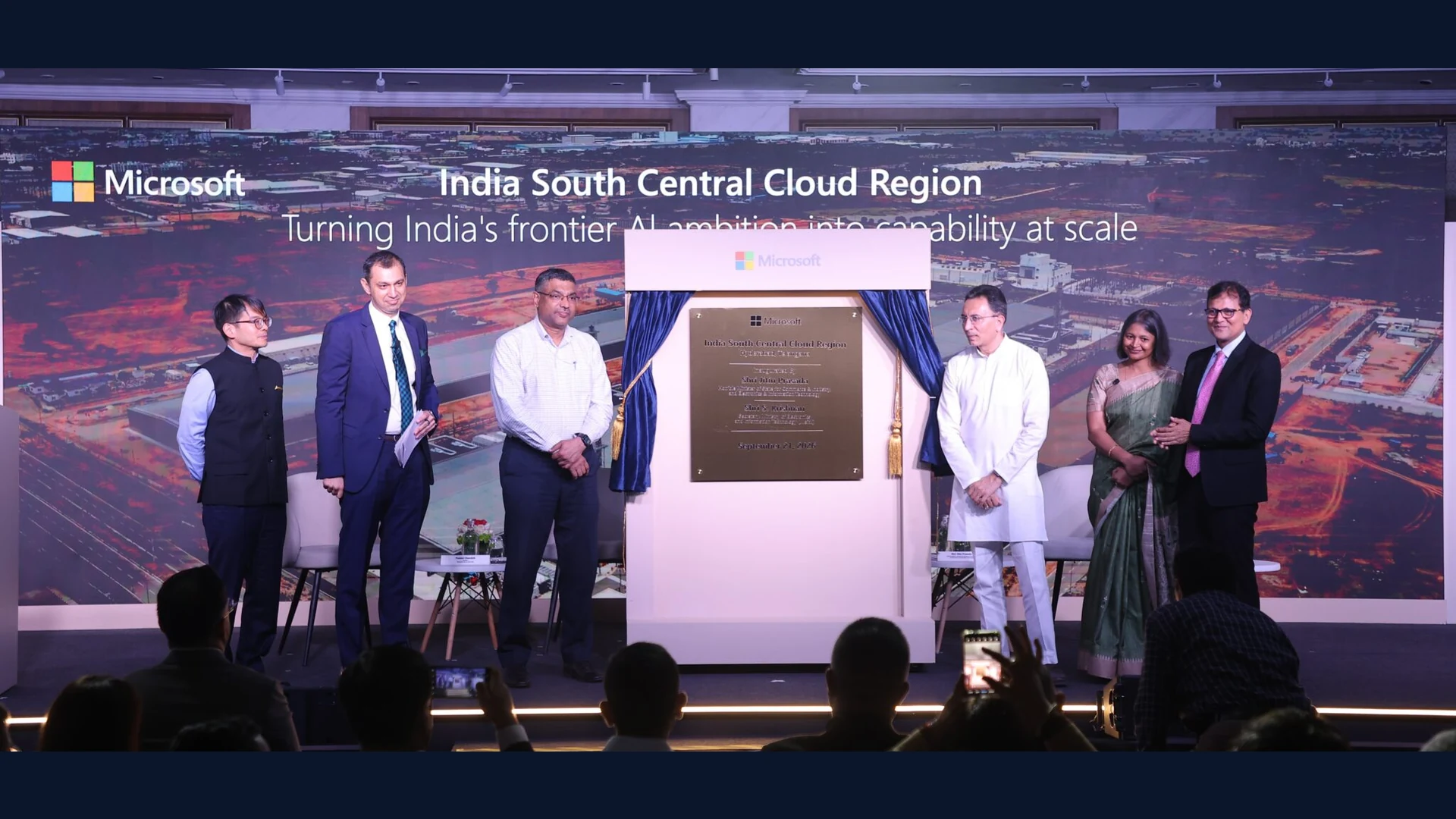
- Microsoft announced on 21 September 2026 that its India South Central datacenter region in Hyderabad is live; it is the company’s fourth cloud region in India.
- The region has a three-zone architecture and begins with a broad Azure portfolio, but Microsoft has not said that every Azure or AI service is immediately available there.
- Microsoft says the full Azure and AI portfolio, including Microsoft Foundry, is planned to roll out progressively over coming months.
- Local capacity, data-residency options, Availability Zones and governance controls are described by Microsoft as tools designed to help eligible workloads address applicable requirements, not as automatic compliance.
- Microsoft says Adani Group, Bajaj Finserv, HDFC Bank and PB Pay have signed up; the reviewed sources do not establish the scope or production status of each customer’s workload.
Microsoft Hyderabad cloud region is live, but its AI service rollout is still staged
The Microsoft Hyderabad cloud region is live as India South Central, giving the company a fourth cloud region in India with a three-zone architecture and a broad Azure portfolio. The practical point for customers is that a live region is not the same as immediate availability of every Azure or AI product: Microsoft says additional Azure and AI capabilities, including Microsoft Foundry, are designed to roll out progressively over the coming months.
That distinction is the central answer for developers, cloud architects and regulated organisations assessing the new location. India South Central can now be evaluated as a deployment region, but a team should confirm its precise service, feature and configuration requirements rather than treating the announcement as a universal product-availability list. Microsoft’s announcement supports the former conclusion; it does not publish a service-by-service catalogue for every workload.
Microsoft presented the region at its AI Infrastructure Summit in New Delhi on 21 September 2026. The company described Hyderabad as a strategic hub for Asia and the Global South. That is Microsoft’s strategic framing of the investment, while the immediately verifiable operational facts are the live region, the three-zone design and the broad Azure portfolio stated in the announcement.
The 21 September announcement was not necessarily the region’s first operational day
The publication date matters because two timings appear in the reporting. Microsoft’s first-party announcement is dated 21 September 2026 and calls India South Central “now-live.” Business Standard’s 21 September report, carried from PTI, says the region became generally available on 6 August. Both details can be true: the region may have been available before the public launch event and later received a high-profile announcement and strategic role.
For that reason, it is more accurate to say Microsoft formally announced and positioned the live Hyderabad region on 21 September than to say it opened for the first time on that date. This avoids turning a corporate event into an unsupported claim about the first moment of customer access. It also helps readers separate the infrastructure timeline from the later rollout of additional services.
The fourth-region status is consistently reported by Microsoft, ET Datacenters, Forbes India and Moneycontrol. The sources reviewed for this report do not provide a verified comparison of capacity, pricing, latency or service parity between India South Central and Microsoft’s other India regions. Those subjects should be assessed from current product and commercial documentation rather than inferred from the launch language.
What is confirmed to be available now
Microsoft confirms three core points about India South Central: it is a live datacenter region in Hyderabad, it has a resilient three-zone architecture designed for sustained expansion, and it launches with a broad portfolio of Azure services. The company also says all of its India datacenter regions are now AI-enabled. These are infrastructure and platform statements, not a promise that a particular customer workload has been approved, deployed or is suitable for the region.
A three-zone architecture is relevant because it places resilience at the centre of the regional design. It still does not answer every workload question. A customer’s own application architecture, redundancy choices, replication setup, recovery targets, dependencies and the regional status of the services it uses will shape its resilience posture. Microsoft’s three-zone statement should be read as a regional capability, not as a guarantee of continuity for every application placed there.
The announcement is deliberately broad on current services. It does not provide a verified product-by-product matrix in the material reviewed for this article. Publishing a list of assumed Azure services, models or data features would create false precision. The supportable description is that the region has a broad Azure portfolio at launch, with the availability of a named service needing a separate current check. That check should also cover the customer’s subscription, quota, support plan, security configuration and any feature-specific prerequisites; none of those operational conditions is resolved by the regional announcement itself.
What remains planned: full Azure and AI capability rollout
The boundary around AI availability is clear in Microsoft’s wording. The company says India South Central is designed to support the full Azure and AI portfolio, including Microsoft Foundry, as additional capabilities roll out in the coming months. “Designed to support” and “roll out” are future-facing phrases. They should not be rewritten as confirmation that every AI capability is ready in Hyderabad today.
This matters especially when a team needs a particular model, managed AI service, data-processing option, network feature or governance control. Service availability can vary by region and can change over time. A migration or new deployment should therefore begin with the service’s current regional documentation and the customer’s own Azure environment, not with a generic assumption based on the region’s launch announcement.
The same caution applies to Microsoft Foundry. It is named as part of the planned progressive rollout, which establishes Microsoft’s intention to expand the regional AI offering. It does not establish that every Foundry capability, supporting service or model option is available on 21 or 22 September 2026. Reporting the roadmap separately from live regional status protects readers from confusing an announced direction with a present configuration.
Data residency and governance are options, not an automatic compliance result
Microsoft says the new region expands local capacity, data-residency options, Availability Zones and governance controls for eligible cloud and AI workloads. It says these capabilities are designed to help customers address applicable requirements connected with MeitY guidance, India’s Digital Personal Data Protection framework, the Reserve Bank of India and CERT-In. This is an important reason the region may be relevant to data-sensitive organisations, but the wording remains conditional and workload-specific.
A local region does not by itself settle where every category of data is stored, how a backup is configured, which services process information, which contractual terms apply, or whether an organisation’s internal policy is met. Microsoft expressly says that customers are responsible for determining which requirements apply to their own workloads. That responsibility includes the customer’s technology, legal, risk and compliance assessment where appropriate.
The practical interpretation is not that India South Central delivers automatic regulatory clearance. It gives organisations another local infrastructure option to assess against their requirements. The article does not provide legal or compliance advice, and it does not treat Microsoft’s description of platform controls as a certification of suitability for banking, public-sector, health, personal-data or any other regulated workload.
A practical checklist before selecting India South Central
Start with the exact service requirement. An organisation should identify the Azure services, AI capabilities, models, data functions and deployment pattern it needs, then verify current India South Central availability in Microsoft’s relevant documentation and its own account context. The public announcement confirms a broad portfolio, but it is not a substitute for a current product-by-region verification.
Next, test the architecture rather than assuming that the regional design answers every resilience need. The relevant questions include how the application uses zones, how data is replicated, what dependent services are in scope and which recovery objectives the organisation has set. Microsoft’s three-zone architecture is a significant regional feature, while the application-level outcome depends on the customer’s implementation choices.
Finally, document the data and governance position for the particular workload. Microsoft frames the region as offering data-residency and governance options designed to help with applicable Indian requirements. A customer still needs to determine what applies to its data, service choices, contractual environment and sector-specific obligations. This is a verification exercise, not a conclusion that can be reached from a press release alone.
Microsoft attributes early customer sign-ups; deployments are not described
Microsoft says Adani Group, Bajaj Finserv, HDFC Bank and PB Pay have signed up for the new region. ET Datacenters and Forbes India also reported the named-customer statement. It indicates early commercial interest in India South Central and is relevant to readers following enterprise adoption of local cloud and AI infrastructure.
The evidence boundary is equally important. The reviewed reports do not independently identify a specific workload, data set, contract value, capacity commitment, go-live date or production architecture for those companies. “Signed up,” when attributed to Microsoft, is the accurate description. It should not be expanded into a claim that every named organisation has migrated systems or is already operating a particular AI service in Hyderabad.
The cooling design is a facility claim, not a complete environmental scorecard
Microsoft says the India South Central facility uses high-efficiency mechanical cooling with effectively zero water use for cooling. Business Standard described the design as air-cooled chillers rather than conventional water-based cooling. The claim is specific to cooling and provides useful context for readers examining the physical infrastructure behind a cloud region.
It should not be stretched beyond the evidence. The available statements do not provide a complete assessment of energy use, carbon intensity, construction impacts, hardware supply chains or total lifecycle environmental performance. The verified point is narrower: Microsoft reports a cooling approach intended to use effectively zero water for cooling at the facility.
Why the Hyderabad region matters to India’s cloud and AI infrastructure conversation
India South Central adds a Hyderabad location to Microsoft’s India cloud footprint at a time when local cloud capacity, AI infrastructure and workload governance are central issues for enterprises and global capability centres. Microsoft frames the region as a strategic hub for Asia and the Global South and says its India regions are AI-enabled. That positioning makes the announcement relevant beyond a routine datacenter update, particularly for organisations assessing where to build or expand cloud-based systems.
The immediate benefit should nevertheless be described carefully. The launch gives customers a new region to evaluate; it does not by itself prove lower latency, lower cost, greater capacity for every service, faster approval or better business outcomes for a particular user. Such conclusions require workload-specific measurement, current commercial information and implementation evidence. The strongest reporting angle is therefore the new option and its stated roadmap, not a blanket performance promise.
What this announcement does not establish
The announcement does not establish a complete inventory of Azure services in Hyderabad, immediate access to every AI product or Microsoft Foundry capability, or identical service parity with every other Azure region. It also does not establish that named customers are running defined production workloads. These are separate questions that need product documentation, customer disclosure or other project-level evidence.
It also does not create automatic compliance, a guaranteed data posture, or a performance outcome for a workload. Microsoft’s public material says the region is designed to help eligible customers address applicable needs and that customers remain responsible for their own requirement assessment. Keeping those limits visible is essential when cloud-region reporting is used by organisations making technical or governance decisions.
The measured conclusion is straightforward: Microsoft India South Central is a live, three-zone Hyderabad cloud region with a broad Azure portfolio, and it is Microsoft’s fourth India region. The more expansive Azure AI and Microsoft Foundry story is a staged rollout. Readers can use that distinction to decide what to verify now and what to monitor as Microsoft releases further regional capabilities.
How this report was sourced
This report relies first on Microsoft News Asia’s 21 September 2026 announcement for the live-region status, fourth-region description, three-zone architecture, broad Azure portfolio, progressive Azure and AI roadmap, named customer sign-ups, governance framing and cooling statement. ET Datacenters, Forbes India, Moneycontrol and Business Standard’s PTI report provide independent reporting on the announcement, its Hyderabad location and the fourth-region status. Their publication dates are 21 September 2026; ET Datacenters published at 3:01 PM IST, Forbes India at 7:15 PM IST, Moneycontrol at 11:19 IST and Business Standard at 1:30 PM IST.
The sources were accessed on 22 September 2026. Business Standard’s report is used for the additional timing detail that general availability began on 6 August. The report deliberately does not provide an unverified service matrix, workload claims for named customers, legal conclusions, performance promises or environmental conclusions beyond the cooling statement. Related REDDY NEWS technology coverage is listed below to support crawlable internal discovery, not as evidence for Microsoft’s announcement.
Reader guide
Article questions, answered
Short answers to common reader questions based on the reporting above.
Is Microsoft’s Hyderabad cloud region live?
Yes. Microsoft said on 21 September 2026 that the India South Central datacenter region in Hyderabad is now live and is its fourth cloud region in India. Business Standard, citing PTI, reported that the region became generally available on 6 August. The 21 September event should therefore be read as Microsoft’s public launch and strategic positioning announcement, not necessarily as the first day the region could be used operationally.
Is every Azure AI service and Microsoft Foundry already available in India South Central?
No such full service-parity claim is confirmed. Microsoft says the live region begins with a broad Azure portfolio and that the full Azure and AI portfolio, including Microsoft Foundry, is designed to roll out progressively over the coming months. An organisation should verify the availability of a specific service, model, feature and region combination through current Microsoft product documentation and its own Azure environment before planning a deployment.
Does India South Central automatically make a workload compliant with Indian rules?
No. Microsoft says the region’s local capacity, data-residency options, Availability Zones and governance controls are designed to help eligible customers address applicable requirements associated with MeitY guidance, India’s Digital Personal Data Protection framework, the Reserve Bank of India and CERT-In. Microsoft also says customers remain responsible for determining which requirements apply to their own workloads. The region is infrastructure, not a blanket compliance certification.
Which companies have signed up for Microsoft’s Hyderabad region?
Microsoft says Adani Group, Bajaj Finserv, HDFC Bank and PB Pay have signed up for India South Central. ET Datacenters and Forbes India also reported that company statement. The reviewed reporting does not independently describe each organisation’s workload, scale of use, migration status or production configuration, so the sign-up statement should not be expanded into a claim that every named company is already running a specified workload there.
What does the cooling claim mean for the Hyderabad datacenter region?
Microsoft says the facility uses high-efficiency mechanical cooling with effectively zero water use for cooling. Business Standard described the approach as using air-cooled chillers instead of conventional water-based cooling. That statement concerns the cooling design reported for the facility; it is not, on its own, a complete lifecycle environmental assessment or a measure of every input used by the wider cloud service.
Sources and further reading
These references support the factual context used in this article. Links open the original publisher.
- AI ambition into action: Microsoft brings AI-ready capabilities across its India cloud infrastructure, establishes India South Central region as a strategic hub for Asia and Global SouthMicrosoft News Asia · accessed 22 September 2026
- Microsoft launches fourth India cloud region in Hyderabad, expands AI infrastructureET Datacenters · accessed 22 September 2026
- Microsoft launches fourth India cloud region in HyderabadForbes India · accessed 22 September 2026
- Microsoft launches fourth India cloud region, expands AI infrastructure footprintMoneycontrol · accessed 22 September 2026
- Microsoft launches 4th India cloud region in Hyderabad to boost AI capacityBusiness Standard / Press Trust of India · accessed 22 September 2026
- SEMICON India 2026 Ends: CDIL and Suchi Start Commercial Production as Semicon 2.0 Moves to ImplementationReddy News · accessed 22 September 2026
- CISA, FBI and NSA AI Model Distillation Advisory ExplainedReddy News · accessed 22 September 2026
- OpenAI Agents API Public BetaReddy News · accessed 22 September 2026