Reddy Anna Cricket Analysis Guide: Facts, Analysis and Safe Cricket Research
Searches for Reddy Anna cricket analysis can mix cricket information with questions about identity, sources and online safety. This independent Reddy News article focuses on how match analysis works through conditions, phases, tactics, matchups and evidence rather than…
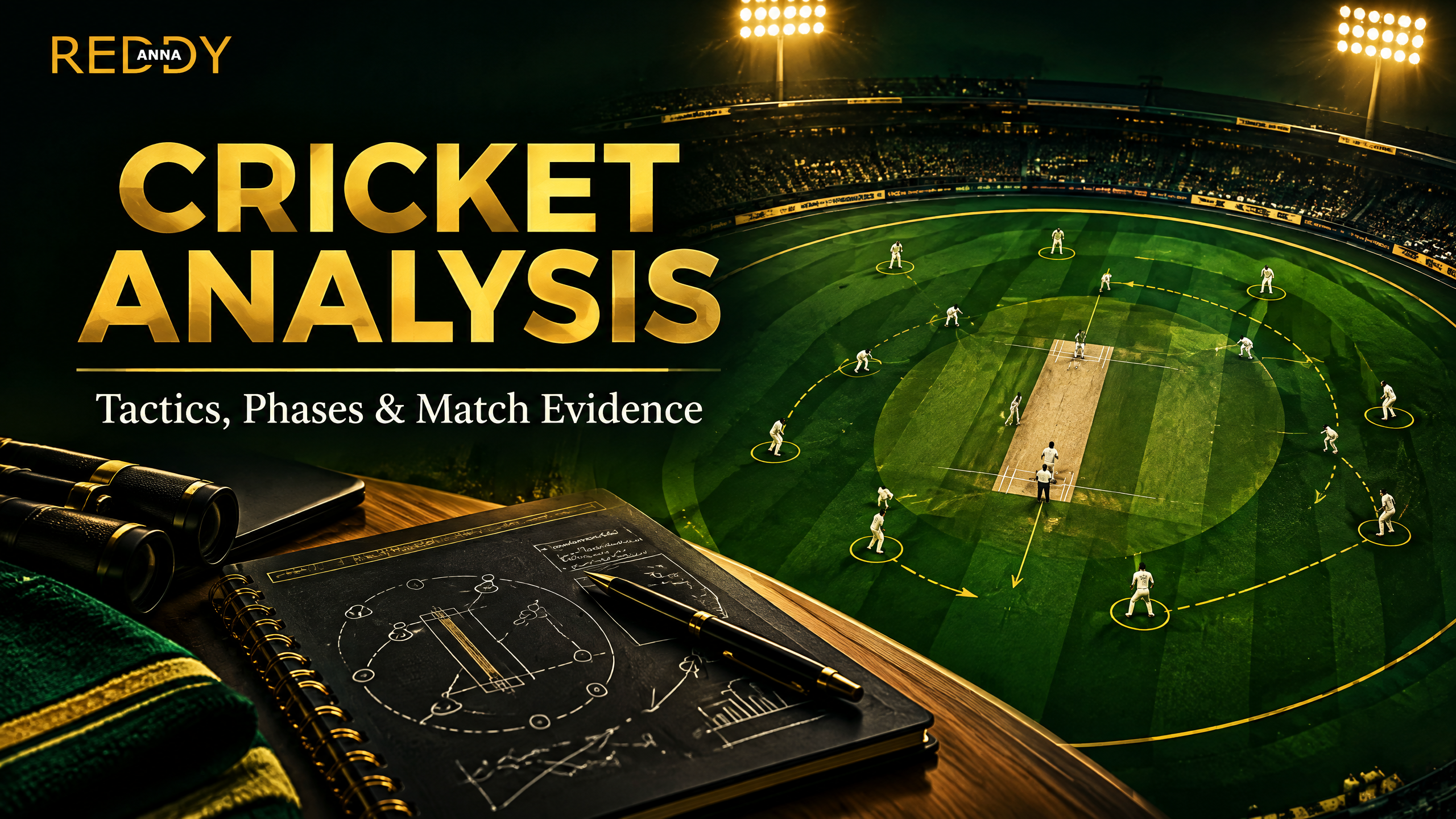
- Cricket analysis explains why a match moved in a particular direction. It can examine the pitch, weather, dew, boundary dimensions, innings phases, batting intent, bowling plans, field settings and execution. Analysis is not a promise about the next match. It is an evidence-led interpretation of events that have already happened or conditions that have been clearly described.
- A limited-overs innings is often read through powerplay, middle-overs and death-overs phases, while a Test innings may be examined through new-ball movement, consolidation, second new ball and changing surface conditions. The phases are a framework, not a fixed answer. A team can deviate from a normal pattern because of wickets, match situation or a specific matchup.
- Matchups are useful when they are specific. A batter may struggle against a particular angle, length or spin type, but a small sample should not be treated as a permanent weakness. A bowler may create pressure through a field plan, but the plan still depends on execution, conditions and the batter’s response.
- Pitch pace, bounce, grip, wind, humidity, dew and boundary size can influence shot selection and bowling value. These factors should be described carefully rather than used as a shortcut. A venue label alone cannot prove how a particular surface will behave on a particular day.
What cricket analysis actually does
Cricket analysis explains why a match moved in a particular direction. It can examine the pitch, weather, dew, boundary dimensions, innings phases, batting intent, bowling plans, field settings and execution. Analysis is not a promise about the next match. It is an evidence-led interpretation of events that have already happened or conditions that have been clearly described.
A strong analysis states its evidence. It may use a scorecard, wagon wheels, phase scoring, lengths bowled, dot-ball pressure, partnerships or field changes. The reader should be able to distinguish the observed event from the analyst’s explanation of why it mattered.
For a reader arriving from search, the useful next step is to attach a date, competition or definition to the question. In a cricket analysis discussion, the same phrase can refer to a current update, a completed match, a historical comparison or a third-party claim. This section is therefore written as a research aid: it explains what to identify, which wording signals uncertainty and which type of source should be checked next. The Reddy Anna label describes the category of this article; it does not turn an unaffiliated page into an official source.
A careful publisher can improve this answer by recording the source, access date and update reason. If a number, fixture, squad detail or rule changes, the page should be revised rather than silently left to age. If the evidence remains incomplete, say what is missing. That approach serves people searching for how match analysis works through conditions, phases, tactics, matchups and evidence rather than predictions, gives answer engines a precise passage to interpret and avoids making a confident claim that the available evidence cannot support.
Reading a match through phases
A limited-overs innings is often read through powerplay, middle-overs and death-overs phases, while a Test innings may be examined through new-ball movement, consolidation, second new ball and changing surface conditions. The phases are a framework, not a fixed answer. A team can deviate from a normal pattern because of wickets, match situation or a specific matchup.
The analysis should connect the phase to a measurable change: run rate, wickets lost, boundary percentage, dot balls, strike rotation or partnership length. Saying that momentum changed is incomplete unless the article shows what changed and when.
For a reader arriving from search, the useful next step is to attach a date, competition or definition to the question. In a cricket analysis discussion, the same phrase can refer to a current update, a completed match, a historical comparison or a third-party claim. This section is therefore written as a research aid: it explains what to identify, which wording signals uncertainty and which type of source should be checked next. The Reddy Anna label describes the category of this article; it does not turn an unaffiliated page into an official source.
A careful publisher can improve this answer by recording the source, access date and update reason. If a number, fixture, squad detail or rule changes, the page should be revised rather than silently left to age. If the evidence remains incomplete, say what is missing. That approach serves people searching for how match analysis works through conditions, phases, tactics, matchups and evidence rather than predictions, gives answer engines a precise passage to interpret and avoids making a confident claim that the available evidence cannot support.
Batting and bowling matchups
Matchups are useful when they are specific. A batter may struggle against a particular angle, length or spin type, but a small sample should not be treated as a permanent weakness. A bowler may create pressure through a field plan, but the plan still depends on execution, conditions and the batter’s response.
Good matchup analysis includes the sample, competition and time period. It should also mention counter-adjustments. Teams can change the batting order, protect a boundary, attack a bowler early or use a different release point. Analysis is strongest when it explains both the initial plan and the response to it.
For a reader arriving from search, the useful next step is to attach a date, competition or definition to the question. In a cricket analysis discussion, the same phrase can refer to a current update, a completed match, a historical comparison or a third-party claim. This section is therefore written as a research aid: it explains what to identify, which wording signals uncertainty and which type of source should be checked next. The Reddy Anna label describes the category of this article; it does not turn an unaffiliated page into an official source.
A careful publisher can improve this answer by recording the source, access date and update reason. If a number, fixture, squad detail or rule changes, the page should be revised rather than silently left to age. If the evidence remains incomplete, say what is missing. That approach serves people searching for how match analysis works through conditions, phases, tactics, matchups and evidence rather than predictions, gives answer engines a precise passage to interpret and avoids making a confident claim that the available evidence cannot support.
How venue and conditions affect an analysis
Pitch pace, bounce, grip, wind, humidity, dew and boundary size can influence shot selection and bowling value. These factors should be described carefully rather than used as a shortcut. A venue label alone cannot prove how a particular surface will behave on a particular day.
Use confirmed match-day information when available and label pre-match expectations as expectations. A post-match analysis can compare the pre-match assumption with what actually happened. That comparison teaches the reader more than a confident forecast.
For a reader arriving from search, the useful next step is to attach a date, competition or definition to the question. In a cricket analysis discussion, the same phrase can refer to a current update, a completed match, a historical comparison or a third-party claim. This section is therefore written as a research aid: it explains what to identify, which wording signals uncertainty and which type of source should be checked next. The Reddy Anna label describes the category of this article; it does not turn an unaffiliated page into an official source.
A careful publisher can improve this answer by recording the source, access date and update reason. If a number, fixture, squad detail or rule changes, the page should be revised rather than silently left to age. If the evidence remains incomplete, say what is missing. That approach serves people searching for how match analysis works through conditions, phases, tactics, matchups and evidence rather than predictions, gives answer engines a precise passage to interpret and avoids making a confident claim that the available evidence cannot support.
What evidence cannot prove
A result cannot prove that every tactical decision was correct, and one match cannot establish a universal player trait. Correlation is not causation: a high score may coincide with a field change without the field change being the only reason for it. An analyst should identify competing explanations and the limits of the sample.
Avoid turning analysis into betting advice or guaranteed outcome language. Historical patterns can inform a question, but they cannot remove uncertainty from a future innings. The job of analysis is to make the game more understandable, not to pretend that it is perfectly predictable.
For a reader arriving from search, the useful next step is to attach a date, competition or definition to the question. In a cricket analysis discussion, the same phrase can refer to a current update, a completed match, a historical comparison or a third-party claim. This section is therefore written as a research aid: it explains what to identify, which wording signals uncertainty and which type of source should be checked next. The Reddy Anna label describes the category of this article; it does not turn an unaffiliated page into an official source.
A careful publisher can improve this answer by recording the source, access date and update reason. If a number, fixture, squad detail or rule changes, the page should be revised rather than silently left to age. If the evidence remains incomplete, say what is missing. That approach serves people searching for how match analysis works through conditions, phases, tactics, matchups and evidence rather than predictions, gives answer engines a precise passage to interpret and avoids making a confident claim that the available evidence cannot support.
A repeatable cricket-analysis workflow
Begin with the match context, then describe the score state at the turning point. Review the relevant overs, partnerships, bowling spells and field settings. Compare the plan with the execution and identify the decision that created pressure or released it. Finally, test the explanation against another plausible cause.
The finished article should include a short conclusion that says what the evidence supports and what remains uncertain. That structure helps readers, answer engines and future analysts return to the same match without confusing interpretation with fact.
For a reader arriving from search, the useful next step is to attach a date, competition or definition to the question. In a cricket analysis discussion, the same phrase can refer to a current update, a completed match, a historical comparison or a third-party claim. This section is therefore written as a research aid: it explains what to identify, which wording signals uncertainty and which type of source should be checked next. The Reddy Anna label describes the category of this article; it does not turn an unaffiliated page into an official source.
A careful publisher can improve this answer by recording the source, access date and update reason. If a number, fixture, squad detail or rule changes, the page should be revised rather than silently left to age. If the evidence remains incomplete, say what is missing. That approach serves people searching for how match analysis works through conditions, phases, tactics, matchups and evidence rather than predictions, gives answer engines a precise passage to interpret and avoids making a confident claim that the available evidence cannot support.
How to use this Reddy Anna cricket analysis guide
Use the article as a starting point, then follow the relevant Reddy Anna category and tab. The right page depends on the question: Reddy Anna Cricket Analysis for tactics, Reddy Anna IPL for competition updates, Reddy Anna IPL Stats for season numbers, Reddy Anna Fixtures for schedules and Reddy Anna Verification for identity and safety checks. Keeping those intents separate helps the reader find a direct answer.
For a current claim, return to the official competition, governing body, team or venue source before relying on it. For an historical claim, check the format, season and definition. For an account or transaction question, use the organisation’s official support route and never disclose sensitive credentials. This separation is the central safety rule for Reddy Anna cricket analysis searches.
Reader guide
Article questions, answered
Short answers to common reader questions based on the reporting above.
Is this an official Reddy Anna page?
No. This is an independent Reddy News article and does not claim official affiliation with Reddy Anna.
Does this cricket analysis guide predict results?
No. It explains information, analysis, statistics, fixtures or verification principles. Historical evidence cannot guarantee a future result.
Where should current cricket facts be confirmed?
Use the relevant official competition, governing-body, team, venue or scorecard source and check the date.
Should I share an OTP, password or payment PIN to verify an account?
No. Never share sensitive credentials with an unverified website, account or message.
Sources and further reading
These references support the factual context used in this article. Links open the original publisher.
- International Cricket Council official websiteInternational Cricket Council · accessed 6 October 2026
- Indian Premier League official websiteIndian Premier League · accessed 6 October 2026
- Board of Control for Cricket in India official websiteBCCI · accessed 6 October 2026