Cricket analysis should judge the decision, not just the result
Good cricket match analysis reconstructs the decision before judging the result. That means reading game state, conditions, laws, matchups and execution instead of treating every failed plan as a foolish one.
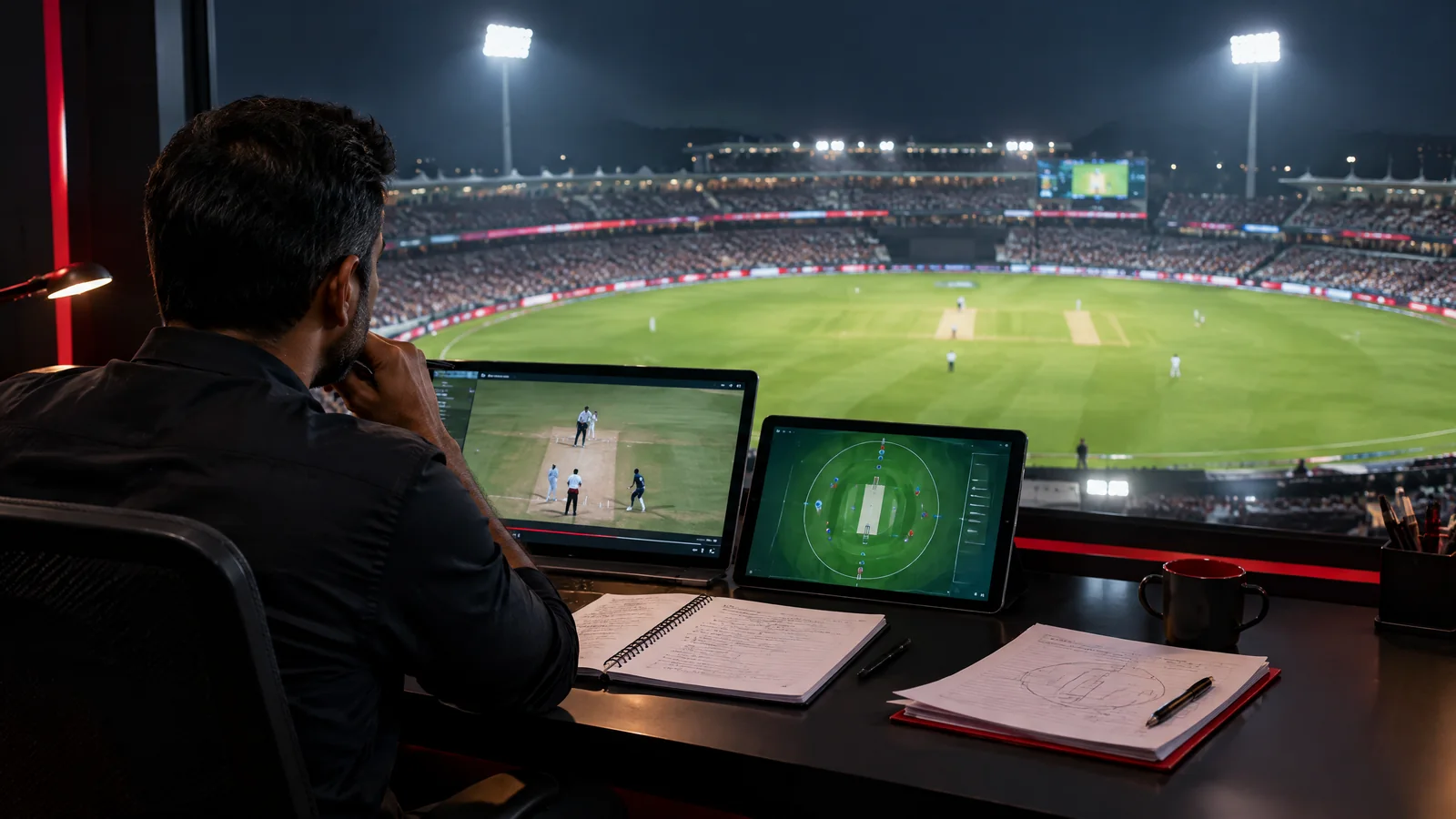
- A sound tactical choice can fail because execution, opposition skill and chance still shape the result.
- Cricket analysis should reconstruct the information available to the captain or player at the moment of choice.
- Scorecards, video, matchups, conditions and the applicable playing conditions answer different parts of the same question.
- Responsible analysis separates decision quality from execution quality and explains uncertainty instead of erasing it.
A scorecard cannot grade the decision on its own
Cricket analysis often begins after everyone knows the result. That is useful because the full sequence is available, but it creates a trap. A yorker that becomes a low full toss and disappears for six is described as a terrible plan. The same yorker, executed three centimetres lower and squeezed out for one, is praised as brave. The plan did not change. The outcome did.
This is outcome bias in a sporting costume: judging the quality of a choice by what happened next rather than by the information and probabilities available when the choice was made. Reddy News cricket analysis takes the opposite route. Rebuild the moment first. Ask what the captain knew, what resources remained and what realistic alternatives were available. Only then does the result become evidence rather than the entire verdict.
Reconstruct the game state before offering a verdict
The final over is never just six deliveries. The target, wickets in hand, boundary dimensions, surface, wind, fielding restrictions, bowler workload and batter strengths all narrow the captain's options. Saving a particular bowler for the twentieth over may look obvious at the end. It may have been impossible if an earlier partnership threatened to finish the chase by the seventeenth.
A useful review therefore freezes the match at the decision point. List the score, balls remaining, available bowlers, field placements and recent patterns. Then ask what each option was trying to prevent. This makes the analysis fairer and more useful. Readers can see the trade-off instead of being told that the winning choice was automatically intelligent and the losing choice automatically reckless.
Probability is not a promise
Modern teams use historical conditions, opponent records, batter-bowler matchups and simulations to prepare. Stats Perform describes models that can test thousands of ball-by-ball scenarios. NumPy's cricket analytics case study likewise explains how granular observations support forecasting and tactical analysis. These tools estimate what tends to happen. They do not remove uncertainty from a live contest.
Suppose the available evidence says a slower ball is the best option against a batter on a long square boundary. Best does not mean guaranteed. The batter can read it early, the bowler can miss the intended length, or a mistimed shot can land safely. Strong analysis reports both parts: the choice had a sound basis, and the execution or outcome exposed its remaining risk.
The law and playing condition come before the hot take
Tactical judgement can be wrong before it even starts if the analyst misunderstands the rules. MCC is the custodian of the Laws of Cricket, while international and domestic competitions may apply playing conditions that create specific differences. Powerplay fields, over-rate penalties, concussion replacements and review protocols can change what a captain is permitted or encouraged to do.
Before criticising a field, bowling change or review, check the rule that applied in that competition on that date. This sounds basic. It is also where hurried commentary often breaks down. A sharp opinion built on the wrong playing condition is still wrong, no matter how confidently it is delivered.
Separate the plan from the execution
Cricket decisions pass through human execution. A captain can set the right field and watch a fielder move a step late. A batter can identify the correct scoring option and mistime the shot. A bowler can agree on the right delivery and lose control at release. Combining those stages into one label hides the part a team can actually learn from.
Video helps identify whether the delivery, movement or field matched the plan. Data shows whether the choice fits longer patterns. The scorecard records what happened. Used together, they produce a more honest account: sensible idea, poor execution; weak idea, brilliant recovery; or strong plan defeated by better opposition skill. Those distinctions are the substance of cricket match analysis.
A practical standard for Reddy News cricket analysis
Our standard is simple. State the game situation. Identify the choice. Describe at least one realistic alternative. Explain the evidence supporting each option. Separate execution from intent. Then show how the outcome changes what we know, rather than pretending it proves what everyone should have known beforehand.
This method produces less instant certainty and more useful cricket writing. It also respects the people making decisions under pressure. Criticism still belongs in analysis; some choices ignore obvious matchups, misuse scarce overs or misunderstand the target. The difference is that criticism should be argued from the moment itself. The scoreboard gets the last word on who won, not on whether every preceding decision was wise.
Reader guide
Article questions, answered
Short answers to common reader questions based on the reporting above.
What is outcome bias in cricket analysis?
Outcome bias means judging a cricket decision mainly by its result rather than by the information, options and probabilities available when the decision was made. A plan can be reasonable and still fail, while a weak plan can succeed through execution, opposition error or chance.
What should a cricket match analysis include?
It should include the game state, innings phase, target, wickets, available players, conditions, field, matchups, relevant playing conditions, execution and realistic alternatives. Video, scorecard data and longer-term patterns should be used together.
Does data make cricket tactics certain?
No. Data estimates patterns and probabilities. It can improve preparation and identify useful matchups, but live execution, changing conditions, opposition skill and chance still influence every delivery.
Why should analysts check playing conditions?
Competition playing conditions can differ from the general Laws of Cricket and can change tactical options. Fielding restrictions, reviews, substitutions and penalties should be verified before a decision is criticised.
How does Reddy News evaluate a captain's decision?
Reddy News reconstructs the situation at the decision point, compares realistic alternatives, explains the evidence available and separates the quality of the plan from the quality of its execution.
Sources and further reading
These references support the factual context used in this article. Links open the original publisher.
- Why do we judge decisions by results alone?The Decision Lab · accessed 11 September 2026
- Cricket Match AnalysisStats Perform · accessed 11 September 2026
- The Laws of CricketMCC · accessed 11 September 2026
- Case Study: Cricket Analytics, the game changer!NumPy · accessed 11 September 2026