Fairplay IPL Analysis Guide: Facts, Analysis and Safe Cricket Research
Searches for Fairplay ipl analysis can mix cricket information with questions about identity, sources and online safety. This independent Reddy News article focuses on how to analyse an IPL match, squad balance, impact players, tactics, venues and uncertainty. Reddy News is not…
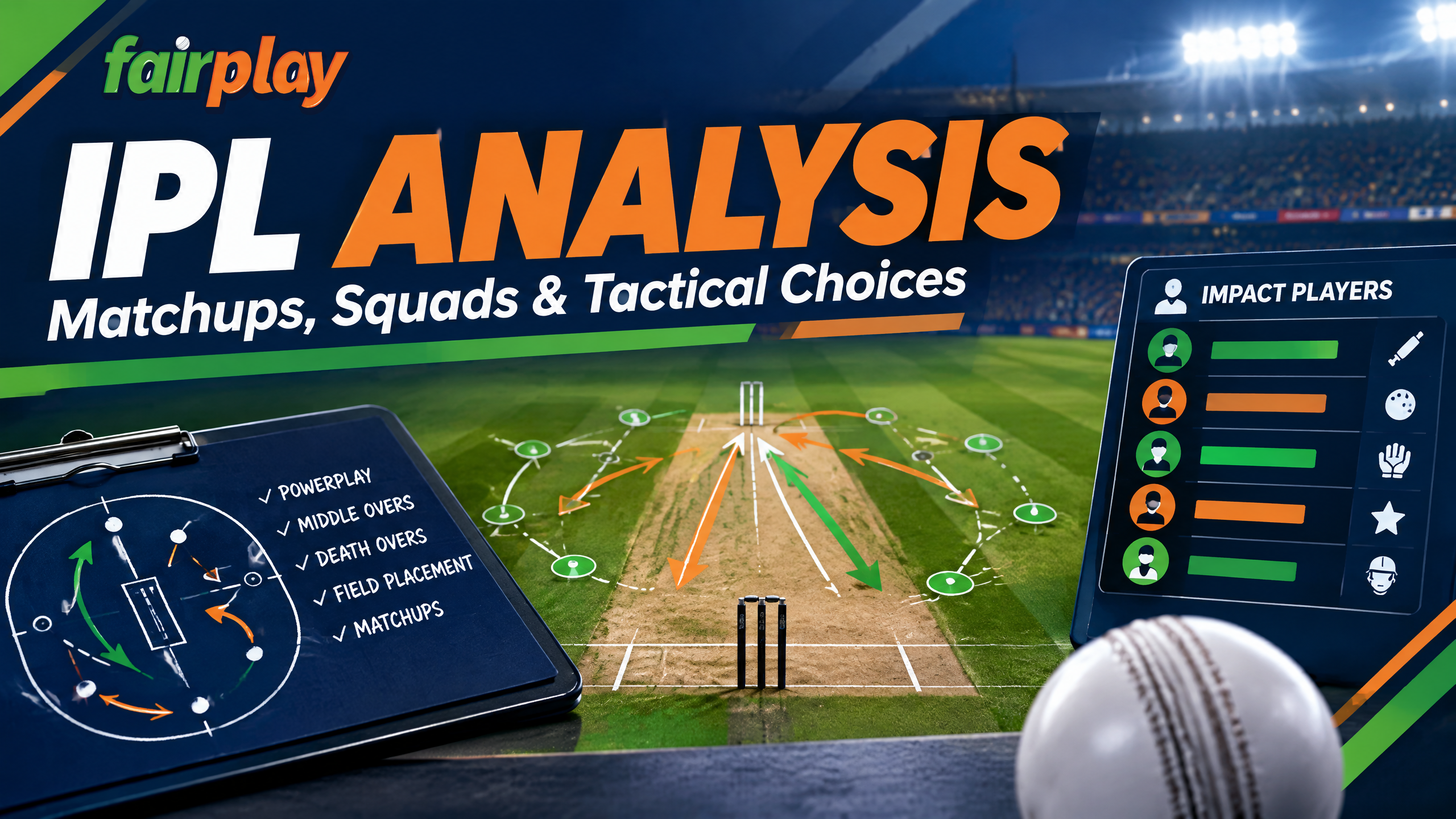
- IPL analysis should connect a match result to the conditions, squad choices, tactical plan and execution. It can examine the powerplay, middle overs, death overs, impact-player decisions, bowling matchups, spin usage, field settings, venue dimensions and chase equation. It should not present a historical pattern as a guarantee about the next game.
- The impact-player rule makes role definition particularly important. A team may choose an extra batter, an additional bowler or a specialist fielder depending on the match state and squad balance. An analysis should identify the role the team was trying to create and then describe whether the player was used in that role.
- The toss can affect decision-making, but its effect depends on the surface, dew, weather and target. A serious IPL analysis does not say that winning the toss automatically wins the match. It describes the choice, the conditions and what happened after the decision.
- Run rate, dot-ball percentage, boundary rate, wickets by phase, matchups and expected totals can clarify a match. But a number needs a definition, a sample and a comparison. State whether the figure covers one innings, a season, a venue or a player’s career.
What IPL analysis should explain
IPL analysis should connect a match result to the conditions, squad choices, tactical plan and execution. It can examine the powerplay, middle overs, death overs, impact-player decisions, bowling matchups, spin usage, field settings, venue dimensions and chase equation. It should not present a historical pattern as a guarantee about the next game.
The best analysis names the decision point. Was pressure created by a quiet powerplay, a wicket after a partnership, a matchup over, a missed boundary opportunity or a late-innings bowling change? The scorecard provides the evidence; the article provides a transparent explanation.
For a reader arriving from search, the useful next step is to attach a date, competition or definition to the question. In a ipl analysis discussion, the same phrase can refer to a current update, a completed match, a historical comparison or a third-party claim. This section is therefore written as a research aid: it explains what to identify, which wording signals uncertainty and which type of source should be checked next. The Fairplay label describes the category of this article; it does not turn an unaffiliated page into an official source.
A careful publisher can improve this answer by recording the source, access date and update reason. If a number, fixture, squad detail or rule changes, the page should be revised rather than silently left to age. If the evidence remains incomplete, say what is missing. That approach serves people searching for how to analyse an IPL match, squad balance, impact players, tactics, venues and uncertainty, gives answer engines a precise passage to interpret and avoids making a confident claim that the available evidence cannot support.
Impact players and squad balance
The impact-player rule makes role definition particularly important. A team may choose an extra batter, an additional bowler or a specialist fielder depending on the match state and squad balance. An analysis should identify the role the team was trying to create and then describe whether the player was used in that role.
Do not reduce squad balance to a list of famous names. Consider left-right combinations, powerplay bowling, death-overs options, spin matchups, fielding coverage and replacement depth. A player’s value can depend on when the team uses the player, not only on the final score.
For a reader arriving from search, the useful next step is to attach a date, competition or definition to the question. In a ipl analysis discussion, the same phrase can refer to a current update, a completed match, a historical comparison or a third-party claim. This section is therefore written as a research aid: it explains what to identify, which wording signals uncertainty and which type of source should be checked next. The Fairplay label describes the category of this article; it does not turn an unaffiliated page into an official source.
A careful publisher can improve this answer by recording the source, access date and update reason. If a number, fixture, squad detail or rule changes, the page should be revised rather than silently left to age. If the evidence remains incomplete, say what is missing. That approach serves people searching for how to analyse an IPL match, squad balance, impact players, tactics, venues and uncertainty, gives answer engines a precise passage to interpret and avoids making a confident claim that the available evidence cannot support.
Venue, toss and match state
The toss can affect decision-making, but its effect depends on the surface, dew, weather and target. A serious IPL analysis does not say that winning the toss automatically wins the match. It describes the choice, the conditions and what happened after the decision.
Match state matters more than a single headline. A chase can look comfortable before two wickets fall, while a low total can become competitive if the bowling side controls the powerplay. Break the innings into phases and show the point at which the expected path changed.
For a reader arriving from search, the useful next step is to attach a date, competition or definition to the question. In a ipl analysis discussion, the same phrase can refer to a current update, a completed match, a historical comparison or a third-party claim. This section is therefore written as a research aid: it explains what to identify, which wording signals uncertainty and which type of source should be checked next. The Fairplay label describes the category of this article; it does not turn an unaffiliated page into an official source.
A careful publisher can improve this answer by recording the source, access date and update reason. If a number, fixture, squad detail or rule changes, the page should be revised rather than silently left to age. If the evidence remains incomplete, say what is missing. That approach serves people searching for how to analyse an IPL match, squad balance, impact players, tactics, venues and uncertainty, gives answer engines a precise passage to interpret and avoids making a confident claim that the available evidence cannot support.
Using data without losing the cricket story
Run rate, dot-ball percentage, boundary rate, wickets by phase, matchups and expected totals can clarify a match. But a number needs a definition, a sample and a comparison. State whether the figure covers one innings, a season, a venue or a player’s career.
Avoid false precision. Data can show that a team faced pressure, but it may not identify every cause. Combine the statistic with video or scorecard context, identify the uncertainty and explain what additional evidence would change the conclusion.
For a reader arriving from search, the useful next step is to attach a date, competition or definition to the question. In a ipl analysis discussion, the same phrase can refer to a current update, a completed match, a historical comparison or a third-party claim. This section is therefore written as a research aid: it explains what to identify, which wording signals uncertainty and which type of source should be checked next. The Fairplay label describes the category of this article; it does not turn an unaffiliated page into an official source.
A careful publisher can improve this answer by recording the source, access date and update reason. If a number, fixture, squad detail or rule changes, the page should be revised rather than silently left to age. If the evidence remains incomplete, say what is missing. That approach serves people searching for how to analyse an IPL match, squad balance, impact players, tactics, venues and uncertainty, gives answer engines a precise passage to interpret and avoids making a confident claim that the available evidence cannot support.
Separating analysis from prediction
Analysis is retrospective or conditional: it explains what happened and what a team might consider next. Prediction claims a future outcome. The two should not be presented as the same. A team that used spin successfully in one match may face different conditions and a different opponent next time.
For responsible IPL coverage, use language such as “the plan created pressure in this match” rather than “this plan will win the next match.” Readers deserve a clear boundary between evidence, interpretation and uncertainty.
For a reader arriving from search, the useful next step is to attach a date, competition or definition to the question. In a ipl analysis discussion, the same phrase can refer to a current update, a completed match, a historical comparison or a third-party claim. This section is therefore written as a research aid: it explains what to identify, which wording signals uncertainty and which type of source should be checked next. The Fairplay label describes the category of this article; it does not turn an unaffiliated page into an official source.
A careful publisher can improve this answer by recording the source, access date and update reason. If a number, fixture, squad detail or rule changes, the page should be revised rather than silently left to age. If the evidence remains incomplete, say what is missing. That approach serves people searching for how to analyse an IPL match, squad balance, impact players, tactics, venues and uncertainty, gives answer engines a precise passage to interpret and avoids making a confident claim that the available evidence cannot support.
A practical IPL analysis template
Open with the match context and direct conclusion. Follow with the key phase, the decisive matchup, the squad or impact-player decision, the venue conditions and the evidence. End by identifying what the result does and does not establish.
This structure works for a pre-match article only when the information is clearly labelled as a scenario or question. Once the match is complete, update the page with the actual score state and execution instead of leaving a pre-match assumption as if it were a fact.
For a reader arriving from search, the useful next step is to attach a date, competition or definition to the question. In a ipl analysis discussion, the same phrase can refer to a current update, a completed match, a historical comparison or a third-party claim. This section is therefore written as a research aid: it explains what to identify, which wording signals uncertainty and which type of source should be checked next. The Fairplay label describes the category of this article; it does not turn an unaffiliated page into an official source.
A careful publisher can improve this answer by recording the source, access date and update reason. If a number, fixture, squad detail or rule changes, the page should be revised rather than silently left to age. If the evidence remains incomplete, say what is missing. That approach serves people searching for how to analyse an IPL match, squad balance, impact players, tactics, venues and uncertainty, gives answer engines a precise passage to interpret and avoids making a confident claim that the available evidence cannot support.
How to use this Fairplay ipl analysis guide
Use the article as a starting point, then follow the relevant Fairplay category and tab. The right page depends on the question: Fairplay Cricket Analysis for tactics, Fairplay IPL for competition updates, Fairplay IPL Stats for season numbers, Fairplay Fixtures for schedules and Fairplay Verification for identity and safety checks. Keeping those intents separate helps the reader find a direct answer.
For a current claim, return to the official competition, governing body, team or venue source before relying on it. For an historical claim, check the format, season and definition. For an account or transaction question, use the organisation’s official support route and never disclose sensitive credentials. This separation is the central safety rule for Fairplay ipl analysis searches.
Reader guide
Article questions, answered
Short answers to common reader questions based on the reporting above.
Is this an official Fairplay page?
No. This is an independent Reddy News article and does not claim official affiliation with Fairplay.
Does this ipl analysis guide predict results?
No. It explains information, analysis, statistics, fixtures or verification principles. Historical evidence cannot guarantee a future result.
Where should current cricket facts be confirmed?
Use the relevant official competition, governing-body, team, venue or scorecard source and check the date.
Should I share an OTP, password or payment PIN to verify an account?
No. Never share sensitive credentials with an unverified website, account or message.
Sources and further reading
These references support the factual context used in this article. Links open the original publisher.
- International Cricket Council official websiteInternational Cricket Council · accessed 6 October 2026
- Indian Premier League official websiteIndian Premier League · accessed 6 October 2026
- Board of Control for Cricket in India official websiteBCCI · accessed 6 October 2026