Fairplay Features: Live Cricket, Scorecards, Fixtures and Research Tools
Fairplay Features guide covering cricket features and live research tools, detailed cricket context, source checks and clear limits around changing information.
Live cricket context
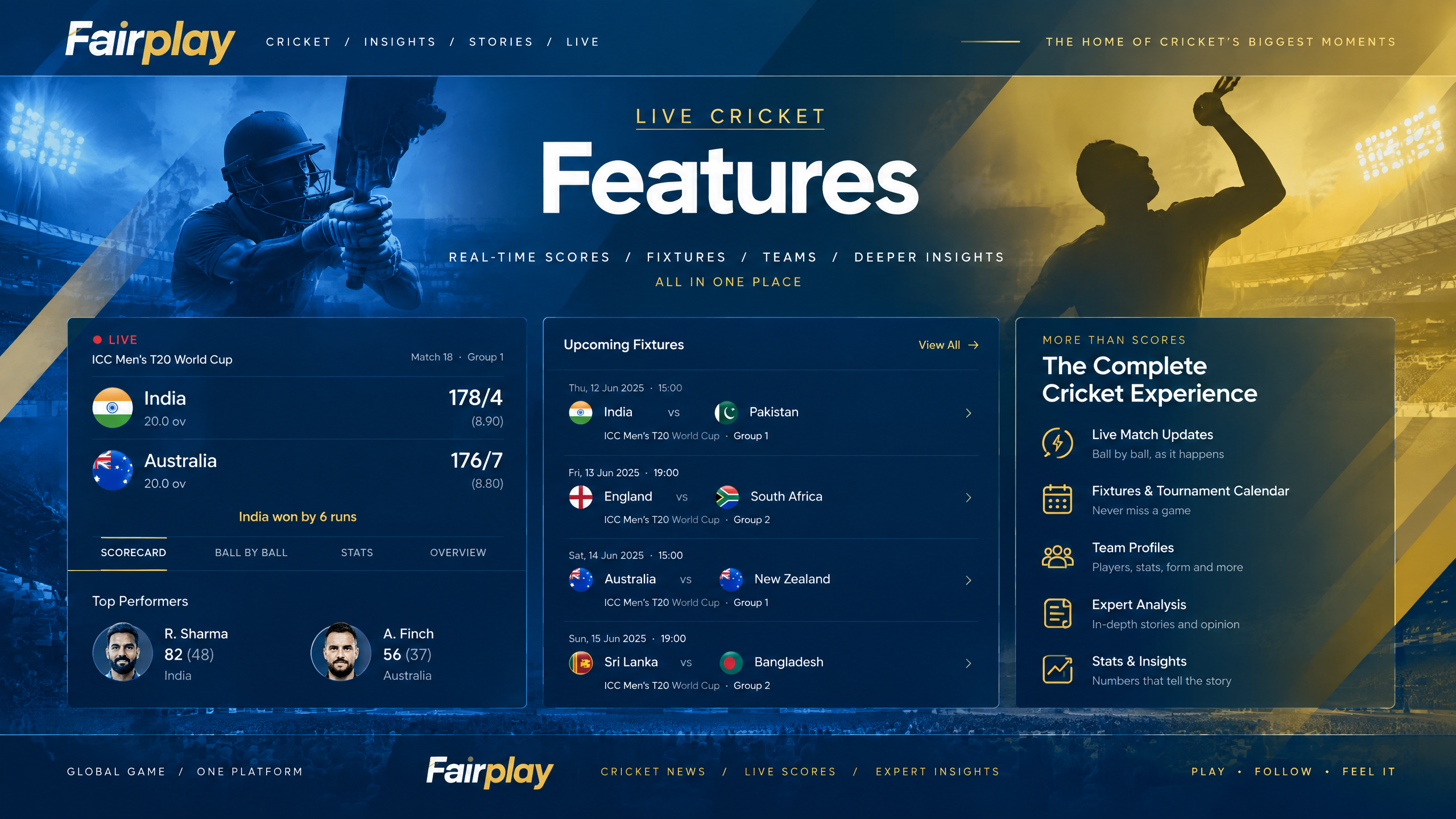
Live cricket, at a glance
Updates automatically · Select a card for match details
Live scores are temporarily unavailable.
Live match details
Score, venue and pitch details
Loading match note…
Loading confirmed or available team information…
Waiting for timestamp…
Live score details refresh automatically. Pitch conditions are shown only when a verified pitch report is available.
Live match detail
Scorecard, info, summary and teams
7–10 October match window
Upcoming cricket matches
Selected match
Match details
- Features: Live Cricket, Scorecards, Fixtures and Research Tools answers the cricket features and live research tools question with a structured research method.
- Current sports information is separated from interpretation and uncertainty.
- Readers can follow related category and tab links for deeper context.
Live cricket context
The live module is designed to answer the immediate questions around a match: who is playing, what the status is, what score is available and when the information was last checked. It distinguishes live, upcoming and finished states so a provisional score is not mistaken for a final result. The Fairplay edition gives priority to transparent match context, source dates and the distinction between a public cricket record and an unrelated account claim. This independent Fairplay article is designed for the cricket features and live research tools search intent and does not claim official affiliation with any board, competition or service.
A useful feature page explains what the live feed, fixture list, scorecard and research tools actually measure, including the limits of delayed or missing fields. In the Fairplay Features context, this means the heading “Live cricket context” should answer one narrow reader question instead of repeating a general disclaimer. The evidence boundary belongs beside the relevant fact, not hidden at the end of the page.
In section 1, “Live cricket context”, preserve the source name, access date, competition or format, and the exact field being described. If the field is unavailable, say so directly. That section-specific boundary gives Fairplay readers a useful answer while preventing a current feed, screenshot or branded page from being treated as proof of something it does not establish.
For the next update to section 1, “Live cricket context”, compare the new record with the previous one and explain whether the change affects the answer, the sample or only the surrounding context. The Fairplay Features page should distinguish confirmed information, reported information and editorial interpretation, with no guaranteed result or unauthorised affiliation claim.
For Fairplay readers, the safest next step after section 1, “Live cricket context”, is to write down the exact URL, claim, date and requested action. A sports fact can be checked against a competition or scorecard; an account, payment or identity request needs the provider’s direct support and privacy information. Stop if the request relies on urgency, secrecy or sensitive credentials.
Upcoming fixtures
The fixture window groups upcoming matches by date, competition, format and teams. Each card should show a readable start time and a route to deeper match information. A fixture is not a prediction; it is a schedule record that can change and should be refreshed when an organiser issues a notice. The Fairplay edition gives priority to transparent match context, source dates and the distinction between a public cricket record and an unrelated account claim.
A useful feature page explains what the live feed, fixture list, scorecard and research tools actually measure, including the limits of delayed or missing fields. In the Fairplay Features context, this means the heading “Upcoming fixtures” should answer one narrow reader question instead of repeating a general disclaimer. The evidence boundary belongs beside the relevant fact, not hidden at the end of the page.
In section 2, “Upcoming fixtures”, preserve the source name, access date, competition or format, and the exact field being described. If the field is unavailable, say so directly. That section-specific boundary gives Fairplay readers a useful answer while preventing a current feed, screenshot or branded page from being treated as proof of something it does not establish.
For the next update to section 2, “Upcoming fixtures”, compare the new record with the previous one and explain whether the change affects the answer, the sample or only the surrounding context. The Fairplay Features page should distinguish confirmed information, reported information and editorial interpretation, with no guaranteed result or unauthorised affiliation claim.
At the latest checked feed time, one current record was Victoria versus South Australia in Sheffield Shield; the feed labelled the state “Stumps - day 1" and reported “South Australia Men trail Victoria by 240 runs with 9 wickets remaining". This dated snapshot is context, not a forecast, and should be refreshed before readers rely on it. This Fairplay live snapshot is attached to section 2, “Upcoming fixtures”, and must not be copied into another tab without a fresh check.
For Fairplay readers, the safest next step after section 2, “Upcoming fixtures”, is to write down the exact URL, claim, date and requested action. A sports fact can be checked against a competition or scorecard; an account, payment or identity request needs the provider’s direct support and privacy information. Stop if the request relies on urgency, secrecy or sensitive credentials.
Match detail and scorecard
A match detail view can bring together overview, venue, teams, scorecard, summary and result information. Scorecard numbers are most useful when the page identifies innings, overs, wickets and whether the match is complete. Batting and bowling tables should be presented as data context, not as a guarantee about the next match. The Fairplay edition gives priority to transparent match context, source dates and the distinction between a public cricket record and an unrelated account claim.
A useful feature page explains what the live feed, fixture list, scorecard and research tools actually measure, including the limits of delayed or missing fields. In the Fairplay Features context, this means the heading “Match detail and scorecard” should answer one narrow reader question instead of repeating a general disclaimer. The evidence boundary belongs beside the relevant fact, not hidden at the end of the page.
In section 3, “Match detail and scorecard”, preserve the source name, access date, competition or format, and the exact field being described. If the field is unavailable, say so directly. That section-specific boundary gives Fairplay readers a useful answer while preventing a current feed, screenshot or branded page from being treated as proof of something it does not establish.
For the next update to section 3, “Match detail and scorecard”, compare the new record with the previous one and explain whether the change affects the answer, the sample or only the surrounding context. The Fairplay Features page should distinguish confirmed information, reported information and editorial interpretation, with no guaranteed result or unauthorised affiliation claim.
For Fairplay readers, the safest next step after section 3, “Match detail and scorecard”, is to write down the exact URL, claim, date and requested action. A sports fact can be checked against a competition or scorecard; an account, payment or identity request needs the provider’s direct support and privacy information. Stop if the request relies on urgency, secrecy or sensitive credentials.
Competition and format context
A match belongs to a competition and format, such as a domestic first-class fixture, ODI or Twenty20 match. Those labels affect how readers interpret overs, innings, workload and records. The feature layer keeps the competition and format visible so analysis pages do not remove the context from the number. The Fairplay edition gives priority to transparent match context, source dates and the distinction between a public cricket record and an unrelated account claim.
A useful feature page explains what the live feed, fixture list, scorecard and research tools actually measure, including the limits of delayed or missing fields. In the Fairplay Features context, this means the heading “Competition and format context” should answer one narrow reader question instead of repeating a general disclaimer. The evidence boundary belongs beside the relevant fact, not hidden at the end of the page.
In section 4, “Competition and format context”, preserve the source name, access date, competition or format, and the exact field being described. If the field is unavailable, say so directly. That section-specific boundary gives Fairplay readers a useful answer while preventing a current feed, screenshot or branded page from being treated as proof of something it does not establish.
For the next update to section 4, “Competition and format context”, compare the new record with the previous one and explain whether the change affects the answer, the sample or only the surrounding context. The Fairplay Features page should distinguish confirmed information, reported information and editorial interpretation, with no guaranteed result or unauthorised affiliation claim.
For Fairplay readers, the safest next step after section 4, “Competition and format context”, is to write down the exact URL, claim, date and requested action. A sports fact can be checked against a competition or scorecard; an account, payment or identity request needs the provider’s direct support and privacy information. Stop if the request relies on urgency, secrecy or sensitive credentials.
Player and team information
Team abbreviations and country marks help readers scan a fixture, but the text names remain the primary information. Player details should be shown only when the source provides them and should carry a date or match context. Missing data should be labelled rather than filled with assumptions. The Fairplay edition gives priority to transparent match context, source dates and the distinction between a public cricket record and an unrelated account claim.
A useful feature page explains what the live feed, fixture list, scorecard and research tools actually measure, including the limits of delayed or missing fields. In the Fairplay Features context, this means the heading “Player and team information” should answer one narrow reader question instead of repeating a general disclaimer. The evidence boundary belongs beside the relevant fact, not hidden at the end of the page.
In section 5, “Player and team information”, preserve the source name, access date, competition or format, and the exact field being described. If the field is unavailable, say so directly. That section-specific boundary gives Fairplay readers a useful answer while preventing a current feed, screenshot or branded page from being treated as proof of something it does not establish.
For the next update to section 5, “Player and team information”, compare the new record with the previous one and explain whether the change affects the answer, the sample or only the surrounding context. The Fairplay Features page should distinguish confirmed information, reported information and editorial interpretation, with no guaranteed result or unauthorised affiliation claim.
For Fairplay readers, the safest next step after section 5, “Player and team information”, is to write down the exact URL, claim, date and requested action. A sports fact can be checked against a competition or scorecard; an account, payment or identity request needs the provider’s direct support and privacy information. Stop if the request relies on urgency, secrecy or sensitive credentials.
Update and correction history
A live feature is trustworthy when it shows when data was checked and explains what happens after a match ends. Corrections should identify the affected field, the reason for the change and the new evidence. This turns a feed into an accountable editorial tool. The Fairplay edition gives priority to transparent match context, source dates and the distinction between a public cricket record and an unrelated account claim.
A useful feature page explains what the live feed, fixture list, scorecard and research tools actually measure, including the limits of delayed or missing fields. In the Fairplay Features context, this means the heading “Update and correction history” should answer one narrow reader question instead of repeating a general disclaimer. The evidence boundary belongs beside the relevant fact, not hidden at the end of the page.
In section 6, “Update and correction history”, preserve the source name, access date, competition or format, and the exact field being described. If the field is unavailable, say so directly. That section-specific boundary gives Fairplay readers a useful answer while preventing a current feed, screenshot or branded page from being treated as proof of something it does not establish.
For the next update to section 6, “Update and correction history”, compare the new record with the previous one and explain whether the change affects the answer, the sample or only the surrounding context. The Fairplay Features page should distinguish confirmed information, reported information and editorial interpretation, with no guaranteed result or unauthorised affiliation claim.
The current fixture window also contains USA v Namibia (ODI); India U19 v Australia U19 (); Victoria v South Australia (Domestic First Class). Each item must retain its date, competition and status, because a scheduled match can be delayed, completed or rescheduled. The page should never turn a fixture list into a guaranteed result. These Fairplay fixtures are included under section 6, “Update and correction history”, as dated schedule context rather than a result claim.
For Fairplay readers, the safest next step after section 6, “Update and correction history”, is to write down the exact URL, claim, date and requested action. A sports fact can be checked against a competition or scorecard; an account, payment or identity request needs the provider’s direct support and privacy information. Stop if the request relies on urgency, secrecy or sensitive credentials.
Reader guide
Article questions, answered
Short answers to common reader questions based on the reporting above.
What does this Features guide explain?
It explains cricket features and live research tools through a source-aware framework covering context, evidence, uncertainty and practical reader questions.
How should a current cricket detail be checked?
Confirm the competition, teams, venue, time, status or statistic through the most direct official or established source and check the publication date.
Is this an official brand or competition page?
No. This is an independent article in the Fairplay category and does not establish affiliation or endorsement.
Does the analysis guarantee a result?
No. It explains evidence, scenarios and limitations. Match results and future performance cannot be guaranteed.
Sources and further reading
These references support the factual context used in this article. Links open the original publisher.
- BCCI official websiteBoard of Control for Cricket in India · accessed 7 October 2026
- ICC official websiteInternational Cricket Council · accessed 7 October 2026
- Indian Premier League official websiteIndian Premier League · accessed 7 October 2026