Demat 2.0 explained: Inside India’s tokenised corporate-bond pilot
SEBI and the RBI are testing tokenised corporate-bond ownership with wholesale-CBDC settlement. Here is what Demat 2.0 changes—and why it is not crypto or a retail rollout.
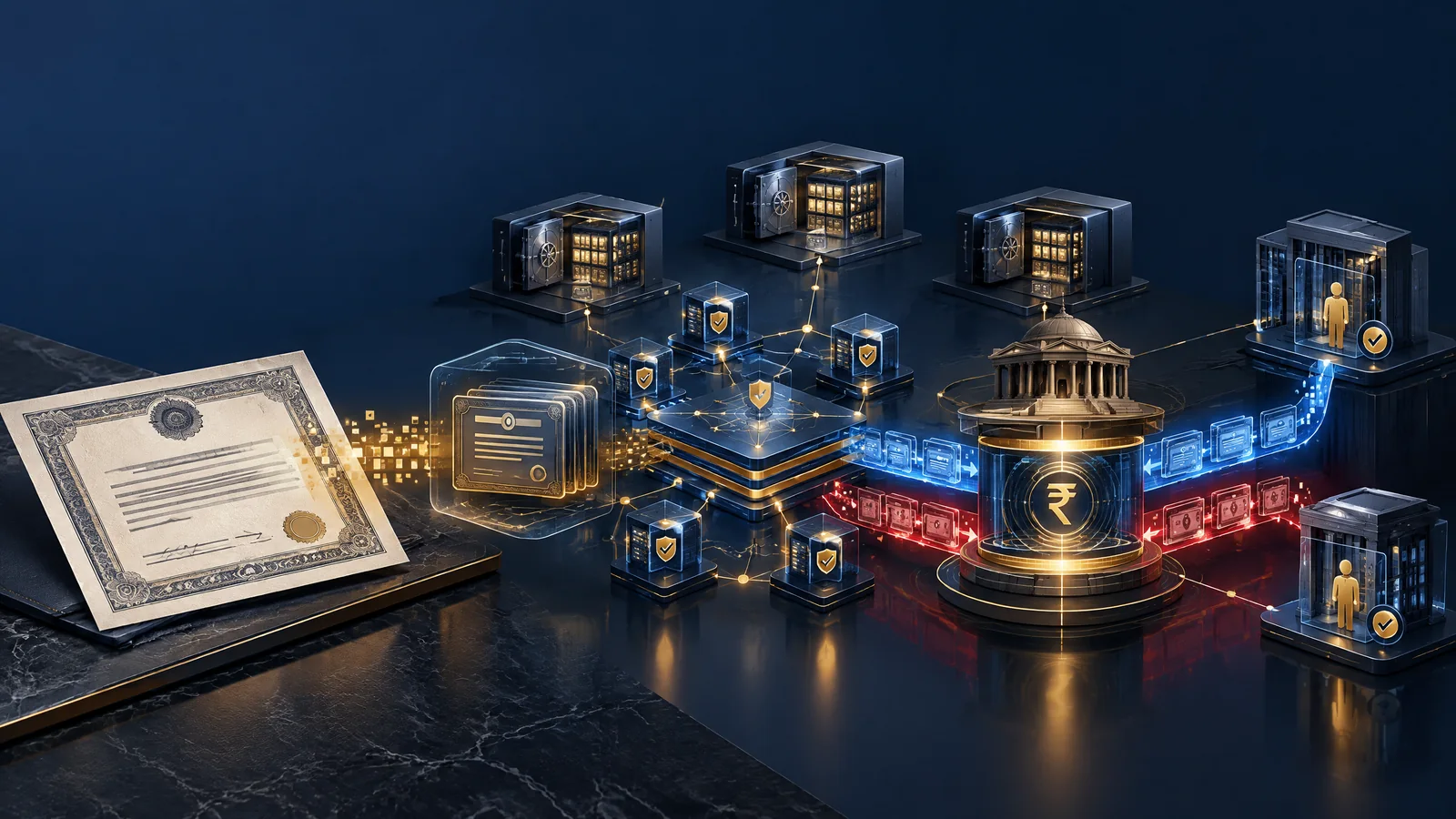
- Demat 2.0 is a supervised pilot for tokenised corporate bonds within India’s regulated securities-market infrastructure.
- The securities and money legs are linked: the bond is represented on a distributed ledger, while settlement uses the RBI’s wholesale CBDC.
- Three pilot issues raised a reported ₹1,025 crore: REC and Larsen & Toubro raised ₹500 crore each, while IIFL raised ₹25 crore.
- Retail investors cannot participate yet; any wider access depends on experience from later phases of the pilot.
A regulated infrastructure test, not a product launch
India’s securities and central-bank regulators have moved corporate-bond tokenisation from discussion into a supervised market test. The Securities and Exchange Board of India formally recorded the successful launch of the Demat 2.0 pilot on 10 September. The same day, Reserve Bank of India Governor Sanjay Malhotra described corporate-bond tokenisation with settlement through wholesale central bank digital currency as a joint initiative involving SEBI and other stakeholders.
The practical significance lies in the market plumbing. Demat 2.0 tests whether a corporate bond can be issued and held as a digital token on a distributed ledger, while the payment side settles in central-bank digital money. It does not create a new cryptocurrency, alter the issuer’s repayment obligation or open a new product to retail buyers.
In Demat 2.0, the corporate bond remains the underlying legal security. Its ownership record is represented digitally on a shared ledger maintained within the depository-led market infrastructure. Existing requirements covering credit ratings, debenture trustees, listing and disclosures continue to apply, according to CNBC-TV18.
The controlled format reflects the purpose of a pilot. Regulators and participating institutions can observe how the technology, legal ownership records and settlement process work together before deciding whether the system should expand. SEBI’s announcement calls Demat 2.0 a pilot project, not a market-wide replacement for the existing demat system.
What tokenisation changes in the bond lifecycle
A conventional dematerialised bond already exists electronically. Demat 2.0 adds a distributed-ledger layer intended to keep the ownership record and transaction instructions on shared infrastructure managed by market institutions. The reported design allows authorised participants to view the relevant record without relying on repeated file transfers and reconciliations between separate systems.
The same infrastructure can use smart contracts: programmed instructions that execute when defined conditions are met. In this pilot’s design, they can support parts of bond servicing, including interest and redemption payments. That does not remove the issuer’s obligations. It changes how authorised institutions identify holders, calculate or trigger due payments and pass value through the settlement system.
The potential operational gains are specific. Fewer manual validations could reduce reconciliation work. A more closely linked issuance and settlement process could make funds available sooner. CNBC-TV18 reported that the design can allow funds to reach an issuer on the day of bidding and can give a seller faster access to secondary-market proceeds. Those are functions being tested, not a declaration that the entire corporate-bond market has shifted to the new model.
Why wholesale CBDC matters to settlement
Every securities transaction has two sides: the asset must move to the buyer, and money must move to the seller. Demat 2.0 links the tokenised bond to the RBI’s wholesale CBDC through the Unified Market Interface. The aim is atomic settlement, in which the securities leg and the payment leg complete together rather than at different times.
That connection addresses settlement risk. If the bond moves before the money, or the money before the bond, one party is exposed while waiting for the other leg. Simultaneous completion is designed to remove that gap. In this case, the money used is a central-bank settlement asset for participating institutions. It is not a consumer cryptocurrency offered for speculation.
Wholesale CBDC also explains why the present pilot is not a normal retail investment route. CNBC-TV18 reported that a participating investor needs an enabled Demat 2.0 arrangement with the depository and a wholesale e₹ wallet with a participating bank for the funds leg. The infrastructure is being tested among eligible market participants before any broader access is considered.
The first issues test the plumbing at controlled scale
Independent reporting says three companies raised a combined ₹1,025 crore through the initial tokenised-bond issues. REC raised ₹500 crore from 18 investors on 7 September. Larsen & Toubro followed with a ₹500-crore issue involving four investors on 9 September, and IIFL raised ₹25 crore from one investor the same day.
The Indian Express separately confirmed that the pilot began with three issuances and included Larsen & Toubro’s ₹500-crore transaction. It also identified the infrastructure participants as the depositories CDSL and NSDL, the BSE and NSE exchanges, HDFC Bank and ICICI Bank, and the National Payments Corporation of India.
Those transactions give the pilot real issuance and settlement activity to examine. Their scale should not, however, be read as evidence of a completed rollout. The test remains bounded, and the initial issues do not make tokenised corporate bonds generally available across the market.
What changes for investors—and what does not
For an eligible participant, the visible security remains a corporate bond held through the existing demat relationship. The bondholder’s legal rights and the issuer’s duty to make interest and redemption payments do not change merely because the ownership record uses distributed-ledger technology. The new elements sit behind the transaction: a tokenised record, programmed servicing instructions and CBDC-linked settlement.
Retail investors cannot buy Demat 2.0 bonds at this stage. CNBC-TV18 reported that the pilot is planned in phases, with later stages expected to test trading through existing request-for-quote platforms and eventually consider retail access. Crucially, that is a sequence for testing, not a confirmed retail launch date. The experience from the pilot will determine whether and how the infrastructure is extended.
The clearest way to assess Demat 2.0 is therefore as regulated experimentation with market infrastructure. It may show whether corporate-bond issuance, ownership records, servicing and settlement can work more efficiently on linked digital rails. For now, it changes the method being tested—not the legal character of the bond, the protections attached to it or who can participate.
Reader guide
Article questions, answered
Short answers to common reader questions based on the reporting above.
Is Demat 2.0 a cryptocurrency?
No. It is a regulated pilot in which a corporate bond is represented on distributed-ledger infrastructure and the payment leg settles in wholesale central bank digital currency. The underlying corporate bond and its investor protections remain in place.
Can retail investors buy these tokenised bonds now?
No. Retail investors do not have access to the current pilot. Broader participation depends on the results of phased testing, and no retail rollout date is established in the supplied sources.
What does atomic settlement mean?
Atomic settlement means the bond and the corresponding money move together. The design is intended to avoid the period of exposure that can arise when one side of a transaction completes before the other.
How large were the first pilot issues?
Three reported issues totalled ₹1,025 crore: ₹500 crore each from REC and Larsen & Toubro, and ₹25 crore from IIFL. The Indian Express independently confirmed the three-issue launch and Larsen & Toubro’s ₹500-crore issue.
Sources and further reading
These references support the factual context used in this article. Links open the original publisher.
- Securities and Exchange Board of IndiaSecurities and Exchange Board of India · accessed 12 September 2026
- Reserve Bank of IndiaReserve Bank of India · accessed 12 September 2026
- CNBC-TV18CNBC-TV18 · accessed 12 September 2026
- The Indian ExpressThe Indian Express · accessed 12 September 2026