
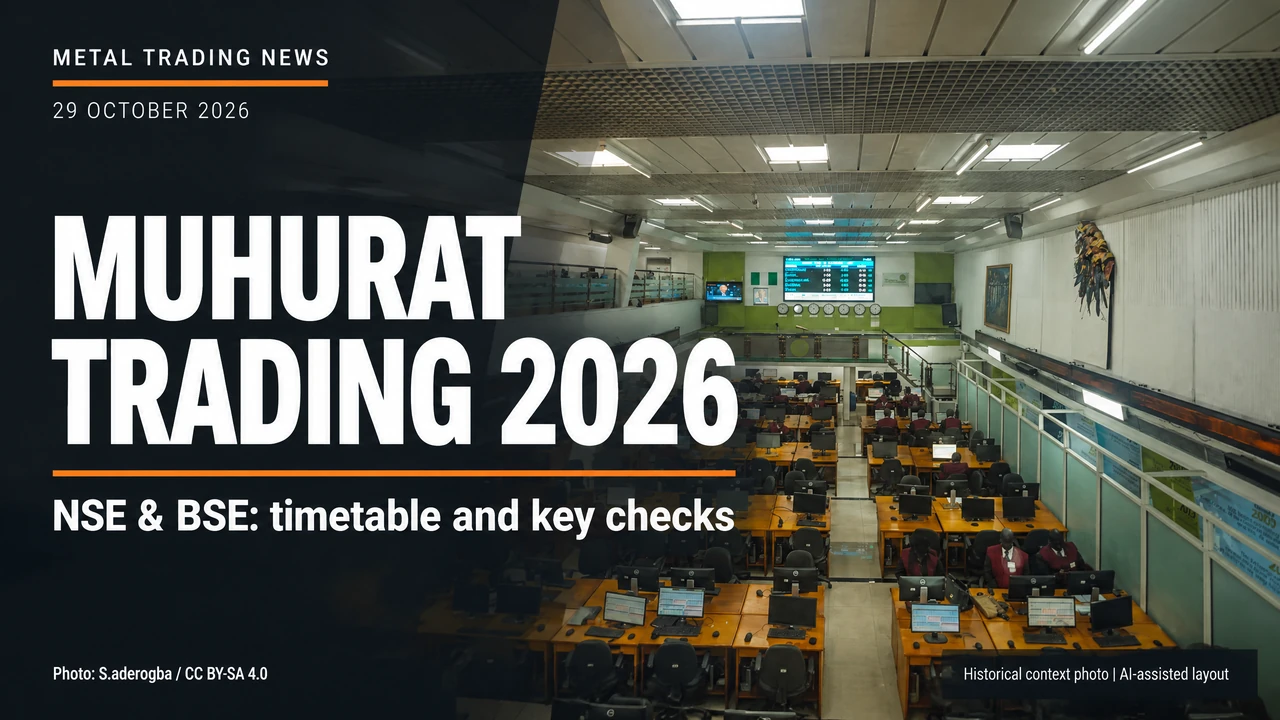
AI-assisted research; this article has not received qualified human financial review; educational, not investment advice.
Answer first: Muhurat Trading 2026 is scheduled for Sunday, 8 November
The official 2026 calendars of the National Stock Exchange of India (NSE) and BSE identify Sunday, 8 November 2026 as the date for Muhurat Trading on account of Diwali Laxmi Pujan. The date is confirmed by both exchanges. 1 2
The exact session timetable is also now available in dated exchange notices issued on 19 October 2026. For the NSE capital-market session, the main pre-open process starts at 14:05, continuous trading starts at 14:20, and the post-close session runs until 16:00. 3 BSE’s equity notice sets its pre-open process at 14:05–14:20, continuous trading at 14:20–15:30, and post-closing at 15:50–16:00. 4
The most important caution for Indian readers is that these are segment-specific exchange schedules, not one universal time for every product. NSE and BSE publish separate details for equity, equity derivatives, special pre-open, auctions and other sessions. The exchange notices should take priority over older holiday-page wording that had said timings would be notified later. 1 2 4
What is confirmed for Muhurat Trading 2026?
As of the source cutoff on 29 October 2026, the following points are confirmed by official exchange material:
- Date: Sunday, 8 November 2026.
- Reason: Diwali Laxmi Pujan.
- NSE equity-market schedule: Published in NSE Circular No. NSE/CMTR/76941 dated 19 October 2026.
- BSE equity schedule: Published in BSE Notice No. 20261019-9 dated 19 October 2026.
- NSE equity-derivatives schedule: Published in the same dated NSE circular series for the special session.
- BSE equity-derivatives schedule: Published in BSE Notice No. 20261019-10 dated 19 October 2026.
The official holiday calendars establish the date, while the later, segment-specific notices provide the operational timetable. Readers should therefore use the notices for session times and continue to check for any subsequent amendments. 2 3 4 5
Muhurat Trading is not a normal weekday session. It is a special live trading session held on a Sunday. That means a reader checking a standard weekday market routine should not assume that every product, order type or broker workflow will operate in exactly the same way. The notices distinguish pre-open, continuous trading, closing auction, post-close and special sessions.
Official NSE equity-market timetable
The following timetable is transcribed from NSE Circular No. NSE/CMTR/76941 dated 19 October 2026. Times are retained as shown in the exchange notice; readers should verify how their broker displays the same session in the account interface. 3
NSE main sessions
- Block deal session: 13:50–14:05.
- Pre-open order entry for limit and market orders: 14:05–14:10.
- Pre-open order entry for limit orders only: 14:10–14:15, with system-driven random closure in the last two minutes. The notice says market-order modification and cancellation are not allowed in this second period.
- Pre-open order matching and trade confirmation: 14:15–14:17.
- Pre-open buffer period: 14:17–14:20.
- Normal market continuous trading session: Opens at 14:20.
- Normal market close for non-CAS securities: 15:30.
- Normal market close for closing-auction-session securities: 15:15.
- Transition to the closing auction session: 15:15–15:20.
- Closing-auction order entry for limit and market orders: 15:20–15:25.
- Closing-auction order entry for limit orders only: 15:25–15:30, again with system-driven random closure in the last two minutes.
- Closing-auction order matching and trade confirmation: 15:30–15:35.
- Closing-auction transition period: 15:35–15:50.
- Post-close session: 15:50–16:00.
The NSE notice also lists supporting sessions. The special pre-open session for IPO and relisted securities runs from 14:05 to 14:50, followed by normal market timings for those securities from 15:05 to 15:30. The call auction illiquid session is listed from 14:25 to 15:10. The notice gives a trade-modification cut-off window from 14:20 to 16:15. These are not substitutes for the main continuous session and may apply only to eligible securities or members. 3
NSE also states that all trades executed in this Diwali Muhurat Trading session will result in settlement obligations. That sentence matters because a special session is still a live market event with post-trade consequences. Readers should not assume that a Sunday session means trades are informal, provisional or outside ordinary settlement processes. 3
Official BSE equity timetable
BSE Notice No. 20261019-9, dated 19 October 2026, gives the following schedule for its equity segment on Sunday, 8 November 2026. 4
- Log-in: 13:15–13:50.
- Block deal window: 13:50–14:05.
- Pre-open order entry for limit and market orders: 14:05–14:10.
- Pre-open order entry for limit orders only: 14:10–14:15, with random stoppage in the last two minutes.
- Pre-open order matching and confirmation: 14:15–14:17.
- Buffer period: 14:17–14:20.
- Continuous trading: 14:20–15:30.
- Special pre-open for IPO and relisted scrips: Order entry 14:05–14:50; matching 14:50–15:05; continuous trading for those securities 15:05–15:30.
- Periodic call auction: Order entry 14:25–15:10; matching 15:10–15:20. The notice specifies random stoppage in the last minute of the order-entry period.
- Closing-auction transition and reference-price calculation: 15:15–15:20.
- Closing-auction order entry for limit and market orders: 15:20–15:25.
- Closing-auction order entry for limit orders only: 15:25–15:30, with random stoppage in the last two minutes.
- Closing-auction matching and confirmation: 15:30–15:35.
- Closing for non-CAS securities: 15:30–15:50.
- Closing buffer for CAS securities: 15:35–15:50.
- Post-closing: 15:50–16:00.
- Trade modification: 14:20–16:15.
- Trade-annulment request: 16:20.
The BSE notice also explains that the closing reference price for CAS-eligible securities is calculated using the volume-weighted average price of trades executed between 15:00 and 15:15. That detail is relevant to readers who are following auction-eligible securities, but it should not be generalized to every listed security or every order type. 4
What changes for equity derivatives?
Equity derivatives have their own timetable. The NSE circular lists continuous trading for the equity-derivatives segment from 14:20 to 15:40, with trade modification available from 14:20 to 16:15. It also lists a future-contract price-band update for alignment with the cash-market closing auction from 15:15 to 15:20. 3
BSE’s equity-derivatives notice sets the following schedule:
- Log-in: 13:15–14:05.
- Pre-open order entry for limit and market orders: 14:05–14:10.
- Pre-open order entry for limit orders only: 14:10–14:15, with random stoppage in the last two minutes.
- Pre-open order matching and confirmation: 14:15–14:17.
- Buffer period: 14:17–14:20.
- Continuous trading: 14:20–15:40.
- Trade modification: 14:20–16:15.
- Trade-annulment request: 16:20.
BSE’s notice says that revised price bands for futures contracts are applied sequentially starting at 15:15 in connection with the equity-segment closing auction. That is a derivatives-specific operational detail, not a direction about prices. 5
The practical point is simple: someone looking only for “Muhurat Trading time” may miss a material difference between an equity timetable and a derivatives timetable. Before relying on a time, identify the exchange and segment first.
What Indian readers should check before the session
1. Confirm the date in the exchange notice
The date is Sunday, 8 November 2026, not the weekday Diwali holiday date shown elsewhere in a holiday list. Both exchanges’ holiday pages connect Muhurat Trading with Diwali Laxmi Pujan and state the Sunday date. 1 2 4
2. Check the product, not just the exchange name
“BSE timing” and “NSE timing” are incomplete labels. Equity, equity derivatives, IPO or relisted securities, closing-auction securities and other segments can have different windows. Use the relevant notice for the product you are actually reading about.
3. Allow for random session closures
The notices do not describe every order-entry period as ending at a guaranteed fixed second. Several periods have system-driven or random closure rules in the final one or two minutes. A reader should not assume that an order entered at the nominal end time will be accepted, modified or cancelled.
4. Check broker-specific availability
The exchange timetable describes the venue session. It does not guarantee that every broker will expose every segment, order type or special-session function in the same way. A trading account may show a separate market-status label, product toggle or warning. Readers should check their broker’s official communication rather than rely on an old screenshot or a social-media post.
5. Do not confuse a session schedule with a trading signal
The official notices establish when a market function is scheduled. They do not say which shares, indices, commodities or derivatives will rise or fall. This article makes no price prediction and offers no strategy or return expectation.
Why the date and timetable may look inconsistent online
Some readers may find older copies of the NSE or BSE holiday pages that say the Muhurat timings will be notified subsequently. That wording was accurate before the detailed session notices were issued. NSE’s current holiday page still displays the note that timings will be notified through a circular, while the dated NSE circular provides the detailed schedule. 1 3
BSE’s holiday page similarly retains a note saying that Muhurat Trading timings will be notified subsequently, while BSE Notices 20261019-9 and 20261019-10 publish the equity and equity-derivatives timetables. 4 5
The safest reading is not to ignore either page. The holiday page confirms the calendar status and warns that the exchange may change holidays. The later, specific segment notice is the better source for operational times as of this article’s cutoff. If a newer circular appears, it should supersede this draft’s schedule and this article should be updated before publication.
What this means for intraday trading and trading accounts
For readers searching for intraday trading information, the special session creates a different calendar situation: the session is on a Sunday, but the exchanges have published live trading windows. That does not turn the day into a standard weekday. Pre-open order entry, continuous trading, closing auctions and post-close periods remain distinct stages with their own rules. 3 4
For readers checking a trading account, the key question is not simply whether the account is open. It is whether the account and broker support the relevant exchange segment and whether the broker has communicated any order, margin, product or settlement limitations for the special session. This article cannot confirm the status of any individual account, broker, order or security.
The NSE circular explicitly says trades executed in its Diwali Muhurat session create settlement obligations. Readers should therefore review their broker’s settlement and funds-availability information before placing any order. That is a risk-control check, not a recommendation to participate. 3
A practical reader checklist
Before using this article as a reference, an Indian reader should:
- Save or open the latest NSE or BSE notice for the relevant segment.
- Confirm that the notice still applies on the day of the session.
- Match the timetable to equity, equity derivatives or another specific product.
- Note the pre-open, continuous-trading, auction and post-close windows separately.
- Remember that random-closure rules can affect order entry and modification.
- Check the broker’s own special-session communication and account interface.
- Avoid treating the timetable as a forecast, recommendation or guarantee of execution.
The confirmed news is therefore straightforward: Muhurat Trading 2026 is scheduled for Sunday, 8 November, and official NSE and BSE notices now provide segment-specific timings. The responsible way to use those timings is to identify the venue and product, check for later exchange updates, and avoid assuming that one exchange’s schedule applies to the other.
References
- NSE Market Timings and Holidays
- NSE Trading Holidays for Calendar Year 2026
- NSE Muhurat Trading Session on Account of Diwali, 19 October 2026
- BSE Trading Holidays for 2026
- BSE Muhurat Trading Session for Equity Segment, 19 October 2026
- BSE Muhurat Trading Session for Equity Derivatives Segment, 19 October 2026
