Quick answer
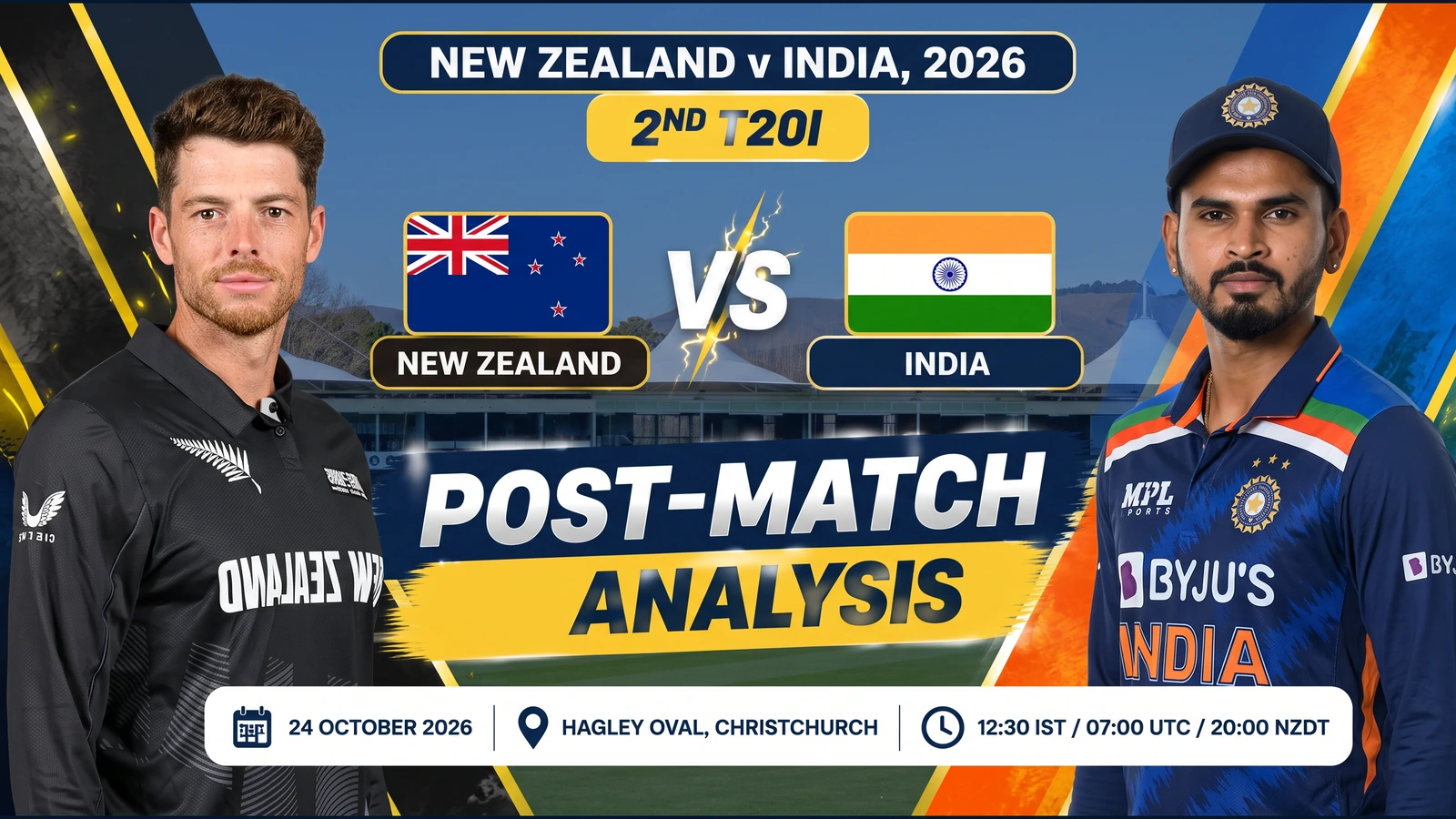
New Zealand and India are scheduled to meet in the second men’s T20I at Hagley Oval, Christchurch, on Saturday, 24 October 2026. The confirmed start is 12:30 IST / 07:00 UTC / 20:00 NZDT. NZC’s home schedule places the first two T20Is at Hagley Oval on 22 and 24 October, while its later broadcast notice repeats the second match at 8:00pm local time (NZC home schedule; NZC coverage notice). The supplied fixture API identifies event cricket-1784530, gives the same UTC start and venue, and labels it “Not started”; its teams response says the lineup is unknown and unconfirmed (fixture window API; match info API; teams API).
This is a careful New Zealand vs India 2nd T20I prediction guide, not a promise of a winner. The toss cannot be reliably predicted before the coin is thrown, and neither team’s final XI, match-day strip, weather or dew conditions is confirmed in the supplied evidence. The useful prediction is therefore conditional: read the toss, surface and confirmed XI together, then assess which captain may choose to bat or bowl for the conditions actually observed.
What time does New Zealand vs India 2nd T20I start in IST?
| Item | Confirmed detail |
|---|---|
| Match | New Zealand v India, 2nd T20I |
| Date | Saturday, 24 October 2026 |
| Venue | Hagley Oval, Christchurch, New Zealand |
| Start | 12:30 IST / 07:00 UTC / 20:00 NZDT |
| Event ID | cricket-1784530 |
| API status at decision time | Not started |
| Playing XI | Not confirmed; teams API says unknown |
The conversion is direct: New Zealand daylight time is 13 hours ahead of UTC on the scheduled date, while Indian Standard Time is 5 hours 30 minutes ahead. The API’s date_time is 2026-10-24T07:00:00+00:00, so this article does not infer a different start from a search-card clock. This remains a pre-match guide, not a score report.
What is the latest first-T20I series context?
First-match source update, 22 October 2026: The linked first-T20I match centre and the owner-supplied match feed now mark event 1784531 as finished and report “India win by 4 wickets.” This is a dated provider result, not a prediction for the second T20I. The feed supplies New Zealand 225/4 in 20 overs and India 230/6 in 19.4 overs; those score fields are attributed to that provider, not described as an independently verified official scorecard.
The broader tour is a five-match T20I series before the later ODIs and Tests, according to the BCCI squad release and NZC schedule. BCCI’s 6 October announcement names Shreyas Iyer as India’s T20I captain and lists five T20Is on 22, 24, 27 and 30 October and 1 November (BCCI squad release). NZC describes the Christchurch fixtures as the tour opener and second T20I (NZC schedule).
Are the announced squads the confirmed playing XIs?
India’s announced T20I squad: Shreyas Iyer (captain), Abhishek Sharma, Sanju Samson (wicketkeeper), Vaibhav Sooryavanshi, Ishan Kishan (wicketkeeper), Tilak Varma (vice-captain), Axar Patel, Shivam Dube, Nitish Kumar Reddy, Naman Dhir, Prince Yadav, Mayank Yadav, Arshdeep Singh, Bhuvneshwar Kumar, Varun Chakravarthy and Kuldeep Yadav. This list is taken from the BCCI release dated 6 October, not from a guessed XI (BCCI).
New Zealand’s updated announced T20I squad: Mitchell Santner (captain), Finn Allen, Michael Bracewell, Josh Clarkson, Devon Conway, Jacob Duffy, Lockie Ferguson, Matt Henry, Bevon Jacobs, Kyle Jamieson, Adam Milne, Daryl Mitchell, Glenn Phillips, Tim Seifert, Nathan Smith and Blair Tickner. NZC’s 9 October update says Mark Chapman (hamstring) and Zak Foulkes (hip flexor) were ruled out and that Clarkson and Tickner were called in as replacements (NZC replacement notice). The ESPNcricinfo match centre also identifies Santner as captain and lists the same current group (ESPNcricinfo match centre).
The supplied teams API is empty for the future event, with is_confirmed:false; therefore these squad lists must not be rendered as the XI. The current parent checks support the announced leadership labels: BCCI names Shreyas Iyer as India’s T20I captain, while NZC’s 9 October replacement notice names Mitchell Santner as New Zealand captain. Those are announced T20I captain assignments, not proof that either side’s final match-day XI or toss representative has been confirmed. A final selection, toss and any further late medical change require a fresh match-day source.
Can the toss winner be predicted before the match?
There is no reliable winner prediction for a coin toss. The fair way to capture it is simple: New Zealand and India each have an equal theoretical chance of winning the toss, but this article cannot know the actual result before it happens. A historical toss pattern, a team’s usual preference or a venue label cannot turn into a dependable toss call. This is not a betting recommendation and no made-up toss winner is supplied.
What can be discussed is the decision after the toss. The captain who wins may choose to bat first if the strip looks dry and firm, the ball appears likely to come on consistently, or the side wants to set a total before any later change in conditions. The same captain may choose to bowl first if there is visible early moisture, useful seam movement, cloud or a reasonable expectation of dew later. Those are conditional cricket decisions, not claims about what Santner or Iyer will do.
The choice also depends on the confirmed XI. A side with several pace-bowling options may value an early attack; a side built around spin or a thin bowling group may prefer to use the best batting conditions first. Daylight, boundary dimensions and the actual amount of moisture matter more than a generic “Hagley Oval always does X” shortcut. The supplied sources do not provide a match-day weather reading, dew forecast or prepared strip inspection, so none is invented here. Recheck those facts and the toss itself before converting this guide into a live update.
What conditional match-prediction scenarios matter?
A responsible match prediction can describe pathways rather than announce a guaranteed winner. If the surface offers pace and carry, both teams’ top-order batters may try to preserve wickets through the first phase before expanding against predictable lengths. New Zealand’s listed options include Finn Allen, Devon Conway, Daryl Mitchell and Glenn Phillips; India’s announced group includes Abhishek Sharma, Sanju Samson, Shreyas Iyer and Tilak Varma. These are squad-level tactical possibilities, not a claim that all of those players will appear in the XI.
If the strip grips or slows, India could have the option of using Axar Patel, Varun Chakravarthy or Kuldeep Yadav in different phases, while New Zealand could consider Santner and other spin or change-of-pace options from the announced squad. The value of that plan depends on handedness, matchups, fielding positions and how quickly the ball comes off this particular strip. If the ball skids on, pace-off bowling may be less effective and running between the wickets may become more important than a pre-match reputation.
A chase could become more comfortable if dew makes the ball harder to grip, but dew is not confirmed and should not be written as a certainty. Conversely, a team batting first could benefit if the surface is easiest before wear or if the evening remains dry. These scenarios explain what to watch: powerplay movement, whether spin gets purchase, the pace of the outfield and the captain’s bowling changes. They do not justify a fake percentage, a guaranteed winner, a fantasy XI or betting advice.
The honest New Zealand vs India 2nd T20I prediction is therefore a conditions-based one: the better response to the confirmed strip, toss, XI and innings pattern should have the advantage, but the evidence available before those checks cannot identify a guaranteed winner. The first-match feed update is reported above, but one completed match alone does not establish a reliable second-match winner prediction.
What does the Hagley Oval pitch evidence actually show?
ESPNcricinfo’s ground profile lists Hagley Oval as established in 1851, with an 18,000 capacity, floodlights, Canterbury as the home team and a grass pitch (Hagley Oval ground profile). “Grass pitch” is a venue description. It does not disclose the prepared strip for this match, its moisture, hardness, boundary dimensions on the day or how it will behave at night. The actual match-day weather, toss and surface remain unknown. This is a historical venue profile, not a forecast pitch report.
The recent men’s T20I record gives a useful historical sample without creating a par score. ESPNcricinfo’s ground-results table lists South Africa’s 33-run win over New Zealand on 25 March 2026, England’s 65-run win over New Zealand on 20 October 2025, the 18 October 2025 England–New Zealand no-result, and earlier Pakistan fixtures (ground results). The scorecard sample below uses five dated matches and preserves the no-result rather than forcing a winner.
| Date | Opponent | Recorded scores | Outcome |
|---|---|---|---|
| 25 Mar 2026 | South Africa | SA 187/4; NZ 154/8 | South Africa won by 33 runs (scorecard) |
| 20 Oct 2025 | England | ENG 236/4; NZ 171 | England won by 65 runs (scorecard) |
| 18 Oct 2025 | England | ENG 153/6; NZ did not bat | No result (scorecard) |
| 16 Mar 2025 | Pakistan | PAK 91; NZ 92/1 | New Zealand won by 9 wickets (scorecard) |
| 21 Jan 2024 | Pakistan | PAK 134/8; NZ 92 | Pakistan won by 42 runs (scorecard) |
For the four completed matches in this five-row sample, a Python calculation gives an average first-innings score of 162.0. The average combined score is 289.25, using only matches with two completed innings. These are descriptive sample calculations, not official venue averages, not a target, and not evidence that the next strip will be high-scoring. The sample is small, spans different seasons and teams, and includes a no-result row that is excluded from aggregate calculations.
Historical scorecards show variation: 91 all out in one Pakistan innings, 236/4 by England in another, and 153/6 before rain stopped the 2025 opener. That range is a reason to wait for the strip report and toss rather than applying a fixed “Hagley pitch” story. The sample can inform questions about pace, carry and innings planning; it cannot forecast the 24 October strip.
Who are the announced captains and what remains unknown?
The available parent checks identify Mitchell Santner as New Zealand’s announced T20I captain and Shreyas Iyer as India’s announced T20I captain. The BCCI release marks Iyer as captain, and NZC’s 9 October notice describes the updated New Zealand group under Santner. The ESPNcricinfo match centre independently uses captain labels. This supports the leadership information in the announced squads, but “announced captain” should not be overstated as a verified playing XI: the future-event teams response is still empty and unconfirmed.
No final XI, match-day injury update, actual strip, weather, toss, score or result is claimed here.
Where can readers follow the match and what should they recheck?
NZC says all India-tour T20Is are live on Sky Sport, Sport Nation and The Alternative Commentary Collective, with highlights after each match on ThreeNow. Its free-to-air notice specifically lists the second T20I for Saturday 24 October at 8:00pm in Christchurch, while the same page’s free-to-air table is selective rather than a promise that every match is free-to-air (NZC coverage notice). The official NZC live-score hub is the safest place to check the match centre and confirmed XI (NZC matches); ESPNcricinfo and Cricbuzz can provide independent scorecard coverage (ESPNcricinfo match centre; Cricbuzz fixture page).
Before publication or a live update, recheck the event status, first-match result, official squad changes, weather, the prepared strip, toss and playing XIs. The central answer stays simple: the fixture and start time are confirmed, the announced squads and leadership assignments are sourced, but the actual team selection and match conditions are not. A final scorecard is required before adding any current result.