Quick answer
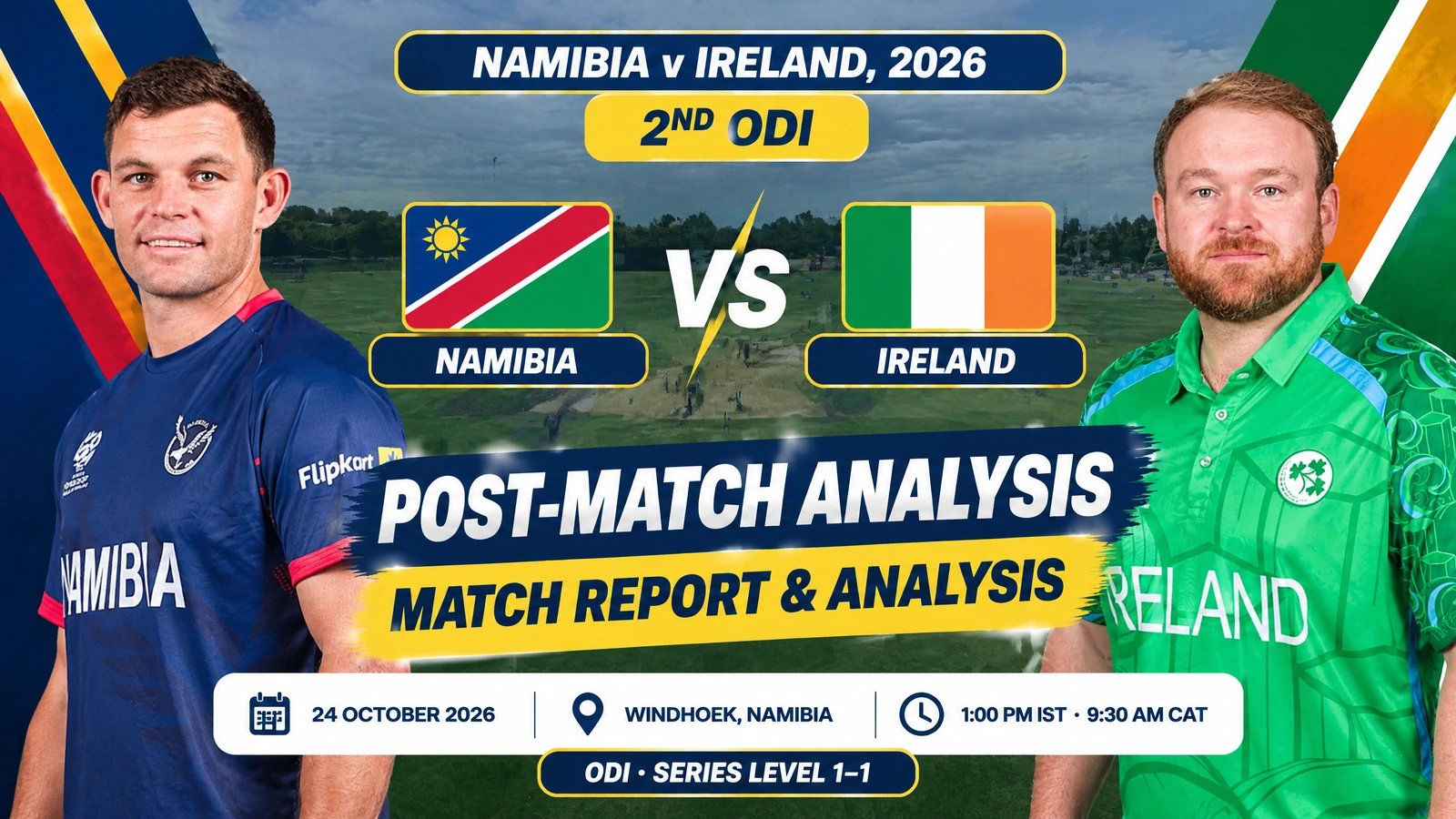
Namibia play Ireland in the second ODI of Ireland’s five-match tour on Saturday, 24 October 2026, with a working start of 09:30 in Windhoek, 07:30 UTC and 13:00 IST. The host board, Cricket Namibia, places the match at FNB Namibia Cricket Ground. The site’s freshly checked cricket provider separately lists Namibia Cricket Ground, Windhoek, with the same start time and provider event 1907918. The ICC event 275411 agrees on the time but lists a different ground, High Performance Oval; Cricbuzz shows a start 30 minutes later. This guide follows the host-board venue schedule and the corroborated 09:30 start, retains both discrepancies explicitly, and asks readers to recheck the organizer’s final notice before travelling. 1 3 11
Ireland lead the series 1–0 after winning the first ODI by 55 runs. The available squad lists are not confirmed playing XIs. Paul Stirling is the current Ireland senior ODI captain in Cricket Ireland’s tour announcement, and Gerhard Erasmus is listed as Namibia’s captain by Cricket Namibia. 5
What time does Namibia vs Ireland 2nd ODI start in IST?
The ICC fixture record gives the start as 07:30 UTC on 24 October 2026. Windhoek is listed at UTC+02:00 for this fixture, so 07:30 UTC is 09:30 local time. India Standard Time is UTC+05:30, making the start 13:00 IST on the same date. This is an ODI, not a T20I, and the scheduled match is the second game of the five-match series. 1
| Location | Start time | Date |
|---|---|---|
| UTC | 07:30 | 24 October 2026 |
| Windhoek, Namibia | 09:30 | 24 October 2026 |
| India Standard Time | 13:00 | 24 October 2026 |
The conversion is straightforward, but it matters because a secondary match page currently displays a different time. Readers in India should not rely on a search snippet or an old fixture card. Check the ICC match centre, the teams’ match-day posts and the live score page close to the toss.
Why does the start time conflict?
The Cricbuzz match page for this event, ID 174957 on that service, says “Match starts at Oct 24, 08:00 GMT” and displays 10:00 AM local. The same page calls its venue Namibia Cricket Ground. That is 30 minutes later than the ICC listing. 3
The ICC’s fixtures page separately lists Namibia versus Ireland as an ODI on 24 October at High Performance Oval, Windhoek, with match ID 275411 and a 07:30 start. The ICC match centre repeats those details. 1 The host board also states 09:30 local, and the approved site cricket provider confirms 07:30 UTC for provider event 1907918 in a snapshot retrieved on 23 October at 17:38 IST. 4 Those independent schedule records support the working start of 07:30 UTC, 09:30 Windhoek and 13:00 IST; they do not support concealing the secondary listing’s difference.
There is a second, related discrepancy. Cricket Namibia’s 14 October announcement says the five-match series will use HP Oval and FNB Namibia Cricket Ground, gives the second match as 24 October, and says all matches start at 09:30. Its schedule places the second ODI at FNB Namibia Cricket Ground. 4 Because that is an official host-board source, the venue conflict should not be hidden. For the venue, this article follows the host board’s FNB Namibia Cricket Ground listing, corroborated by the provider’s Namibia Cricket Ground, Windhoek record. 11 The ICC listing remains inconsistent and is disclosed rather than silently merged with the host schedule. The final organizer notice still takes priority; none of these differences proves a last-minute venue change.
What is the latest series context?
Ireland won the first ODI at High Performance Oval on 22 October. The scorecard records Ireland at 229/9 in 50 overs and Namibia at 174 all out, a margin of 55 runs. Namibia won the toss and elected to field. The first match was ODI number 5043 in the scorecard record, while the second fixture has the separate ICC event ID 275411. 7
Ireland’s first innings had a stable middle before a late cluster of wickets. Paul Stirling made 56 from 71 balls, Cade Carmichael scored 45 from 80, Harry Tector and Lorcan Tucker both made 28, and Andy Balbirnie added 20. Namibia’s Jan Nicol Loftie-Eaton took 4/36 from nine overs. JJ Smit took two wickets, and Namibia’s attack kept Ireland from turning a useful platform into a much larger total. 7
Ireland’s defence was built around wickets rather than an overwhelming score. Gavin Hoey took 3/29, while Loftie-Eaton’s decisive contribution came with the ball through his four wickets. Namibia’s Ruben Trumpelmann made 50 in the chase, but Namibia were dismissed for 174 in 37.5 overs according to the match report and research record. That left Ireland with a 1–0 series lead and Namibia needing to improve both the length of the chase and its response after early wickets. 7
The opener is useful evidence, not a script. Namibia chose to field and then lost the chase; that does not mean the second toss winner should automatically choose one option. The match also showed that the contest can turn in the middle overs. Namibia’s bowling had enough quality to remove established Irish batters, but Ireland’s attack did a better job of converting pressure into a complete result.
Are the squads confirmed playing XIs?
No. The ICC match centre displays squad pools, not the final XI. A squad is the group available for selection; it does not tell readers which 11 will take the field, who will keep wicket, or whether a player will be rested. Final XIs normally become official at the toss. 2
Ireland’s published tour group includes Paul Stirling, Lorcan Tucker, Mark Adair, Andrew Balbirnie, Ben Calitz, Curtis Campher, Cade Carmichael, George Dockrell, Gavin Hoey, Matthew Humphreys, Andy McBrine, Liam McCarthy, Byron McDonough, Jai Moondra, Jordan Neill and Harry Tector. Cricket Ireland also describes Stirling as the continuing leader of the senior ODI squad. 5
The ICC match centre lists Namibia’s options as Jan Nicol Loftie-Eaton, Jan Frylinck, JJ Smit, Gerhard Erasmus, Bernard Scholtz, Malan Kruger, Zane Green, Michael van Lingen, Ruben Trumpelmann, Louren Steenkamp, Jan Balt, Alexander Volschenk, Jack Brassell, Max Heingo, Waldo Smith and Junior Taanyanda. 2
No source checked for this draft confirms a final XI, an injury withdrawal or a replacement. It would be inaccurate to turn these names into a predicted XI or to state that any player is unavailable. Recheck the toss graphic and the official scorecard before treating a player as selected.
Who are the captains?
Paul Stirling is Ireland’s current senior ODI captain for the Namibia tour. Cricket Ireland’s 9 October announcement says Stirling will continue to lead the senior ODI squad, and the ICC tour announcement labels him captain in the squad list. 5
Gerhard Erasmus is listed as captain of Namibia’s men’s Eagles on Cricket Namibia’s national-team page. The ICC match centre also marks Erasmus as Namibia’s captain in the squad pool. 2
Those are current squad and team leadership references. They are not a guarantee that every match-day graphic will be identical, nor do they confirm the final XI. The toss presentation is the correct place to verify the match-day captains and playing groups.
What does the venue evidence show?
The available same-format venue sample is extremely small. The Cricbuzz venue page supplied in the research records one ODI in its displayed sample at High Performance Oval: the 22 October opener. It reports an average first-innings score of 229 and an average second-innings score of 174, because the sample consists of that one match. Ireland’s 229/9 is shown as the highest ODI total in that sample, and Namibia’s 174 as the lowest. 10
| High Performance Oval ODI sample | Figure |
|---|---|
| Matches in the available displayed sample | 1 |
| First-innings score in that match | 229/9 |
| Second-innings score in that match | 174 all out |
| Difference | 55 runs |
| First-innings run rate | 229 ÷ 50 = 4.58 |
| Namibia chase rate | 174 ÷ (37 + 5/6) = approximately 4.60 runs per over |
In cricket notation, 37.5 overs means 37 overs and five balls, not 37.5 decimal overs. The calculation therefore uses 37 + 5/6 completed overs. The arithmetic describes the latest match at a different listed ground. It does not establish a reliable venue average, a fixed par score or a forecast for the second ODI’s strip. The first-match report said the pitch became slower and that some deliveries kept low as the innings progressed. That observation gives the second match a tactical question: can batters adapt their shot selection if pace off the surface again becomes more important than pure stroke-making? 8
Because Cricket Namibia’s official schedule places the second ODI at FNB Namibia Cricket Ground, the one-match High Performance Oval sample cannot be presented as a complete record for whichever ground is ultimately used. This guide deliberately does not invent a venue history or merge records from two grounds. For the host-board venue followed in this guide, the High Performance Oval table is preceding-match context only. A verified same-format scorecard sample and a current-strip inspection for FNB Namibia Cricket Ground were not available in this evidence packet. No par score, ground-specific win rate or current pitch forecast is inferred.
Which players and match-ups matter?
Stirling’s 56 was the clearest Irish batting signal in the opener. He combined a long stay with enough boundary access to keep Ireland moving, and his role as captain adds a decision-making layer. Namibia will want to prevent the first 20 overs from becoming a comfortable platform. That does not require a risky attacking plan on every ball; it requires enough control to make Stirling and his partners hit into less predictable scoring areas.
Loftie-Eaton’s 4/36 is the most direct Namibian bowling evidence from the first ODI. He removed Stirling, Tector, Tucker and Dockrell in the scorecard sequence. Ireland’s response should be less about avoiding him entirely and more about managing the overs in which he threatens the middle order. Namibia, meanwhile, need his wickets to be supported by pressure at the other end rather than asking one bowler to carry the innings. 7
Hoey’s 3/29 mattered because Ireland found wickets after Namibia’s chase had begun. A repeat would force Namibia’s lower order to start rebuilding before the target is properly under control. Trumpelmann’s fifty showed that Namibia still had a route to a more competitive finish after damage had been done, but the better version of the chase would preserve more batting resources for the last 15 overs.
Carmichael’s 45 from 80 balls was a different kind of contribution. It was not a rapid innings, but it helped Ireland absorb the middle overs and reach the final phase with a platform. Namibia’s bowlers must decide whether to attack that tempo with fields that invite risk or squeeze singles and wait for a mistake. The surface report makes that decision more important than a generic “bat first or chase” slogan.
Can the toss winner be predicted?
No. A fair toss cannot be responsibly predicted from the first ODI. Namibia won that toss and fielded, but one decision is not a trend and does not create a repeatable edge. No win probability or toss tip is included here.
The useful pre-match question is conditional. If the pitch is visibly firm and the ball comes on, the captain batting first may value wickets in hand for the final 10 overs. If the strip looks dry or the match-day inspection confirms the slower, lower bounce described after the opener, captains may place more weight on scoreboard pressure and their best middle-overs bowlers. Neither scenario makes the result certain.
What conditional match scenarios should readers watch?
Ireland start with the stronger immediate evidence because they won the opener by 55 runs and led the decisive phases of both innings. Namibia’s route back is clear but demanding: turn their early bowling pressure into a lower Irish total, then bat long enough that a single collapse does not decide the chase.
If Namibia bat first, their top order needs to make the middle overs a foundation rather than a repair job. The opener showed how quickly a chase can become dependent on one late fifty. A deeper first innings would also allow their bowlers to attack without needing a perfect spell every time.
If Ireland bat first, their challenge is to improve on 229 without treating the one-match sample as proof that a very high score is required. Loftie-Eaton and Smit already showed that Namibia can take wickets. Ireland’s best response may be rotation, careful risk selection and a stronger final 10 overs.
If the pitch again slows, cutters, spin and strike rotation may become more important than repeated boundary attempts. If the ball travels better than it did late in the first ODI, the same historical sample will be less predictive. These are match-reading scenarios, not a guaranteed winner, betting advice or a forecast of conditions that have not yet been observed.
Where can readers follow the match?
Use the ICC match centre for event 275411 for the fixture record, toss and scorecard. Cricket Ireland says the series can also be followed through its scorecard service and that the livestream is on ICC.tv. 2 Recheck the final venue, start time, XI, toss, ground inspection and any weather or broadcast change immediately before play. No broadcast partner is claimed here because a match-specific television listing was not verified in the sources used for this draft.
FAQs
Is Namibia vs Ireland 2nd ODI a T20 match?
No. It is the second ODI of a five-match one-day international series. The 50-over format is confirmed by the ICC fixture and Cricket Ireland’s tour page. 1
What is the exact ICC match ID?
The ICC match centre ID is 275411. That is the event identity used for this guide. A different Cricbuzz page uses its own event number, 174957, so those numbers should not be treated as interchangeable. 2
What was the score in the first ODI?
Ireland made 229/9 and Namibia were dismissed for 174, giving Ireland a 55-run win. Stirling made 56, Hoey took 3/29 and Loftie-Eaton took 4/36. 7
Is the final Namibia XI announced?
Not in the evidence used for this draft. The ICC page lists squad options. The final XI should be taken from the toss announcement or official scorecard, not inferred from the squad list. 2
Who captains Ireland and Namibia?
Paul Stirling is Ireland’s current senior ODI captain for the tour. Gerhard Erasmus is listed as Namibia’s men’s captain by Cricket Namibia. Confirm the match-day graphic at the toss. 5
Is High Performance Oval definitely the venue?
No. The ICC event record lists High Performance Oval, but Cricket Namibia’s official schedule specifies FNB Namibia Cricket Ground for 24 October and the site’s fresh provider snapshot also lists Namibia Cricket Ground, Windhoek. This guide follows the host-board schedule while recording the conflicting ICC label; recheck the final organizer notice. 2 11
Can the toss winner or match winner be predicted?
No reliable toss prediction is possible, and this article gives no guaranteed winner or betting advice. Ireland have the stronger immediate evidence after the first-match win, while Namibia have a plausible route back through better batting depth and sustained middle-overs pressure.
Sources and update note
The fixture evidence was checked on 23 October 2026. The provider observation for event 1907918 is 12:08:36 UTC / 17:38:36 IST. That is a source-observation time, not this article’s publication time. The working 09:30 local start follows the host board, ICC and provider agreement. The venue follows the host-board schedule with provider corroboration; the different ICC venue and secondary start time remain visibly disclosed.
