
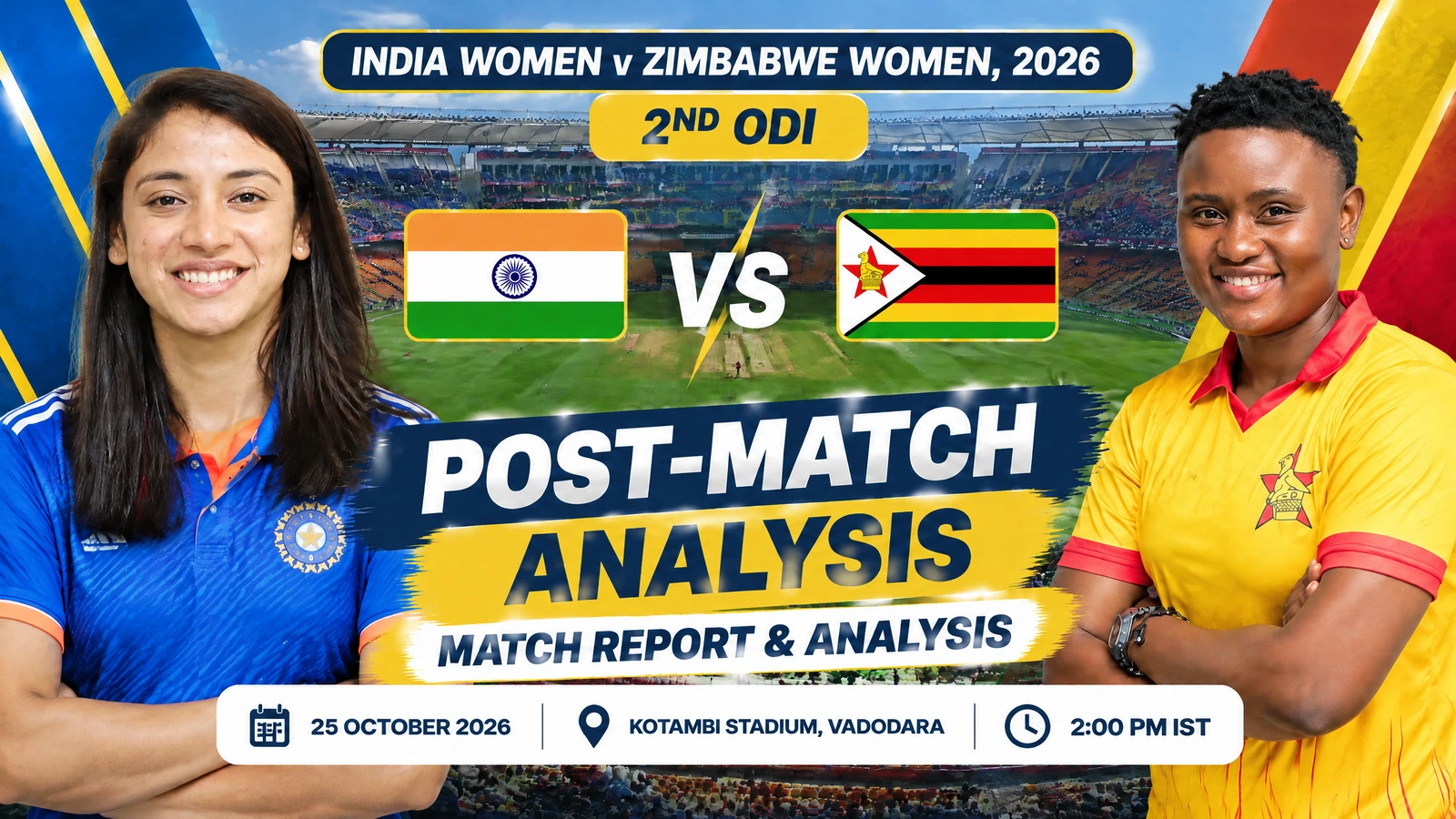
Quick answer
India Women vs Zimbabwe Women is scheduled as the second women’s ODI of the three-match series on Sunday, 25 October 2026. The first ball is listed for 14:00 IST (08:30 UTC) at Kotambi Stadium, also listed as BCA Stadium, Vadodara. The fixture API identifies event cricket-1775131, gives the same UTC start and venue, and marks the match “Not started”; its broad competition label says “Twenty20 Internationals”, but its explicit format field says “Womens ODI”. The BCCI schedule and Cricbuzz match page support the ODI format, date, time and venue.
This is a pre-match guide, not a result report. At the editorial check on 22 October 2026 at 12:22 UTC (17:22 IST), the first ODI scheduled for 23 October was still in the future, so no first-ODI result or series score is stated. No toss, current pitch report, current weather observation, or playing XI should be inserted until an official match-day source confirms it. The announced squads are not the same thing as the final elevens. The fixture API still supplies the pre-match event state; the Cricbuzz squads page says squad data is unavailable.
What time does India Women vs Zimbabwe Women 2nd ODI start in IST?
| Item | Confirmed information |
|---|---|
| Fixture | India Women vs Zimbabwe Women, 2nd ODI |
| Date | Sunday, 25 October 2026 |
| Start | 14:00 IST / 08:30 UTC |
| Venue | Kotambi Stadium / BCA Stadium, Vadodara, India |
| API event | cricket-1775131 |
| API status at verification | Not started |
| Series context | Three ODIs in Vadodara, 23, 25 and 28 October |
| Toss and XI | Not confirmed at the research timestamp |
For readers in India, 14:00 IST is the useful local start time. The API’s date_time field is 2026-10-25T08:30:00+00:00. Cricbuzz also lists 2:00 PM local and says the match starts at 08:30 GMT. The match info API independently records the UTC start and Kotambi venue.
The six-match tour began with three T20Is in Raipur and moves to Vadodara for the ODI leg. The BCCI schedule lists the first ODI on 23 October, the second on 25 October and the third on 28 October. The ICC Zimbabwe tour release says the ODIs count towards the ICC Women’s Championship. That establishes schedule and competition context; it does not establish a result for the first ODI or a 2–0, 1–0 or 0–0 series position while that match is still future.
Who are the captains and what squads were announced?
The BCCI captaincy release appointed Smriti Mandhana as India’s full-time white-ball captain on 6 October 2026 and records that she had led India in 18 T20Is and four ODIs. The BCCI squad release names Mandhana as India’s ODI captain and Deepti Sharma as ODI vice-captain. India’s announced ODI squad is Smriti Mandhana, Shafali Verma, Pratika Rawal, Harmanpreet Kaur, Harleen Deol, Tejal Hasabnis, Deepti Sharma, Richa Ghosh, Yastika Bhatia, Vaishnavi Sharma, Nandni Sharma, Sree Charani, Kranti Gaud, Sayali Satghare and Renuka Thakur.
Zimbabwe’s announced tour group is led by Josephine Nkomo. The ICC Zimbabwe tour release refreshed the official announcement with the retained 15-player squad: Josephine Nkomo, Beloved Biza, Chipo Mugeri-Tiripano, Kelis Ndhlovu, Michelle Mavunga, Francisca Chipare, Olinder Chare, Kudzai Chigora, Nyasha Gwanzura, Nomvelo Sibanda, Loryn Phiri, Chiyedza Dhururu, Modester Mupachikwa, Tendai Makusha and Sharne Mayers. The same release identifies Nkomo as captain. The ICC captaincy report separately confirms Nkomo as Zimbabwe women’s national-team captain and Nomvelo Sibanda as deputy.
These are tour or announced-squad captaincy facts, not a claim that either player will definitely walk out for the second ODI. The fixture API returns empty home and away line-ups with is_confirmed: false. The Cricbuzz squads page also says squad data is not available. Therefore the final XI, wicketkeeper selection, bowling balance and match-day captain must remain open until the toss or a verified team announcement.
No replacement affecting this match was identified in the official BCCI or ICC releases checked for this article. That is not proof that a late replacement cannot occur. Recheck the team sheets and both boards’ channels before publication or immediately before the match.
What does each side bring into the ODI?
India’s announced group combines established international players with a deeper set of recent call-ups. Mandhana’s role is both top-order anchor and new white-ball captain. Shafali Verma and Pratika Rawal offer alternative opening combinations; the squad also includes Harmanpreet Kaur, Harleen Deol and Tejal Hasabnis as middle-order options. Deepti Sharma provides an all-round option and is the named ODI deputy. Richa Ghosh and Yastika Bhatia are the announced wicketkeeping choices. Vaishnavi Sharma, Sree Charani, Kranti Gaud, Sayali Satghare and Renuka Thakur give the selectors different left-arm, spin and pace combinations, but the exact balance is unknown until the XI is named. BCCI squad release
Zimbabwe’s group comes from a historic phase for the programme. The ICC Zimbabwe tour release says the retained squad secured Zimbabwe’s first ICC Women’s Championship victory, a four-wicket win over West Indies at Harare on 27 September. The release highlights Nkomo and Nomvelo Sibanda as experienced all-round options and notes Nyasha Gwanzura’s career-best 4/33 in that victory. Those are recent-context signals, not forecasts for Vadodara.
For a beginner reader, the tactical question is simple: can Zimbabwe turn the pressure created by its bowlers into a complete 50-over performance, and can India’s top order convert a start into a long innings without assuming that the venue will behave like a T20 surface? The answer depends on the toss, surface and selected XI. This is reasoned match analysis, not an official prediction.
What do historical Kotambi records show about the venue?
The useful venue evidence available for this guide is a scoped sample of exactly three women’s ODIs, dated 22, 24 and 27 December 2024. It is not a complete or current ground record. These are scorecards for women’s ODIs, not a venue-wide database, and they should not be mixed with WPL or women’s T20 results when describing 50-over context. See the 22 December scorecard, 24 December scorecard and 27 December scorecard.
| Date | Match and innings | Result | What it shows, cautiously |
|---|---|---|---|
| 22 Dec 2024 | India Women 314/9; West Indies Women 103 all out in 26.2 overs | India won by 211 runs | India’s total was built over 50 overs and its bowlers finished the chase early. |
| 24 Dec 2024 | India Women 358/5; West Indies Women 243 all out in 46.2 overs | India won by 115 runs | A high first-innings total was possible in this sample, but the chase still ended before 50 overs. |
| 27 Dec 2024 | West Indies Women 162 all out in 38.5 overs; India Women 167/5 in 28.2 overs | India won by five wickets with 130 balls remaining | The two innings were far lower than the previous game; the result cannot be used as a fixed pitch rule. |
The three scorecards show a wide range: 162 to 358 for the completed first innings in this dated sample. That range is a reminder that opposition quality, wickets, tactics, start time, weather and the day’s surface all matter. It is not evidence that 300 is “par”, that chasing is always easier, or that the 2026 strip will repeat any 2024 score. The 22 and 24 December games were day/night fixtures, while the 27 December game began at 09:30 local; the 2026 start is 14:00 IST. Read the historical cards as context, not a current forecast. 22 December scorecard 24 December scorecard 27 December scorecard
No actual pitch-strip photograph or grounds report for 25 October was verified at the editorial check. No match-day weather source was included because a forecast can change and no current observation was verified. Do not describe the strip as flat, slow, turning, fresh or seam-friendly without a current, attributable report. Historical scorecards do not substitute for a pitch report.
Can the toss winner be predicted reliably?
There is no reliable, evidence-based way to name the toss winner in advance. A toss is a random on-field event, not a team-strength statistic, so this guide makes no fair-coin winner prediction and offers no odds. The toss result should be added only after the official match centre records it.
The useful decision comes after the toss and the inspection. If the captain and match officials actually observe moisture on the strip, visible deterioration, or dew already present, the captain can weigh batting first against bowling first in light of that observed condition. If none of those conditions is actually observed, do not invent a moisture, deterioration or dew advantage from a forecast or from a 2024 scorecard. The choice remains a match-day tactical decision, not a pre-match certainty.
What conditional match-prediction scenarios should readers consider?
A qualified pre-match reading is possible, but a guaranteed winner, betting odds and fantasy recommendations are not. India’s announced group contains more established international experience and several batting, wicketkeeping and bowling combinations, while Zimbabwe’s announced 15-player group brings a recent breakthrough win and a meaningful challenge from its bowling and all-round options. Those are qualitative team-context signals from the BCCI squad release and ICC Zimbabwe tour release; they are not a venue-2024-statistics conversion into a win probability.
Scenario 1 — India’s top order controls the middle overs: If India preserve wickets through the first ten overs and the selected middle order maintains intent, India can create scoreboard pressure. That is a scenario, not a predicted score or guaranteed result.
Scenario 2 — Zimbabwe’s bowlers turn pressure into wickets: If Zimbabwe’s attack gets early breakthroughs and its middle order builds partnerships, the match can become competitive even against India’s deeper announced group. The recent West Indies win supplies confidence context, not a probability.
Scenario 3 — the strip changes during the match: If actual match-day observation shows deterioration or another materially different surface condition, the value of wickets in hand and the batting/bowling choice can change. Use what is observed at Kotambi, not a fixed “par” number from 2024.
How should readers assess the match after confirmed team news?
If India bat first: the first checkpoint is not a guessed score. Watch whether the opening pair preserve wickets through the first ten overs, then whether the middle order can keep the rate moving without exposing the lower order too early. India’s announced squad gives several batting options, but the final combination is unknown. This is educational analysis, not a betting or performance guarantee. BCCI squad release
If Zimbabwe bat first: the key observation is whether the top and middle order can build partnerships against India’s likely mixture of pace and spin. Nkomo’s leadership and the recent confidence from the West Indies win are relevant context, but neither predicts a score. The value of the first innings will be clearer after the team sheet and conditions are known. ICC Zimbabwe tour release
If the match is shortened: a 50-over historical average becomes even less useful. Revised targets, fielding restrictions and the number of overs available can change priorities. Use the official playing conditions and live scorecard rather than applying an invented par score.
If the surface looks different from 2024: trust the current evidence. A historic scorecard records what happened in a particular match; it does not certify the composition or preparation of the 2026 pitch. This distinction is especially important for new readers who may mistake a venue name for a permanent playing characteristic.
What should be checked before a match-day update?
- Check the BCCI and Zimbabwe/ICC team announcements for late changes, then confirm the toss and final XI from the official match centre.
- Replace “not started” only when the fixture status changes in the source API or a reputable live scorecard records play.
- Add the first-ODI result and series score only from a completed, attributable scorecard. Do not backfill from a social post without matching the official result.
- Add a current pitch or weather note only with a source, timestamp and clear label such as “match-day update”.
- Keep the three December 2024 cards labelled as a historical women’s ODI sample. Do not add WPL or women’s T20 records to this section.
- Correct any captain or replacement line after an official board update. Announced squads are not a playing XI.
The durable answer for a first-time reader is therefore straightforward: India Women vs Zimbabwe Women’s second ODI is scheduled for 14:00 IST on 25 October at Kotambi/BCA Stadium, Vadodara; the announced captains are Smriti Mandhana and Josephine Nkomo; the final XI, toss, current strip, weather observation and series position remain unconfirmed at the 12:22 UTC editorial check. BCCI schedule and squad release ICC Zimbabwe tour release fixture API
Sources and limits
The article uses the fixture API and match info API for event ID, explicit format, UTC time, venue, status and pre-match line-up fields. The BCCI squad release and BCCI captaincy release support India’s announced 15-player ODI group, Mandhana’s captaincy and the schedule. The ICC Zimbabwe tour release and ICC captaincy report support Zimbabwe’s announced 15-player squad and captaincy context. Cricbuzz independently confirms the fixture, while its squads page records that squad data is not available. The three dated scorecards, second scorecard and third scorecard support only the scoped 2024 women’s ODI sample. No claim is made about a current ground record, a current pitch/weather condition, a toss winner, a guaranteed winner, odds or fantasy outcome.