
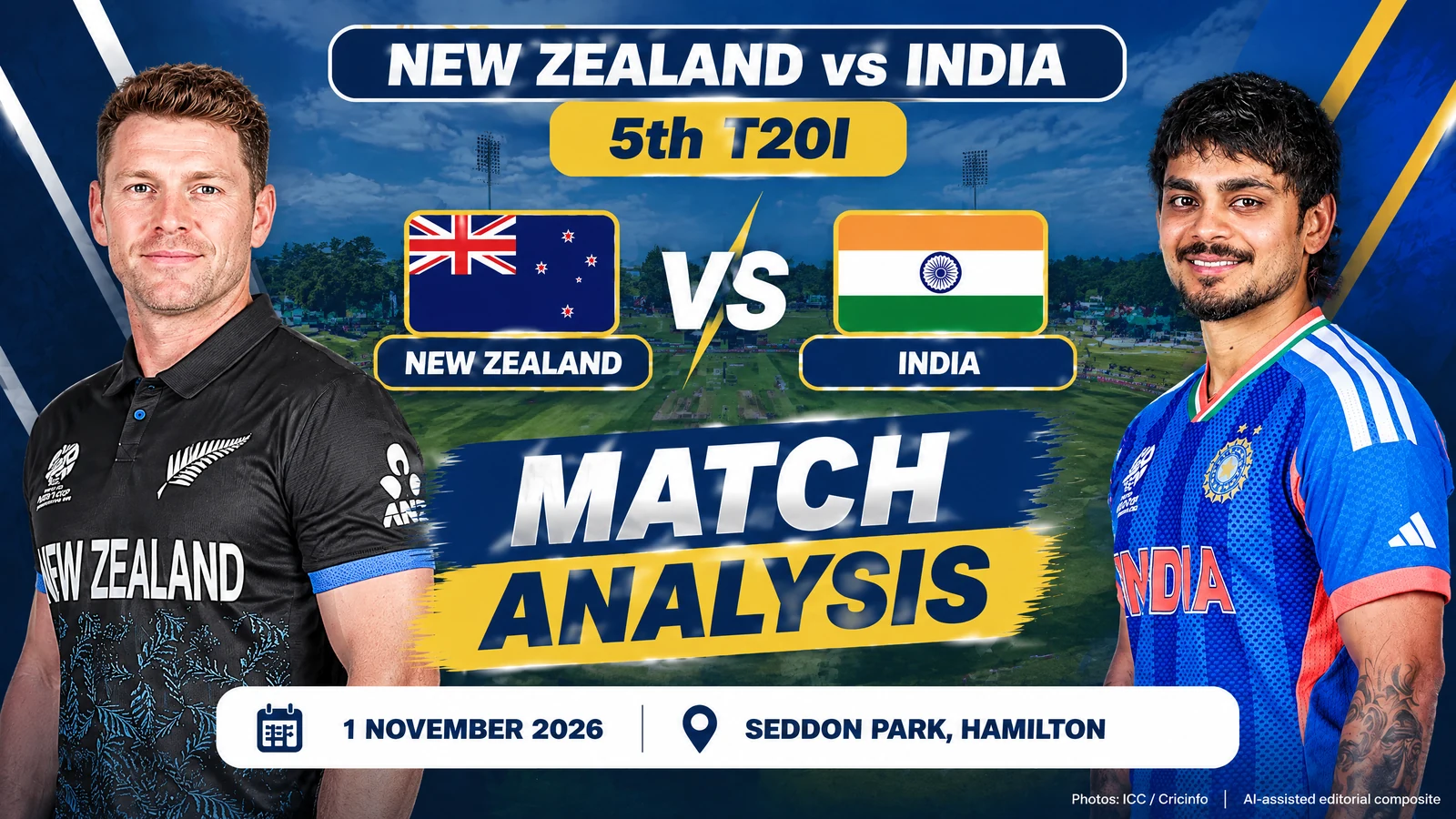
Result report — checked 1 November 2026 at 16:31 IST. New Zealand beat India by seven wickets at Seddon Park, Hamilton, chasing 192 with 195/3 in 18 overs. India had made 191/8 in 20 overs after New Zealand won the toss and chose to field. Glenn Phillips finished the chase unbeaten on 65 from 38 balls, while Adam Milne was named Player of the Match after taking 4/19. The completed match left India with a 3–2 series win in the five-match T20I series. 2 3 4
Result: what happened, and why did New Zealand win?
New Zealand won because its chase recovered quickly after the early loss of Finn Allen and then kept moving through two substantial partnerships. Allen fell for 2 at 9/1 in the second over. Daryl Mitchell joined Tim Seifert and made 29 from 16 balls, including four sixes, in a 73-run stand that carried New Zealand to 82/2. Mitchell was then dismissed by Varun Chakaravarthy. 2 4
Seifert and Phillips changed the shape of the chase. Seifert made 93 from 50 balls, with 11 fours and five sixes, before his innings ended. Phillips stayed through the finish, scoring 65 from 38 balls with eight fours and three sixes. He and Bevon Jacobs, who made 1 not out from one ball, took New Zealand to 195/3 after 18 overs. The winning boundary came from Phillips off Bhuvneshwar Kumar at 17.6. 3 4
India’s 191/8 was competitive but not enough once New Zealand’s middle order maintained a high scoring rate. India’s innings contained two rapid top-order contributions: Ishan Kishan made 61 from 32 balls, and captain Shreyas Iyer made 50 from 23. Naman Dhir added 33 from 23 and Nitish Kumar Reddy 22 from 17. Those innings took India to 191, but New Zealand’s chase reached the target with 12 balls unused. 2 4
Milne gave New Zealand the best individual bowling performance. He took four wickets for 19 runs in four overs, removing Abhishek Sharma, Sanju Samson, Nitish Kumar Reddy and Bhuvneshwar Kumar. Nathan Smith took 2/28 and Blair Tickner 2/38. India’s early wickets meant Kishan and Iyer had to rebuild rather than launch from a settled opening platform, and New Zealand kept finding wickets at the points where India tried to accelerate. 2 4
The arithmetic of the result is direct. India’s total of 191 set a target of 192. New Zealand scored 195, which is four runs above the target, and the innings ended after 18 completed overs with three wickets down. In a T20 score such as 195/3, the first number is runs and the second is wickets lost. An over contains six legal deliveries, so 18 overs represents 108 legal balls. 3 4
Who scored for India, and how did the first innings develop?
New Zealand’s decision to bowl first was rewarded by two early wickets. Abhishek Sharma fell for 1 from two balls, and Sanju Samson made 4 from 10. Kishan then supplied the innings’ main acceleration. His 61 included five fours and five sixes, a strike rate of 190.62. A batter’s strike rate is runs scored per 100 balls; it describes scoring speed rather than the total value of an innings. 2 4
Iyer continued the attack after Kishan’s dismissal. His 50 came from 23 balls at a strike rate of 217.39, with three fours and four sixes. Tilak Varma made 6, while Dhir’s 33 from 23 and Reddy’s 22 from 17 gave India a late push. Bhuvneshwar Kumar added 6 from four, and India ended on 191/8 with seven extras. The innings run rate was 9.55 runs per over. 2 4
Milne was the difference in the bowling figures. His economy rate was 4.75 runs per over, calculated from 19 runs conceded in four overs. By comparison, Michael Bracewell’s two overs cost 38, while Mitchell Santner conceded 39 in four. Those figures do not by themselves explain every phase of a T20 innings, but they show how Milne’s control gave New Zealand a way to absorb India’s two major batting bursts. 2 4
Who was in the confirmed XI?
The completed scorecard lists the match-day teams rather than a probable-XI projection. India’s XI was Sanju Samson, Abhishek Sharma, Ishan Kishan, Shreyas Iyer, Tilak Varma, Naman Dhir, Nitish Kumar Reddy, Bhuvneshwar Kumar, Prince Yadav, Arshdeep Singh and Varun Chakaravarthy. Iyer was India’s captain. 2
New Zealand’s XI was Tim Seifert, Finn Allen, Daryl Mitchell, Glenn Phillips, Bevon Jacobs, Michael Bracewell, Mitchell Santner, Nathan Smith, Adam Milne, Jacob Duffy and Blair Tickner. Santner was New Zealand’s captain. The toss record states that New Zealand won and elected to field first. 2
The approved banner pairing remains Tim Seifert on the left and Ishan Kishan on the right. Both were in the confirmed match-day XI. The result does not change that approved identity order. 2
What was the series outcome?
India won the five-match series 3–2. Cricbuzz’s completed match page states that New Zealand won the fifth T20I by seven wickets and that the series ended 3–2 in India’s favour. The same page identifies Glenn Phillips as Player of the Series in its post-match material, while Adam Milne is identified as Player of the Match for this game. 3
The first three completed results in the supplied event records were India wins: the first T20I by four wickets after New Zealand made 225/4 and India replied with 230/6; the second by four wickets after New Zealand made 180/5 and India chased 181/6; and the third by six wickets after New Zealand made 198/3 and India reached 199/4. 7 8 9
This report does not insert a separate fourth-match score or winner because the authorized stable scorecard evidence used for that individual match was not supplied in the current refresh. The overall 3–2 series result is nevertheless directly stated by the completed fifth-match source and is not being inferred from an assumed fourth-match margin. 3
Where and when was the match played?
The match was played at Seddon Park, Hamilton, New Zealand, on Sunday, 1 November 2026. BCCI lists the start as 7:00am UTC, which corresponds to 12:30pm India Standard Time and 8:00pm local New Zealand daylight time in Hamilton. The public scorecard carries the same venue and local start. 1 2 4
The source clocks matter because live score pages update at different moments. The API response identifies its own as_of time as 2026-11-01T11:01:15Z and its refreshed overview as 11:01:16Z, equivalent to 16:31:15 and 16:31:16 IST. The completed Cricbuzz live-scores page was retrieved at approximately 16:31:25 IST and displayed the finished score, result and series line. Its commentary includes a source-displayed match clock of 23:36 local / 10:36 GMT / 16:06 IST for an earlier late-innings update. BCCI was retrieved at approximately 16:31:15 IST and returned the fixture identity, venue and scheduled time but no completed result in the rendered page. 1 3 4
Those are source and retrieval clocks, not publication dates. The match itself began at the scheduled time; the completed result is supported by the API’s Finished status and by Cricbuzz’s result page, not by the earlier live snapshot retained in the original draft. 3 4
What does one Seddon Park historical sample show?
The venue comparison is deliberately limited to one historical scorecard rather than presented as an all-match ground record. In the 29 January 2020 third T20I at Seddon Park, India batted first and made 179/5 in 20 overs. New Zealand then made 179/6 in 20 overs, tying the regulation match before India won the one-over eliminator. India’s first-innings score was therefore 179, and New Zealand’s second-innings score was also 179. The regulation total was 358 runs. 5
That batting order is important. The historical scorecard does not show New Zealand batting first; it records India’s 179/5 as the first innings and New Zealand’s 179/6 as the chase. The earlier draft’s reversed ordering has been corrected here. Rohit Sharma was Player of the Match for that 2020 game after scoring 65 from 40 balls. 5
The 2020 game is a useful example of scoring conditions and match tension at this ground, but it is only one historical observation. It does not establish a current par score, a ground average or a pitch forecast. The 2026 match adds a separate completed observation: India made 191/8 and New Zealand successfully chased it with 195/3. Those two matches show that substantial T20 scoring has occurred at Seddon Park, but they are not a complete venue database. 4 5
No claim is made here about dew, a current strip report, boundary dimensions, weather impact or a generic home-ground advantage. Such claims would require separate dated evidence. The safe venue conclusion is narrower: the verified 2020 tie and the completed 2026 chase provide context, while neither substitutes for a full historical sample or match-day pitch inspection.
What should readers take from the scorecard?
The most important performance contrast is between India’s explosive middle-order scoring and New Zealand’s more complete chase. India reached 191 despite losing both openers early, with Kishan and Iyer providing the main acceleration. New Zealand lost Allen in the powerplay but then had Mitchell, Seifert and Phillips score at rates that kept the asking rate manageable. A required rate is the runs still needed divided by the overs or legal balls remaining; once New Zealand built those partnerships, India could not create enough further wickets to change the chase.
Milne’s 4/19 was the clearest reason New Zealand remained in control before batting. Phillips’ 65 not out was the clearest reason the chase finished early. Seifert’s 93 made the target vulnerable, but the result was completed by Phillips and Jacobs after Seifert’s departure. India’s 191 was not a collapse; it was a defendable total that New Zealand surpassed through a stronger chase at the finish. 2 3 4
Sources and definitions
The result uses the completed Cricbuzz live-scores page and the documented public API as the primary current sources. The BCCI page is retained for official fixture identity, scheduled time and venue. The historical scorecard is used only for the bounded 2020 Seddon Park comparison. A score written as runs/wickets gives total runs followed by wickets lost. Overs are counted in groups of six legal balls. Strike rate means runs per 100 balls faced. Economy rate means runs conceded per six-ball over. A target of 192 means the chasing side must reach at least 192 to win after a first-innings total of 191. 1 2 3 4 5
Sources and verification
The result report uses the supplied, dated source record. Links below are visible source titles; no additional live lookup was performed by this local builder.
- BCCI official match centre: New Zealand vs India, 5th T20I
- Cricbuzz scorecard: New Zealand vs India, 5th T20I
- Cricbuzz live scores and completed commentary: New Zealand vs India, 5th T20I
- Documented public API event 1784533: completed match detail
- Historical New Zealand vs India, 3rd T20I at Seddon Park, 29 January 2020
- NZC broadcast notice and India T20I schedule
- Documented public API event for the 1st T20I
- Documented public API event for the 2nd T20I
- Documented public API event for the 3rd T20I